
Visa survey: AI fraud fear reshapes Asia Pacific remittance priorities
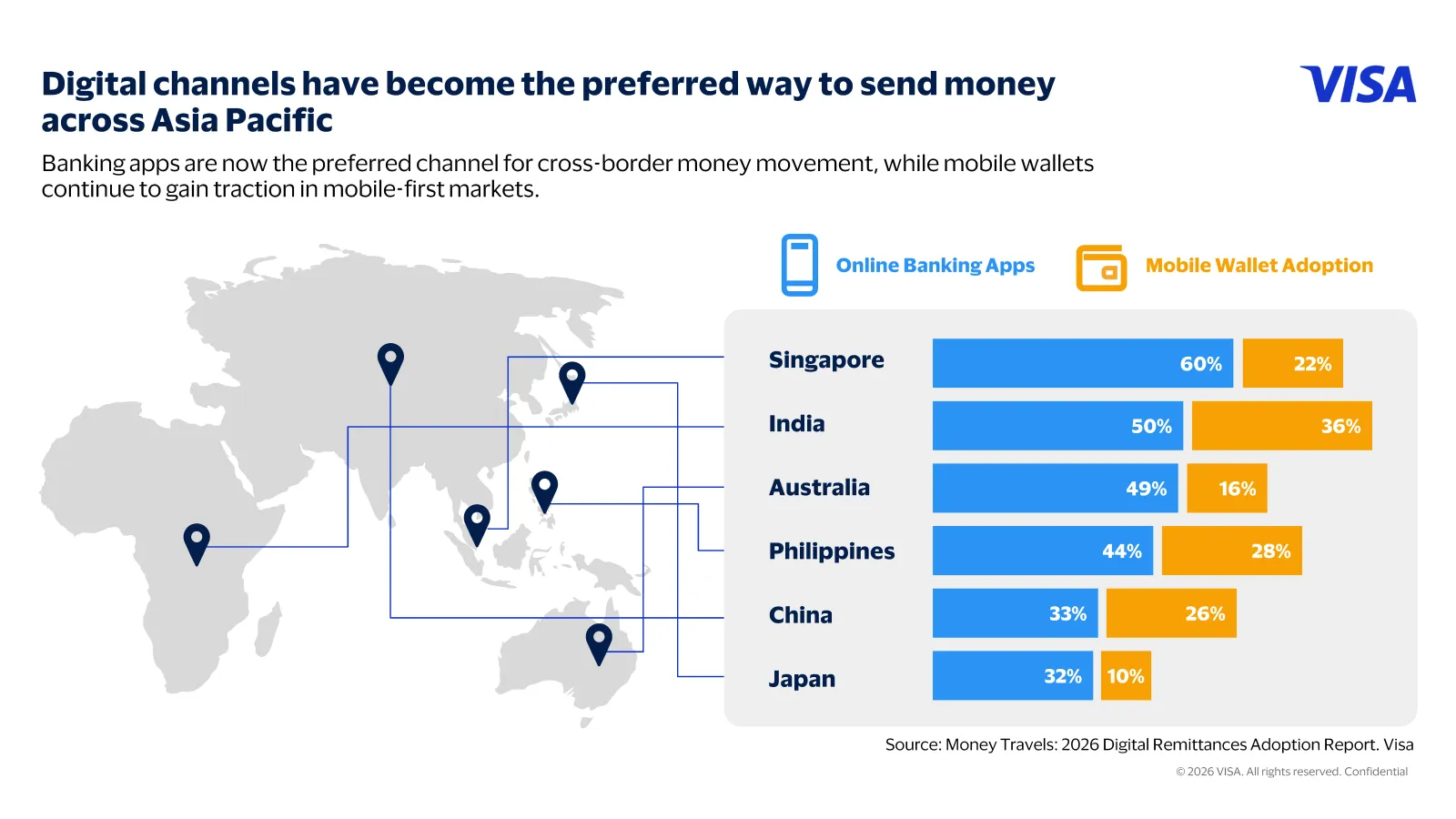
Visa has published its Asia Pacific findings from the Money Travels 2026 Digital Remittances Adoption Report, drawing on responses from more than 45,000 remittance senders and receivers across 20 markets. The headline shift: security and trust have overtaken speed and convenience as the primary lens through which consumers in the region evaluate cross-border payment services. The data signals a structural recalibration that carries implications well beyond the payments industry.
The study, conducted by Morning Consult between February and March 2026, covers six Asia Pacific markets including Australia, India, Japan, Mainland China, the Philippines and Singapore. It finds that mobile banking apps remain the dominant channel for international transfers, with adoption ranging from 33% to 60% across markets. Mobile wallet uptake is climbing fastest in India (36%), the Philippines (28%) and Mainland China (27%). Japan is the regional outlier: nearly one-third of Japanese consumers still prefer transferring money via physical bank branches, a figure that sits in sharp contrast to the digital-first posture of the rest of the region.
AI-enabled fraud is rewriting the risk calculus
The report's most strategically significant finding concerns AI-generated fraud. In the Philippines, 62% of consumers say they are concerned that deepfakes could be used to impersonate family members or orchestrate financial scams; in India the figure is 53%. These are not abstract fears: scam exposure among remittance users is highest in India (40%) and the Philippines (29%).
The response is a notable inversion of the fintech growth playbook. Speed to transfer has long been the headline metric used by digital-payments providers to win market share from traditional banks and money-transfer operators. Yet the Visa data shows consumers in Japan (68%), Singapore (57%) and Australia (57%) are willing to accept a 24-hour transfer delay in exchange for stronger AI-powered fraud protection. That willingness creates both a product-design opportunity and a competitive pressure point: providers that deploy credible AI fraud-detection infrastructure may be able to command premium positioning, while those that lean solely on speed messaging face a trust deficit.
Stablecoins: awareness gap meets regulatory ambiguity
For the first time, the Money Travels study included a dedicated module on stablecoins. The findings confirm a wide education gap. Roughly half of Asia Pacific consumers believe stablecoins carry the same risk profile as cryptocurrencies, despite the instruments being designed to maintain a stable value. Visa's own methodology note flags that stablecoins are not currently covered by deposit insurance schemes such as the FDIC or CDIC, and that survey scenarios involving "bank-equivalent protections" are hypothetical.
Consumer intent towards stablecoins increases materially once respondents receive a clearer explanation of how the instruments work, suggesting that adoption curves are more likely to be shaped by financial literacy programmes and regulatory clarity than by technology readiness alone. This dynamic should interest cross-sector strategists watching the convergence of regulated payments rails, central bank digital currency pilots and private stablecoin networks across the region.
The convergence read-across
The Visa findings land at a moment when Asia Pacific regulators and sovereign institutions are actively competing to position their jurisdictions as regional hubs for cross-border digital finance. Singapore's MAS has been advancing stablecoin regulatory frameworks; India's UPI-linked international expansion is accelerating; and the Philippines remains both one of the world's largest remittance-receiving economies and one of its most fraud-exposed.
For capital allocators, the report crystallises a thesis that has been forming across fintech, cybersecurity and AI infrastructure: the next wave of growth in digital payments will be won not by reducing friction alone, but by combining low-friction rails with verifiable, AI-backed trust signals. That convergence points towards investment pressure on identity verification, anti-fraud AI and compliance infrastructure as integral components of the payments stack, rather than bolt-on features. Providers and investors who treat fraud defence as a cost centre rather than a product differentiator may find themselves structurally disadvantaged as consumer expectations harden.
"Building trust through education, transparency and security will be critical to the next phase of adoption," said Chavi Jafa, Senior Vice President and Head of Commercial and Money Movement Solutions for Asia Pacific at Visa.