
Copla launches TPRM platform to close a 69% vendor compliance gap
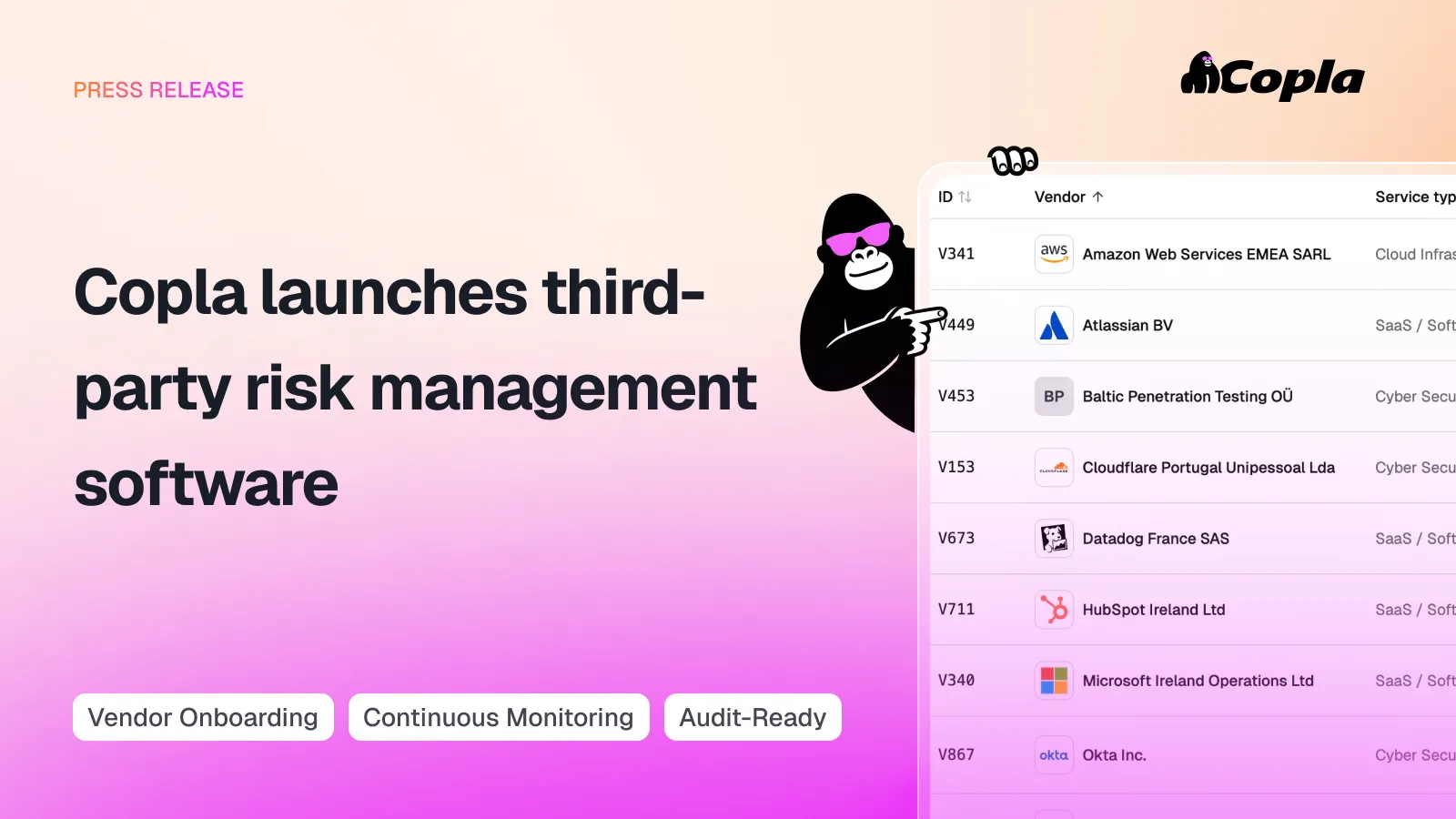
European compliance-automation firm Copla has launched a dedicated third-party risk management (TPRM) platform, aiming to replace the patchwork of spreadsheets, email chains, and annual reviews that most organisations still rely on to track vendor obligations. The launch targets a structural problem that cuts across procurement, IT, legal, and compliance functions: the inability to monitor third-party risk as it actually evolves, rather than once a year.
The product sits within Copla's broader GRC (governance, risk, and compliance) automation stack and is positioned explicitly beyond the financial sector. That positioning is notable at a time when most TPRM market conversation centres on banking and insurance regulation.
The regulatory pressure building beneath the surface
The compliance gap Copla is responding to is quantifiable. The World Economic Forum's Global Cybersecurity Outlook 2025 found that 69% of organisations either consider regulatory requirements too complex, too numerous, or simply cannot verify whether their suppliers meet them. That figure spans industries, suggesting the problem is systemic rather than sector-specific.
The pressure is sharpest in European financial services, where the EU's Digital Operational Resilience Act (DORA) requires firms to maintain a continuously updated register of ICT third-party providers. The results of the European Supervisory Authorities' 2024 dry-run exercise were stark: only 6.5% of nearly 1,000 tested firms passed all required data quality checks. Separate research found only 8% of financial entities reported full DORA compliance on third-party risk, with 46% naming the vendor register as the single hardest requirement to satisfy.
Copla's CEO and co-founder Aurimas Bakas frames the product around a timing mismatch between how risk actually moves and how most companies track it. "Manual monitoring assumes risk waits for the calendar. In practice, certifications lapse on their own schedule, vendors get breached mid-quarter, and by the time an annual review catches it, the gap has usually been open for months," he said. The platform is designed to flag changes as they occur and maintain an audit-ready record continuously, rather than scrambling before an inspection.
Feature coverage includes vendor onboarding with document collection and questionnaire automation, risk evaluation across six domains, certification tracking with expiry alerts, breach and dark-web monitoring, contract lifecycle management, and a timestamped audit log.
The convergence angle: where cybersecurity, regulation, and supply chains collide
The broader significance of Copla's launch extends beyond any single product category. Third-party risk sits at the intersection of three forces reshaping enterprise risk management simultaneously: escalating regulatory complexity (DORA, NIS2, and their equivalents globally), the expansion of cyber threats into vendor supply chains, and the growing strategic scrutiny of critical dependencies exposed during pandemic-era disruptions.
For cross-sector investors and executives, the TPRM software market is increasingly a proxy for the regulatory compliance arms race. What began as a financial-services problem has migrated into critical infrastructure, healthcare, manufacturing, and logistics, as regulators in those sectors import similar requirements. The total addressable market for GRC automation platforms is expanding accordingly, driven not by IT department discretion but by board-level liability and supervisory enforcement.
European-headquartered vendors like Copla carry an additional competitive angle. DORA, NIS2, and incoming AI Act obligations are creating demand for compliance tooling with native European regulatory architecture built in. US-headquartered incumbents in the GRC space have historically engineered primarily for SOC 2 and FedRAMP frameworks; the EU's expanding rulebook is creating an opening for regionally fluent challengers.
The capital landscape in this space is active but fragmented. GRC automation sits between cybersecurity VC (where rounds are large and competitive) and regtech (where European sovereign and institutional capital has been cautious but growing). Whether a bootstrapped or early-stage vendor like Copla can scale ahead of better-capitalised US platforms entering the European regulatory market will depend largely on how fast DORA enforcement tightens in 2026 and 2027.