
Riyadh day two: a live card link, $329.5m for barq, SME capital
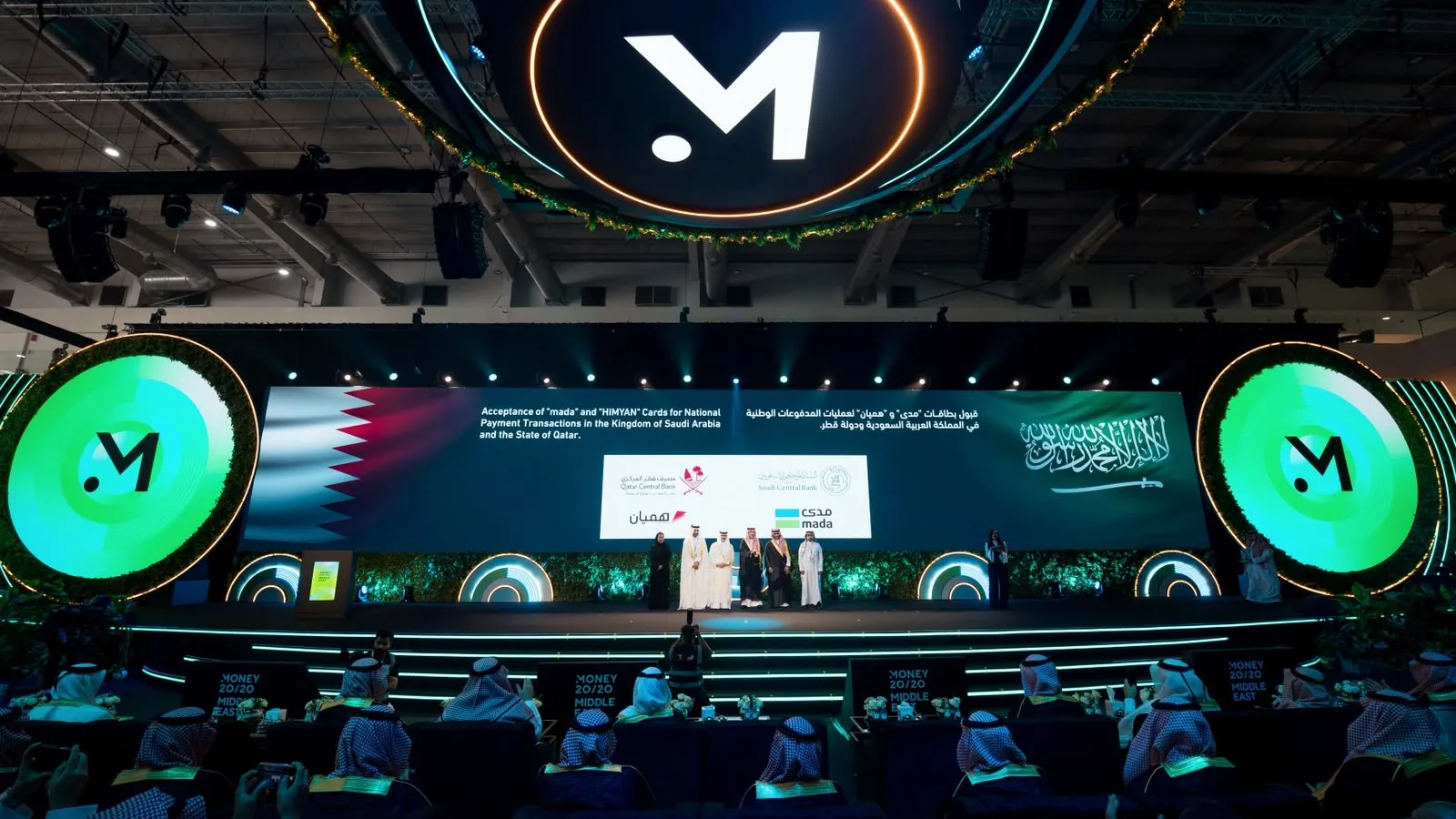
The Saudi and Qatari central bank governors put the first HIMYAN card payment through the mada network in front of the room on the second day of Money20/20 Middle East. barq closed a $329.5m round at a $1.85bn valuation, a SAR 500m SME financing fund opened, and the Capital Stage spent the afternoon on the question of who, or what, should be allocating the money. Tuesday was about capability switching on rather than being promised.
The Saudi Central Bank and Qatar Central Bank announced an agreement enabling the cross-border use of the two countries' national payment cards, mada in Qatar and HIMYAN in Saudi Arabia. H.E. Ayman M. Al-Sayari, Governor of SAMA, and H.E. Sheikh Bandar bin Mohammed bin Saoud Al-Thani, Governor of the Qatar Central Bank, then made the first transaction themselves. Acceptance will be introduced gradually, once the technical and operational integration between the two schemes is complete.
A domestic card scheme is the most sovereign piece of retail payments infrastructure a country builds, tied to its own settlement rails, fee structures and supervisory reach. Agreeing reciprocal acceptance between two of them is a harder negotiation than opening a new corridor, and it is the kind of plumbing that makes Gulf consumer and merchant businesses easier to scale across borders. Doing the first payment live shows how far the technical work has already gone.
The market behind the numbers
Al-Sayari opened the Executive Summit earlier in the day with the figures behind the sector. Saudi Arabia had 371 fintech companies by the end of August, up from 301 in May and against a National Fintech Strategy target of 525 by 2030. Electronic payments made up more than 85 per cent of retail transactions by the end of 2025, and investment in the sector passed SAR 30bn in the first half of this year. SAMA began licensing open banking providers on 26 March, with Lean Technologies the first to receive a licence.
For investors, the more useful point came from the floor. "Saudi Arabia has shifted from being an interesting market to being an investable market," said Mohamed Alaadin, general partner at Development Partners International. "For investors, that is a significant distinction: we can now underwrite opportunities based on clearer regulation, deeper pools of capital, follow-on funding and an increasingly credible path to liquidity and exits."
What is inside a $1.85bn Series A
barq closed a $329.5m Series A at a $1.85bn valuation, with Noon Investments, Sohar International Bank and the M20 Fund among its investors. Founded in 2023 by Ahmed Alenazi and licensed by SAMA in January 2024, the company says it has more than 15 million users across more than 210 nationalities and has processed SAR 440bn. It also deepened its partnership with Mastercard during the show.
Read as a venture round, a Series A of that size three years after founding looks aggressive. Read as growth capital into a business that already holds a payments licence and a large user base, it looks more like the later-stage financing it effectively is. The sequence, licence first, users second, capital last, is the same one Tabby's licence stack showed on Monday, and it is becoming the shape of a fundable Saudi fintech.
The gap between equity and the banks
The Fina Fund that SILQ's embedded finance arm and Riyadh-based Joa Capital unveiled on Monday, with a target size of SAR 500m, is aimed squarely at Saudi small businesses. SILQ puts the Kingdom's SME financing shortfall at around SAR 400bn, with SME lending at 11.3 per cent of total bank loans in 2025 against a 2030 target of 20 per cent.
That gap was the subject of two Capital Stage sessions. Armineh Baghoomian, managing director at Partners for Growth, set out the space most Gulf scale-ups fall into: equity is widely available and bank credit serves companies that already meet traditional lending criteria, which leaves structured growth debt for companies with recurring revenue or receivables but not yet the track record a bank wants. Walter Gontarek, chief executive of Channel Capital, argued that lenders outside the banks are turning alternative data into a real advantage, and that stronger risk governance in the Kingdom is starting to show up in portfolio returns and cheaper funding for borrowers.
For an allocator the second point matters more than the size of the gap. If the cost of filling it is falling, private credit into Saudi small businesses becomes a return story rather than a development one.
Who decides
The same stage turned to AI in the investment process. "There is a big difference between capability and accountability," said Fariha Ansari Javed, partner at Stride Ventures. "AI can help us analyse data, identify what we may be missing, but it never takes away human judgement. Ultimately, accountability remains with the allocator." Hussain Almarhoon, founding and managing partner of HALA Capital, said his firm treats AI as a challenger rather than a decision-maker, because sophisticated analysis built on incomplete data can create false confidence.
Trust ran through the other stages too. "The more the world becomes digital, the more the world will require trust," said Fahad Al Guthami, chief executive of American Express Saudi Arabia, opening The Bridge stage. Jeff Parker, chief executive of Paymentology, argued on a panel about banking the next billion customers that regulation gives an institution a baseline of trust, but a place in someone's everyday life is earned through the experience.
The plumbing underneath
The rest of the day's news was infrastructure. Visa can now process e-commerce transactions for Saudi merchants locally through its Visa Acceptance Platform, following certification for SAMA's new e-commerce payments interface. HyperPay and Mobily Pay both went live on Mozn's domestic financial crime tooling, SiFi and IDEMIA Secure Transactions launched tap-to-activate business cards, and Geidea and The Saudi Investment Bank signed a memorandum of understanding on payment and point-of-sale services.
None of these is a headline on its own. They are the compliance, processing and acceptance layers that decide how quickly the companies being funded this week can actually grow.
Money20/20 Middle East closes today at the Riyadh Exhibition and Convention Centre in Malham, with the MoneySurge finalists pitching on the Executive Summit stage at 4pm.