
FireSwarm and Kelowna forge drone-swarm hub with dual-use ambitions
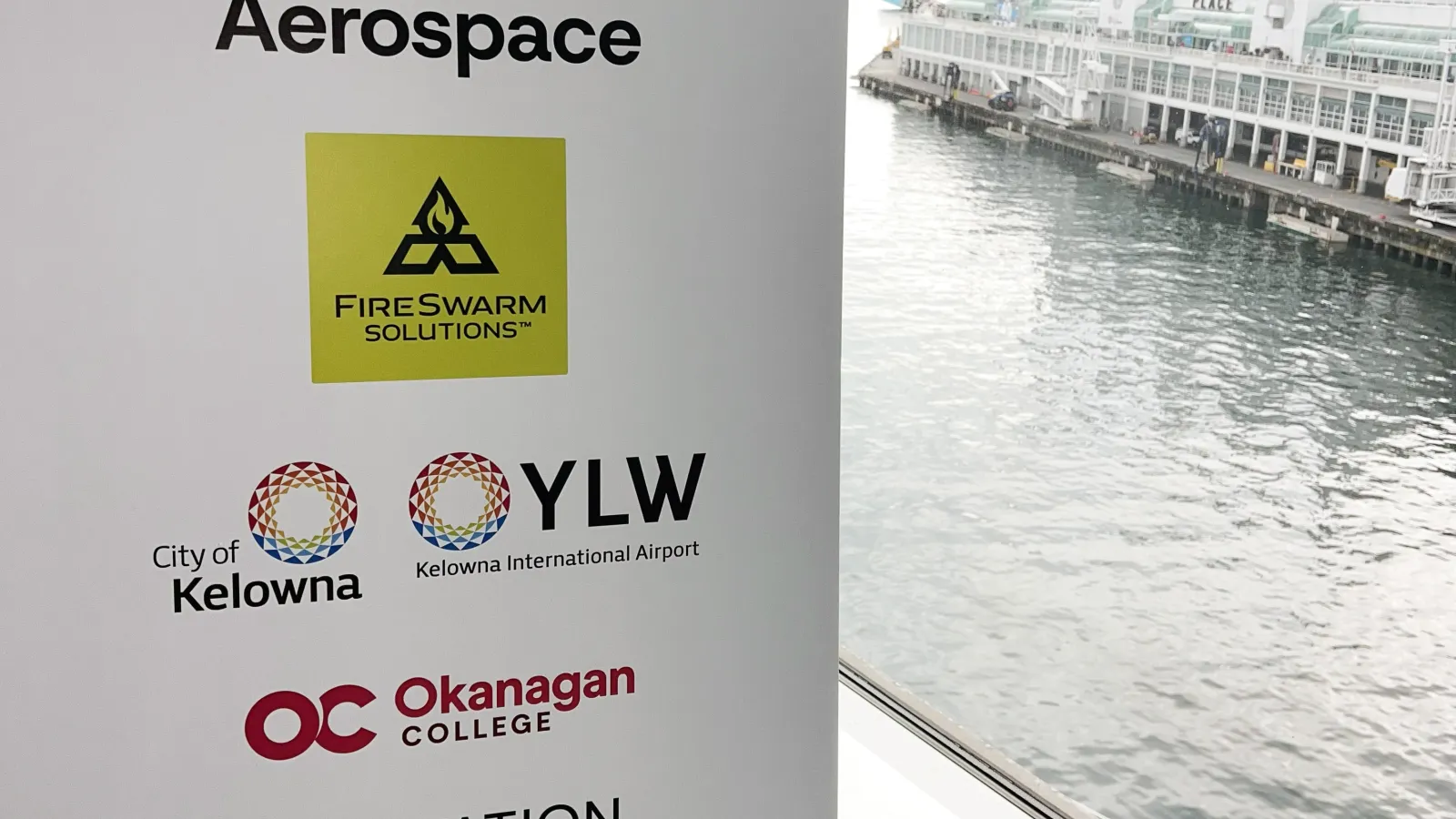
FireSwarm Solutions, the Squamish-based autonomous drone-swarm company, has signed Memoranda of Understanding with the City of Kelowna and Okanagan College, laying the institutional groundwork for what the three partners describe as a national hub for drone and aerospace innovation anchored at YLW Kelowna International Airport. The announcement, made at the Union of BC Municipalities convention in Vancouver, brings together municipal government, a regional post-secondary institution, and a defence-adjacent technology company under a single economic development ambition.
The timing is deliberate. Following successive devastating wildfire seasons across the Okanagan, FireSwarm's core platform, an automated swarm of drones designed for wildfire suppression and emergency response, has moved from proof-of-concept to operational demonstration. In 2025, the company conducted an integrated training exercise with the Kelowna Fire Department on Knox Mountain, observed by Transport Canada and BC Wildfire Service. That exercise is now cited as the trigger for the city partnership. The company says its technology is engineered for civilian emergency response but is explicitly adaptable to broader defence and security applications, a framing that widens the commercial and governmental addressable market considerably.
Talent pipeline as strategic infrastructure
The Okanagan College dimension of the agreement carries strategic weight beyond workforce development optics. The college is already a leading provider of Aircraft Maintenance Engineer training in British Columbia. Under the new MOU, the two parties will jointly develop programmes equipping AMEs with drone-specific skills, covering uncrewed aerial systems technologies, avionics and advanced manufacturing. A purpose-built training hangar is already under construction at YLW, funded through the BPL Legacy Association and the College itself.
"Our partnership with FireSwarm will help ensure aircraft maintenance engineers and other aerospace professionals are equipped for an industry increasingly shaped by uncrewed systems, AI and advanced manufacturing," said Dr. Neil Fassina, president of Okanagan College. That statement is notable for what it implies: the institution is not simply reacting to employer demand but positioning itself as a credentialling gatekeeper for an emerging sector before the sector fully matures.
Dual-use dynamics and the defence read-across
For cross-sector observers, the more consequential signal in this announcement is the explicit dual-use framing. FireSwarm's boilerplate describes its technology as "developed for civilian emergency response and adaptable to broader defence and security needs." Combined with the presence of Transport Canada observers at the Knox Mountain exercise, this positions Kelowna's emerging ecosystem squarely within the growing market for sovereign-capable uncrewed systems, a category attracting procurement attention from NATO members seeking alternatives to offshore UAS supply chains.
Canada has particular reason to accelerate domestic UAS capability. Federal procurement discussions around wildfire management, border surveillance and Arctic domain awareness have all surfaced uncrewed systems as a priority, yet Canadian-owned industrial capacity in the sector remains thin relative to US and Israeli incumbents. A municipally anchored hub with integrated training infrastructure and a company holding regulatory relationships with Transport Canada is, in capital-allocation terms, a credible early-stage platform.
The City of Kelowna's own framing reinforces this reading. Mayor Tom Dyas pointed to YLW's status as Canada's largest municipally owned and operated airport, generating an estimated CAD $2.08 billion in annual economic impact, as the physical and logistical foundation for the partnership. Airports of that scale with proximity to recurring wildfire zones represent rare test environments for autonomous aerial systems operating under real emergency conditions.
The three partners are careful to describe the MOUs as a starting point rather than a concluded deal, and no capital figures or programme launch dates are attached to the announcement. The next material signals to watch are federal and provincial co-investment commitments, which FireSwarm's CEO explicitly flagged as a prerequisite for scaling the opportunity. Whether Ottawa's defence and emergency-management procurement pipelines accelerate that timeline will determine whether Kelowna's aerospace ambitions remain regional or achieve the national profile the partners are projecting.