
Riyadh day one: Tabby's $6.5bn and the licences behind it
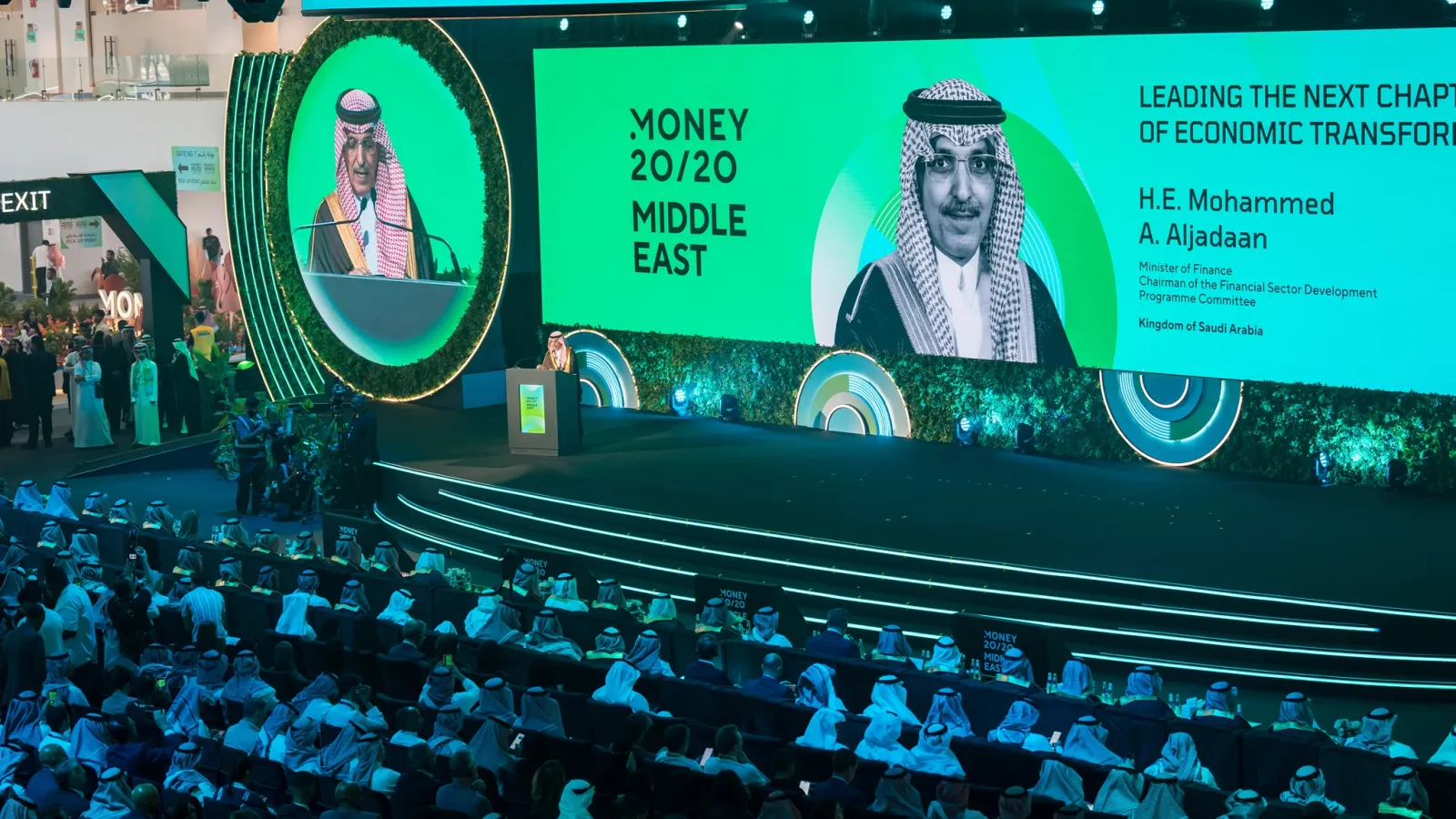
Money20/20 Middle East opened its second edition on Monday, with H.E. Mohammed Al-Jadaan, Saudi Arabia's Minister of Finance and chairman of the Financial Sector Development Program, inaugurating the show at the Riyadh Exhibition and Convention Centre in Malham and touring the floor.
By the end of the first day the show had produced a $233m equity round at a $6.5bn valuation, a new SAR 500m financing fund aimed at Saudi small businesses and a cross-border payout network opening six markets across the region. For anyone following the Kingdom's capital formation rather than its product launches, the common thread was licensing.
What is inside $6.5bn
Tabby announced a $233m equity round at a $6.5bn valuation, led by existing investor Blue Pool Capital with HSG, Wellington Management and Arbor Ventures. Bloomberg reported that the valuation puts Tabby ahead of Klarna. The company says it has been profitable since 2023 and processes more than $18bn in annualised transaction volume across 25 million registered users and 70,000 business partners.
The round includes a liquidity option for employees, on top of more than $100m in share sales Tabby has run through tenders since 2023. A company that has been running tenders for employee shares for three years is managing its shareholder base for a long private life rather than a near-term listing, which says a good deal about the patience regional founders now expect from local capital.
The valuation also rests on a licence stack. Over the past year the Saudi Central Bank has granted Tabby consumer and SME finance licences, allowing larger and longer-term lending than instalments at a checkout. Tabby has bought Tweeq, a SAMA-licensed digital wallet, taking it into accounts, cards and transfers, and in the UAE it holds a Stored Value Facilities licence, under which it launched Tabby Cash. The $6.5bn is a valuation of a licensed consumer finance business across two jurisdictions, not of a checkout button. The deal remains subject to regulatory approvals, including from SAMA.
A fund for the SME gap
SILQ's embedded finance business, Fina, and Riyadh-based Joa Capital unveiled the Fina Fund on the main stage, a direct financing fund managed by Joa Capital, which is licensed by the Capital Market Authority, with a target size of SAR 500m. It is designed to put working capital into the order flow of Saudi small businesses, where SILQ already serves more than 50,000 SMEs.
The target is modest against the gap. SILQ puts the Kingdom's SME financing shortfall at around SAR 400bn, with SME lending at 11.3 per cent of total bank loans in 2025 against a 2030 target of 20 per cent. Small business working capital is the hardest kind of lending to scale because it needs underwriting data that balance-sheet lenders have never held. Platforms that already sit inside a merchant's purchasing do hold it, which is why financing of this shape keeps forming around the payments layer rather than inside the banks.
Six markets, most of them hard
Thunes expanded its Direct Global Network into Bahrain, Lebanon, Oman, South Yemen, Syria and the UAE, giving its members payouts to bank accounts, mobile wallets and cash pickup locations in local currency through a single integration or existing SWIFT connectivity. It follows the company's move into real-time payments in Saudi Arabia last September.
Bahrain, Oman and the UAE are digital economy markets. Lebanon, South Yemen and Syria are remittance corridors of the difficult kind, with Thunes citing around $7bn a year flowing into Lebanon and remittances worth more than 38 per cent of GDP in South Yemen. Opening commercial cash pickup into Syria is a compliance and correspondent banking achievement before it is a commercial one. Thunes says its compliance platform rests on more than 50 licences worldwide, and in this region the constraint on moving money has shifted from technology to permission.
The regulator's line
The clearest statement of how the Kingdom intends to run this market came from Turky A. Kabarah, director of fintech enablement at SAMA, on a panel about designing financial systems that scale safely. "We do not view regulatory requirements as barriers to innovation, but as a roadmap that enables fintech companies to innovate and scale safely," he said, describing controlled testing as the way SAMA develops its frameworks. That sandbox-to-licence sequence is exactly what produced Tabby's licences, and it is the same route SAMA opened for open banking providers in March.
On a separate panel on central bank digital currency, Dr Saeeda Jaffar, managing director for international at Circle, argued that bots are already making large numbers of transactions, and that no existing payment rail handles that volume as well as digital currencies can.
The next capital market
On the Capital Stage, Dr Ekrem Arıkan, chief executive of Merkezi Kayıt Kuruluşu, the Central Securities Depository of Türkiye, joined Stefan Klestil of Speedinvest and moderator Simon Hardie of Findexable on programmable money and tokenised assets. Arıkan set out Türkiye's digital asset framework and the depository's crypto asset registry, and argued that digital technology should be connected to real financial assets inside regulated capital markets.
A central securities depository decides whether a tokenised instrument is a security with a registered owner or a database entry. Türkiye built its registry before the market arrived, and for Gulf capital markets weighing tokenisation, that order of work is a useful reference point.
Capital with no equity attached
The MoneySurge pitch competition opened its first round on the Capital Stage, with 25 startups selected from more than 450 applicants competing for a $400,000 prize pool. Judges included Klestil, Abdulaziz Alomran of Impact46, Lizzie Chapman of Baystreet, Efayomi Carr of Flourish Ventures and Mareme Dieng of AXIAN Group.
The prize money is equity-free. In a region where the hardest cheque to raise is the first one that does not price the company, a non-dilutive pool of that size is worth more to an early-stage founder than the headline suggests.
The show continues on Tuesday, when SAMA Governor H.E. Ayman M. Al-Sayari opens the Executive Summit.