
Ant International's AMP goes global as agentic payments race heats up
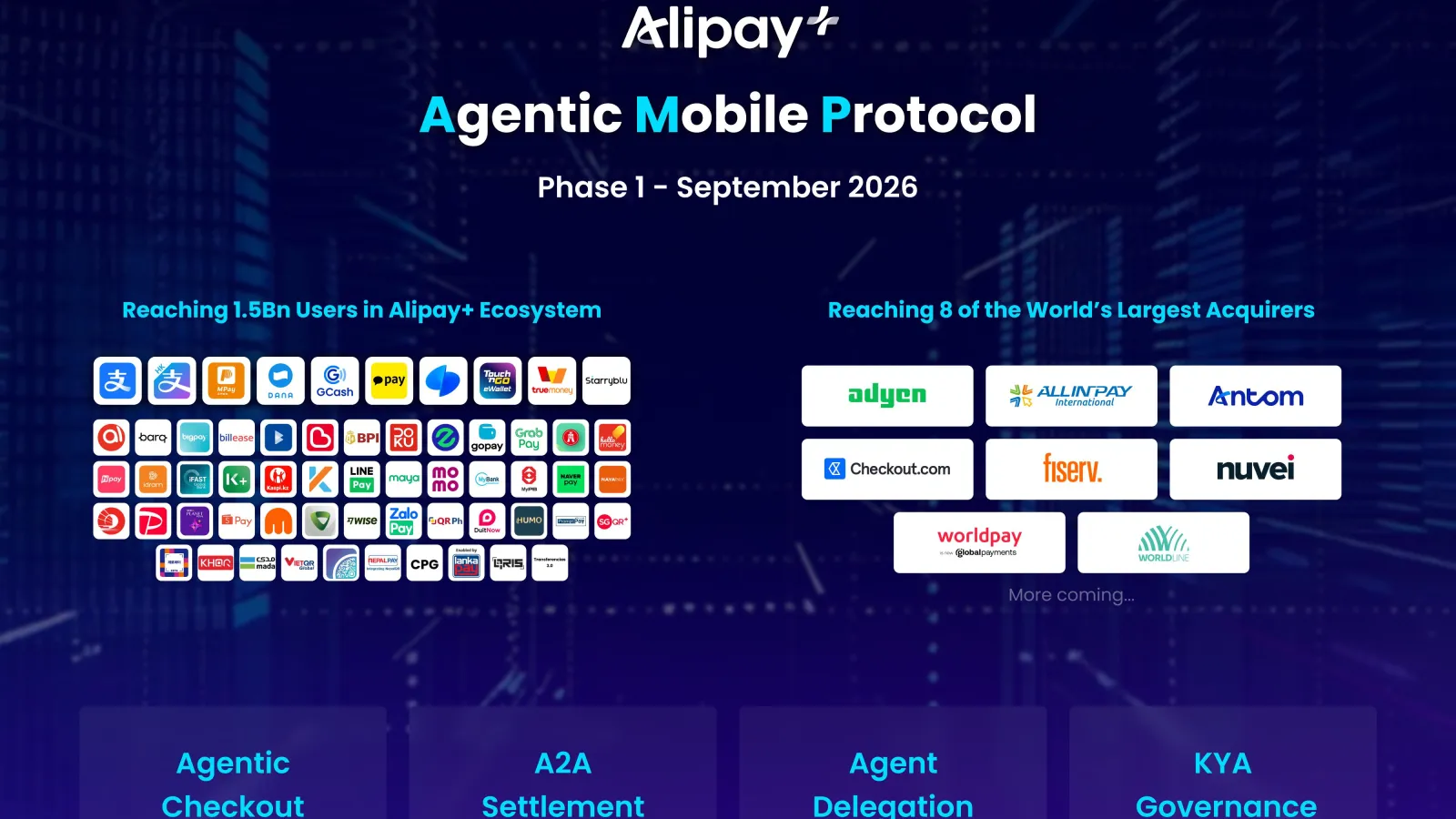
Ant International has moved its Agentic Mobile Protocol (AMP) from pilot to global rollout, signing up ten digital wallets and seven acquiring partners, including Adyen, Fiserv, and Worldline, to embed AI-agent payment capabilities across a network the company says serves two billion consumer accounts. Simultaneously, Ant, Mastercard, and Visa have begun work on a shared Know-Your-Agent (KYA) interoperability framework, a move that pulls the world's dominant card rails directly into the architecture of agentic commerce.
AMP, launched in April 2026, is an open payment protocol that lets AI agents execute transactions end-to-end inside existing mobile wallets, covering QR scans, card swipes, and tap-to-pay, without requiring users to create new accounts or re-link payment credentials. The company says agent-to-wallet integration steps are cut by up to 50%, and the protocol supports nano-scale agent-to-agent (A2A) settlements as small as $0.000001, a denomination that conventional payment rails cannot handle. The source code is now public on GitHub.
Trust infrastructure becomes the battleground
The KYA framework is the strategically significant piece. As AI agents proliferate across consumer and enterprise surfaces, "know your customer" compliance, a bedrock of financial regulation globally, must extend to machine actors. The tripartite collaboration between Ant, Mastercard, and Visa, convened through the Monetary Authority of Singapore's BuildFin.ai platform, signals that regulators are already treating agent identity as a systemic risk question, not a product feature.
Jiang-Ming Yang, Chief Innovation Officer at Ant International, framed the challenge directly: "Agentic commerce will only have a real path to mass adoption when supported with a deep foundation of trust. We are committed to strengthening collaboration with card networks, policy leaders like MAS and other stakeholders on new accountability mechanisms."
Ant's AgentSafePay mechanism adds a money-back guarantee against agent-specific failure modes, including large language model hallucinations and intent drift, where an agent's final transaction diverges from the user's original instruction. These are novel liability categories that existing payment dispute frameworks were not designed to accommodate.
Convergence read-across: fintech, AI infrastructure, and regulatory arbitrage
The AMP rollout sits at a sharper convergence point than it might first appear. For the AI infrastructure sector, AMP represents one answer to a critical unsolved problem: how agentic systems monetise at scale. Foundation-model providers and agentic-AI platform builders, from the hyperscalers to specialist agent-orchestration startups, currently lack a standardised payment primitive. An open, interoperable protocol backed by Alipay+'s merchant footprint (150 million merchants) gives the ecosystem a credible settlement layer to build against.
For capital allocators, the geography of the Phase I wallet cohort is telling. Partners span China, Hong Kong, Indonesia, the Philippines, South Korea, Macao, Malaysia, Thailand, and Singapore, concentrating the initial rollout across mobile-first, high-growth markets where digital wallet penetration has already outpaced card infrastructure. Western acquirers, Adyen, Checkout.com, Worldline, provide the bridge to card-dominant markets, suggesting Ant is deliberately constructing a protocol that connects the two payment worlds rather than competing within either.
The regulatory dimension adds a further layer. Singapore's MAS is co-convening the KYA standards work through BuildFin.ai, positioning the city-state as the governance hub for agentic financial infrastructure in Asia. That is a deliberate piece of digital-sovereignty positioning: if the identity and accountability standards for AI agents in payments are written in Singapore, under MAS oversight, the jurisdiction gains structural influence over a technology layer that will underpin trillions in future commerce flows. Cross-sector investors watching the race between US, EU, and Asian regulatory regimes to set AI-finance standards should note that MAS has moved earliest and most concretely here.
The open-source release of AMP broadens the coalition-building beyond the named Phase I partners. Whether adoption accelerates or fragments into competing protocols, a risk the KYA interoperability effort is explicitly designed to mitigate, will determine whether AMP evolves into neutral infrastructure or remains a de facto Alipay+ extension.