
T3 Defense wins $1.3m power order for European air-defence line
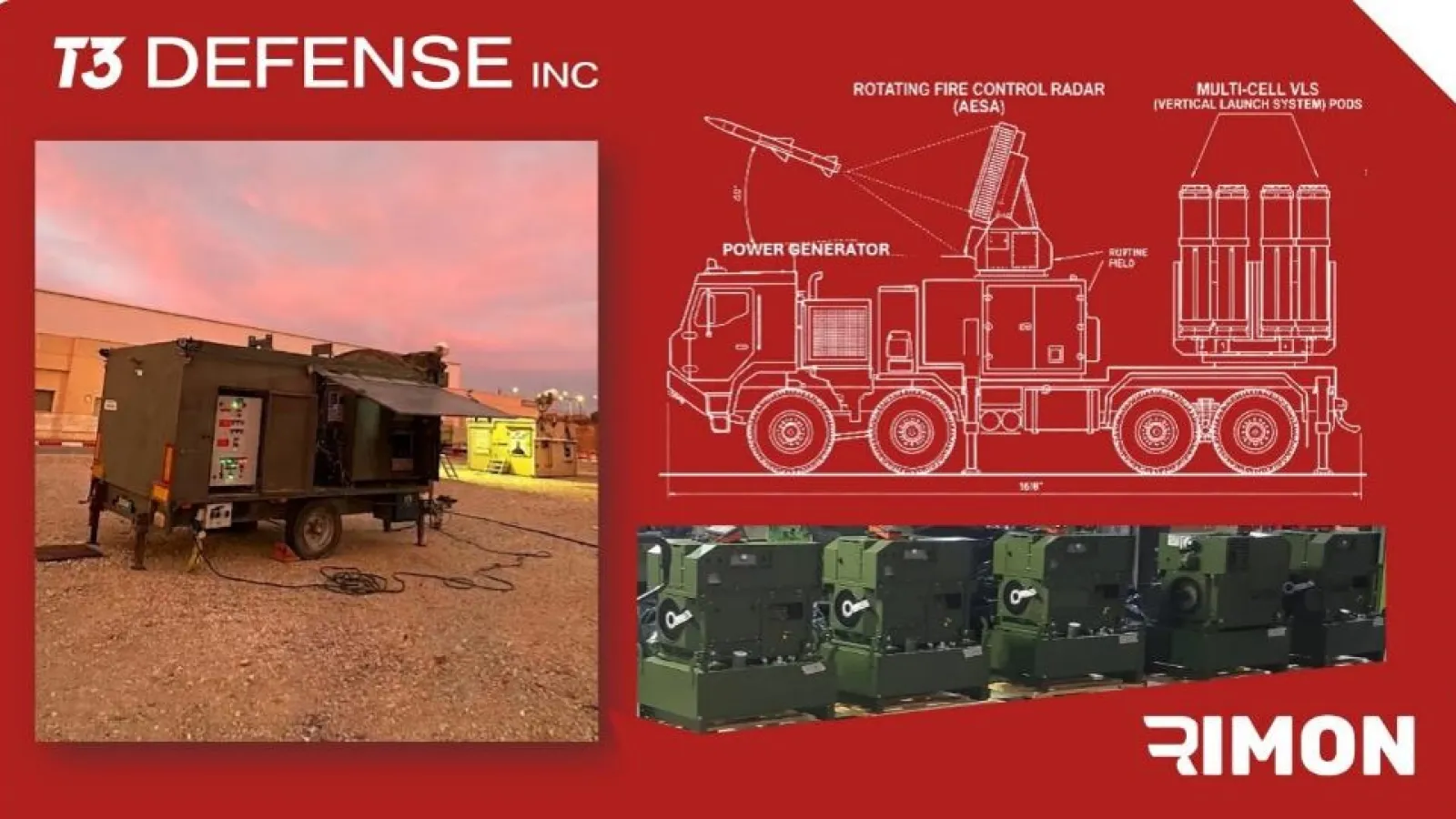
T3 Defense, the Nasdaq-listed Israeli-American defence acquirer, has secured a $1.3 million purchase order through its subsidiary Rimon Agencies for engineered power-generation systems destined for a European air-defence production line. The customer is an unnamed leading Israeli defence prime contractor, and deliveries are scheduled for a European facility as part of what T3 describes as a serial production programme rather than a one-off procurement.
The scale of the contract is modest by prime-contractor standards, but its strategic signal is not. It marks Rimon's first purchase order tied to European defence-production activity, opening the Israeli systems integrator into a supply chain that European governments are urgently trying to expand following years of underinvestment in air-defence capacity.
A beachhead order, not a one-off
Rimon's business model sits in the less glamorous but operationally critical tier of the defence stack: mobile power systems, sensor masts, and integrated mission vehicles that allow advanced technologies to function in environments without fixed infrastructure. In that sense, power generation is the unsexy backbone of layered air-defence architectures, which require sustained, field-reliable energy to run radar, communications, launchers, and command systems simultaneously.
Rimon has been performing strongly by its own recent metrics. By the end of July 2026, it had generated approximately $5.25 million in year-to-date revenue, already surpassing its full-year 2025 figure of $4.6 million. The new $1.3 million order has been added to a backlog that stood at around $2.1 million as of the same date, indicating that Rimon is operating with meaningful revenue visibility for the remainder of 2026.
Chief Executive Menny Shalom framed the order in explicitly programmatic terms: "Europe's continued investment in layered air defence would create demand for the sub-systems our businesses provide. This order opens a path for Rimon into the European air-defence supply chain, where we see multi-year, program-driven demand for exactly this class of hardware."
The macro context: Europe's rearmament and the sub-tier opportunity
The order sits inside a structural shift that is reshaping defence capital allocation across NATO-aligned economies. European governments, accelerating procurement following Russia's invasion of Ukraine, are contending with a painful bottleneck: prime contractors can win the contracts, but the sub-tier suppliers capable of delivering mission-critical hardware at serial-production scale are limited in number. Power generation, positioning and navigation, and command-and-control integration represent exactly the categories where capacity constraints are most acute.
This creates an unusual opening for smaller, specialised suppliers with proven records in high-demand environments. Israel's defence-industrial base, forged through decades of operational requirements, has produced a cluster of such suppliers. T3 Defense's acquisition strategy is explicitly designed to aggregate them, assembling a portfolio that includes Rimon, Positech, Tiltan, ITS, and Nimbus across launcher systems, tactical mobility, counter-drone hardware, and training simulation.
For cross-sector investors, the read-across extends beyond straightforward defence procurement. The push to qualify Israeli sub-tier suppliers into European production lines intersects with debates around defence-industrial sovereignty: European governments want domestic or allied supply chains for critical defence hardware, but domestic capacity alone cannot meet near-term rearmament timelines. That gap is where companies like T3 Defense are positioning. Sovereign and institutional capital flowing into European defence modernisation is increasingly looking beyond prime contractors toward the programme-critical sub-tier, and small-cap consolidators with operational subsidiaries already qualified on active programmes represent one route to that exposure.
Whether the Rimon order converts into broader programme participation will depend on qualification processes, export-control clearances, and the pace of European air-defence production ramp-up, all of which the company's own forward-looking disclosures flag as material uncertainties. The strategic direction, however, is clearly set.