
Hyundai and AfDB ink deal to build Africa's EV and clean energy base
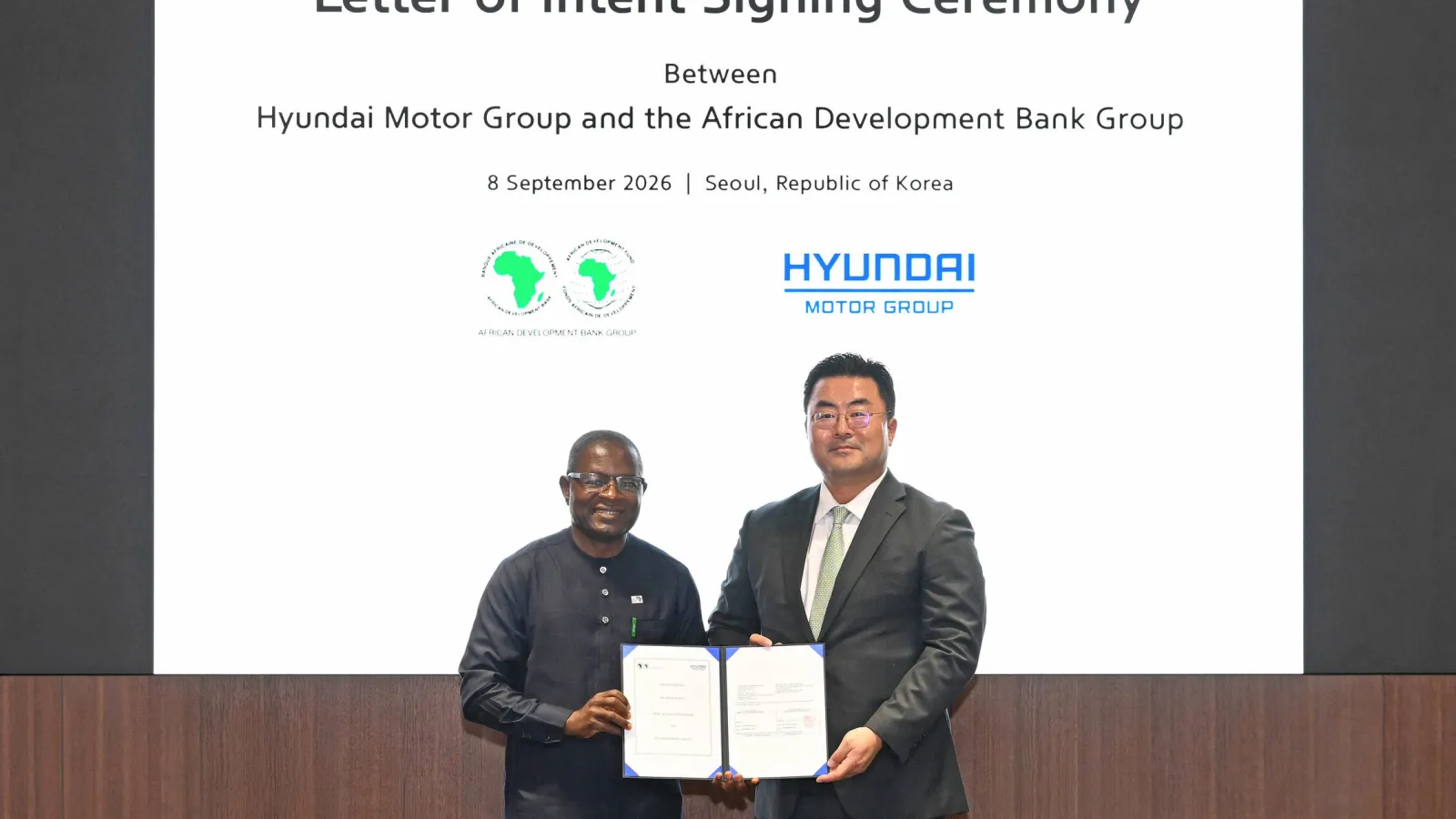
Hyundai Motor Group and the African Development Bank (AfDB) have signed a Letter of Intent to establish a long-term strategic partnership targeting six industrial pillars across Africa: clean energy transition, sustainable mobility, transport and logistics infrastructure, electric vehicle (EV) value chain development, manufacturing capacity building, and talent development. The deal, signed at Hyundai's Yangjae headquarters in Seoul, pairs the South Korean conglomerate's technical operations across mobility, energy and construction with the AfDB's multilateral development financing firepower.
The pairing is significant in structural terms. Private-sector industrial capability linked explicitly to blended finance, investment structures that combine concessional public capital with private returns, has become the preferred mechanism for de-risking large infrastructure plays in emerging markets. Hyundai Vice Chair Jaehoon Chang described the arrangement as a "Blended Finance Package that links policy financing with private capital while securing investment stability," signalling that the Group is not simply licensing technology but is seeking co-investment frameworks that transfer sovereign-risk mitigation onto the multilateral balance sheet.
Africa's Critical Minerals as the Strategic Pivot
The EV value chain component of the agreement is where the macro logic tightens most sharply. Africa holds an estimated majority of the world's cobalt and manganese reserves, alongside significant lithium and platinum-group metal deposits, the raw material substrate of battery and fuel-cell production. By embedding an EV value chain development workstream within a multilateral-backed agreement, Hyundai is positioning to access those minerals upstream, at the point of extraction and early processing, rather than purchasing refined materials on spot markets dominated by Chinese intermediaries.
This is a familiar strategic move: automakers from Volkswagen to Stellantis have pursued offtake agreements and equity stakes in African mining assets over the past three years. What distinguishes this deal is the AfDB wrapper. The bank's development financing mandate gives it leverage with African governments on permitting, local-content requirements and infrastructure co-investment, barriers that have slowed purely commercial mining and processing ventures. Hyundai is, in effect, buying geopolitical access alongside tonnage.
Blended Finance Meets Industrial Policy
The broader read-across for cross-sector investors is the acceleration of a model in which multilateral development banks act as crowding-in mechanisms for corporate balance sheets. The AfDB, the World Bank's IFC arm, and regional equivalents such as the Asian Infrastructure Investment Bank have all expanded their private-sector co-financing windows since 2023 as OECD governments sought to direct industrial capital toward the Global South without direct budget exposure. Hyundai's move adds a major automotive and energy conglomerate to a roster previously dominated by renewables developers and telecoms infrastructure funds.
The green hydrogen workstream is worth watching separately. Hyundai's fuel-cell division already produces hydrogen-powered commercial vehicles and has invested in electrolyser supply chains. Africa's solar irradiance profile makes it a candidate for cost-competitive green hydrogen export, a thesis that Saudi Arabia's NEOM and Morocco's NOOR projects have already tested. If Hyundai and the AfDB can structure bankable hydrogen projects, the output could feed Hyundai's own European and Asian logistics fleets, closing a vertical loop that most Western automakers are still trying to sketch on whiteboards.
Kevin Chika Urama, the AfDB's Chief Economist, described Hyundai as "a strategic partner whose experience, technological capabilities, and long-term vision are closely aligned with the African Development Bank's vision of unlocking Africa's potential."
The LOI is a framework document, not a capital commitment, and the transition from signed intent to funded projects has historically been slow in multilateral deal structures. The next material signal will be whether the parties publish sector-specific implementation frameworks, and which African governments sign bilateral agreements underneath the umbrella, within the 12-month window that multilateral MoUs typically allow before momentum dissipates. Investors tracking African industrial infrastructure and EV supply chain exposure should treat this as an early-positioning signal rather than a near-term capital event.