
T3 Defense subsidiaries post record revenue on aerial sensor demand
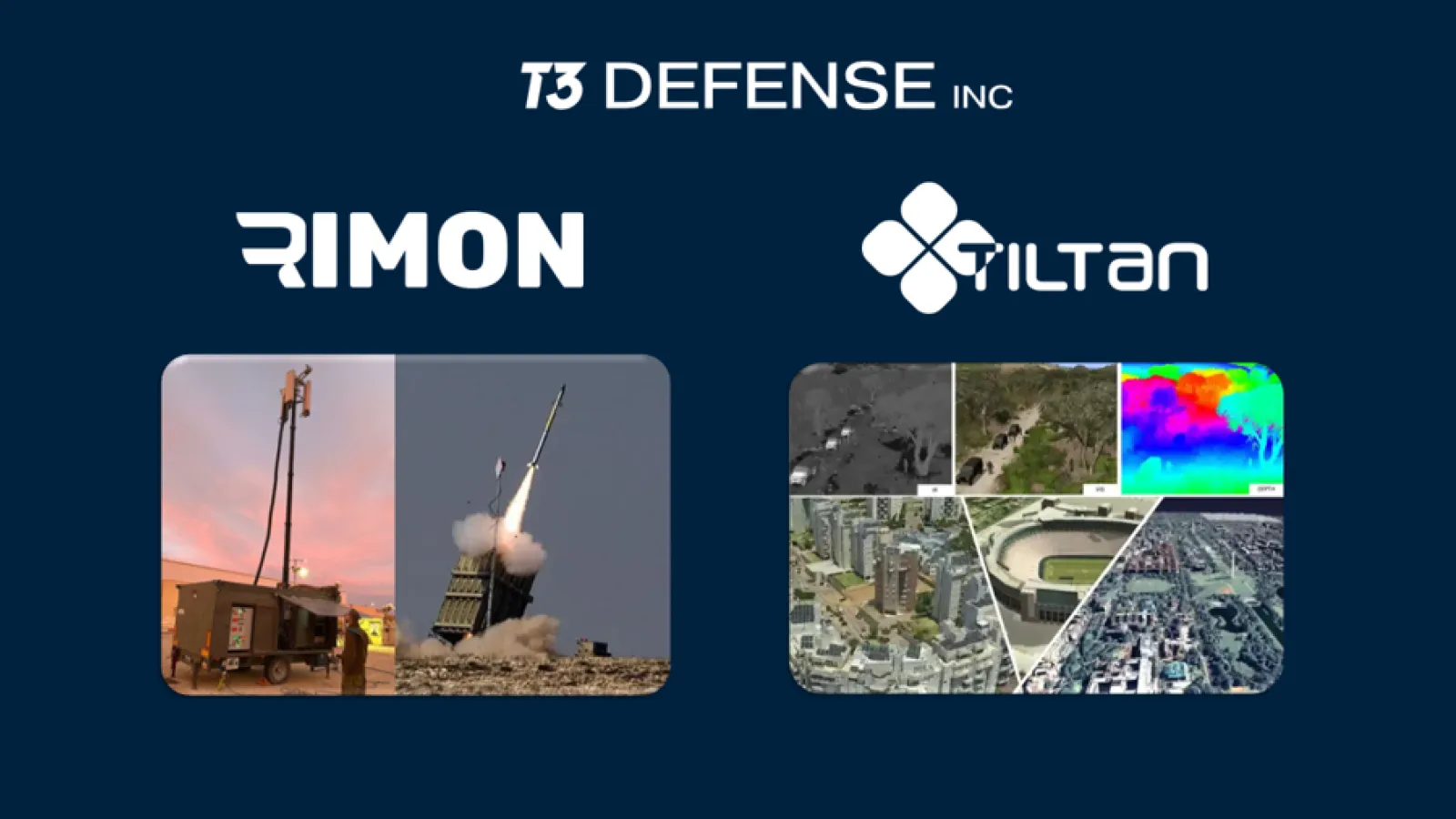
T3 Defense Inc. (Nasdaq: DFNS), a New York-listed defence-technology holding company with operational roots in Israel, reported record year-to-date revenues across two of its wholly owned subsidiaries, Rimon and Tiltan, for the period ending July 2026. The milestone arrives as Israel's defence industry continues to absorb accelerated procurement timelines and as global demand for advanced aerial sensing systems tightens the competitive landscape for specialist suppliers.
Rimon, which supports leading entities within Israel's defence supply chain, recorded $2.6 million in July alone, described by the company as an all-time monthly high. Year-to-date revenue reached approximately $5.25 million, already surpassing the whole of 2025's $4.6 million full-year figure. The subsidiary now anticipates full-year 2026 revenue exceeding $7.2 million and is preparing what the company calls a "meaningful operational expansion", including additional hiring, upgraded management systems, and a potential move to a larger production facility.
Aerial sensors at the centre of Tiltan's growth
Tiltan's trajectory is being driven by a different but strategically adjacent capability: high-fidelity simulation of day and thermal aerial sensors. The unit reported approximately $1.0 million in year-to-date revenue and $2.5 million in total purchase orders received so far this year, with a backlog of $1.5 million and a further $3.5 million in outstanding proposals pending conversion. Full-year revenue is anticipated to exceed $4.0 million. Customers, described as top-tier global defence clients, selected Tiltan's simulation systems after evaluating alternatives, citing unique capabilities for replicating real-world external conditions in a laboratory environment. The practical upshot is shorter development cycles and reduced reliance on costly field testing.
"We remain focused on converting this momentum into durable, long-term growth across the platform," said Menny Shalom, Chief Executive Officer of T3 Defense.
Convergence context: defence-tech roll-ups and the simulation economy
T3 Defense's operating model sits within a broader consolidation trend in defence technology, where holding companies are aggregating niche capability providers across sensing, electronics, and engineering. This roll-up strategy mirrors approaches taken by larger Western primes and specialist acquirers in the UK and continental Europe, particularly as defence ministries across NATO and allied nations seek to shorten procurement timelines and reduce dependence on single-source suppliers.
Tiltan's sensor simulation niche is particularly instructive for cross-sector investors. The ability to bring high-fidelity thermal and electro-optical sensor behaviour into a laboratory environment accelerates not just military development cycles but has clear read-across into autonomous vehicle sensor validation, drone logistics, and remotely operated systems in industrial environments. The underlying technology for simulating how sensors perceive the physical world is, in principle, transferable across any domain relying on machine vision operating in degraded or complex conditions.
From a capital perspective, small-cap defence-tech holding companies like T3 Defense occupy an increasingly watched corner of the market. Sovereign and institutional capital has shifted meaningfully toward defence and dual-use technology since 2022, with European and Israeli defence budgets expanding in response to persistent geopolitical pressure. For investors tracking this space, the relevant signal is less the absolute revenue figures (which remain modest at sub-$10 million scale) and more the backlog conversion rate and whether management can execute the operational scale-up at Rimon without margin compression.
T3 Defense's ability to maintain Nasdaq listing compliance and access its equity line of credit facility, both flagged as risk factors in its forward-looking disclosures, will be key variables to watch as it moves into the second half of 2026.