
Dassault Aviation H1 revenue surges 46% on Rafale export surge
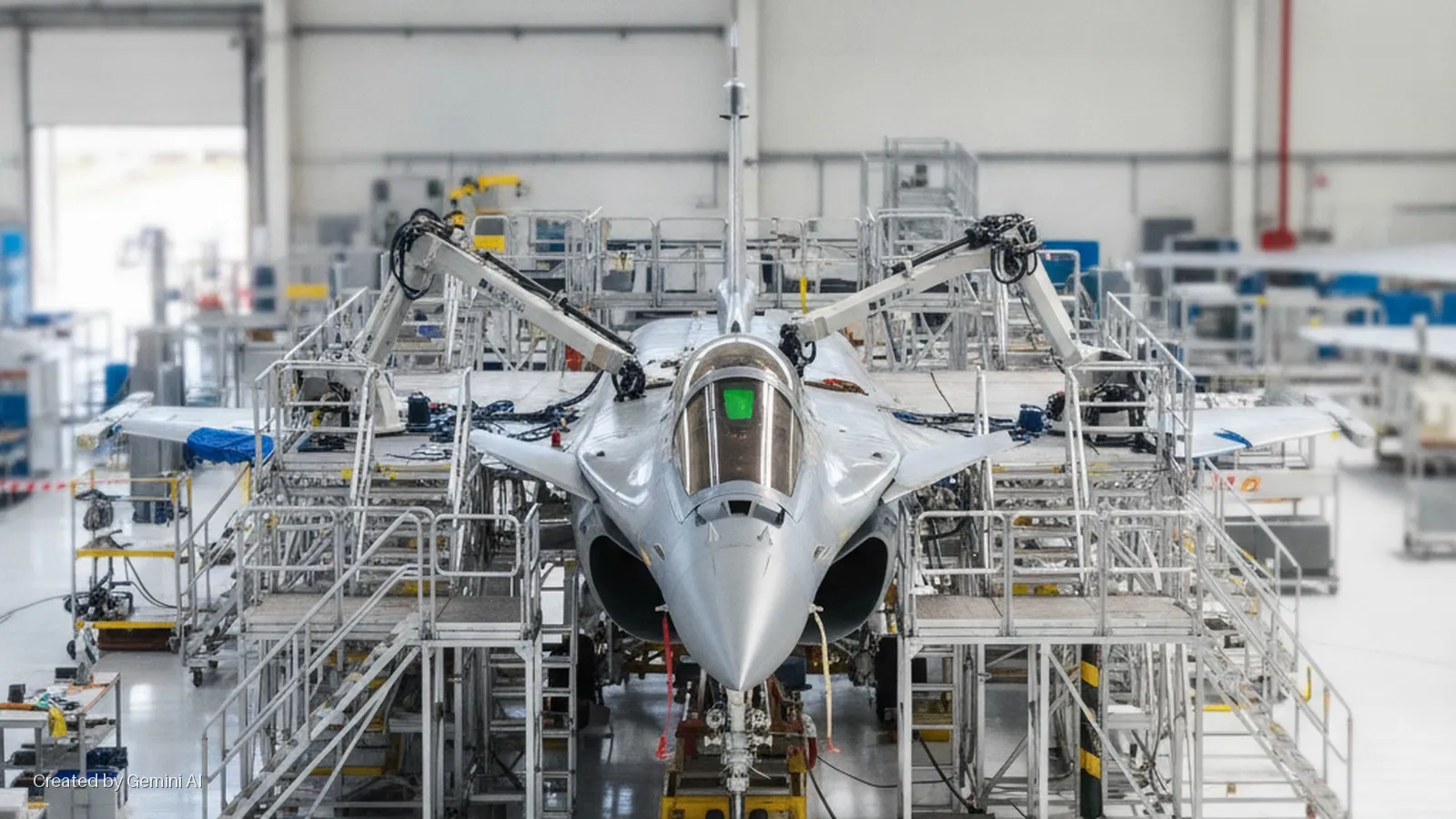
Dassault Aviation, the French maker of the Rafale combat jet and Falcon business aircraft, reported a 46% year-on-year rise in first-half 2026 net sales to EUR 4.16 billion, driven predominantly by an acceleration in export deliveries of its Rafale fighter. Operating income more than doubled to EUR 330 million, lifting the adjusted operating margin to 7.9% from 6.3% a year earlier. The figures cement Dassault's position as one of the clearest beneficiaries of the post-2022 global rearmament cycle.
The defence segment accounted for 71% of net sales, with export defence revenues surging to EUR 2.10 billion from EUR 949 million in H1 2025. The driver was straightforward: 10 Rafale Export deliveries versus four in the comparable period, reflecting the maturation of contracts signed during the defence-spending wave that followed Russia's invasion of Ukraine. Available cash rose to EUR 10.10 billion, underpinned by advance payments on future Rafale Export orders, giving the company an unusually robust balance sheet for a defence prime of its size.
India, Ukraine and the FCAS collapse
Three strategic events during the half will shape the medium-term order book more than any single delivery milestone. First, India's Defence Acquisition Council entered direct negotiations for the acquisition of 114 Rafale jets, a contract that CEO Éric Trappier described as the company's "major strategic objective." If concluded, it would dwarf the 26-aircraft naval Rafale order India placed in H1 2025 and represent one of the largest single-nation fighter procurements of the decade. Second, France and Ukraine signed a roadmap after the period end for Kyiv to acquire 16 Rafale, a deal that simultaneously serves French industrial interests and Ukraine's long-term air-sovereignty ambitions. Third, and with wider industrial consequences, France and Germany agreed to halt the FCAS/NGF next-generation fighter programme. Dassault is now in discussions with the French state on an alternative demonstrator, either as a purely French programme or a narrower bilateral.
The FCAS cancellation is particularly significant for the European defence-industrial landscape. The programme had been the flagship of Franco-German defence integration and a prospective anchor for European Strategic Autonomy in aerospace. Its collapse leaves a gap in continental fifth-plus-generation capability planning and opens the question of whether France will pursue a national successor or seek new coalition partners, with implications for defence-tech procurement budgets across NATO's European flank.
The convergence angle: AI, drones and sovereign rearmament capital
On the civilian side, the Falcon business-jet division recorded 23 new orders against just eight in H1 2025, and the maiden flight of the long-delayed Falcon 10X on 19 June 2026 began the test campaign ahead of a revised 2029 entry into service. The Falcon backlog has risen to EUR 5.43 billion, suggesting a simultaneous up-cycle in corporate and UHNW aviation demand alongside the defence surge.
For cross-sector investors, the more forward-looking signal came on 13 July. Dassault and Harmattan AI announced the first successful in-flight collaborative engagement between a Rafale and an unmanned aerial system carrying the NAMIB electronic-warfare payload. The test, though brief in description, marks an important data point: manned-unmanned teaming (MUM-T) is transitioning from laboratory concept to operational demonstration on one of the world's most capable frontline fighters. The capital flows tracking this shift are substantial. Sovereign defence budgets across Europe are expanding; the French LPM update provides for further increases. Meanwhile, AI-enabled autonomy is moving from a software investment category into a direct input to aerospace hardware procurement decisions, compressing the traditional boundary between defence-tech venture rounds and sovereign procurement cycles. Investors allocating across deep-tech and defence should read Dassault's H1 not merely as an earnings release, but as a proxy for where geopolitical risk capital is being committed at scale.
Full-year 2026 guidance remains EUR 8.5 billion in net sales, comprising 40 Falcon and 28 Rafale deliveries.