
Kraken Robotics clears regulatory hurdle for Covelya Group acquisition
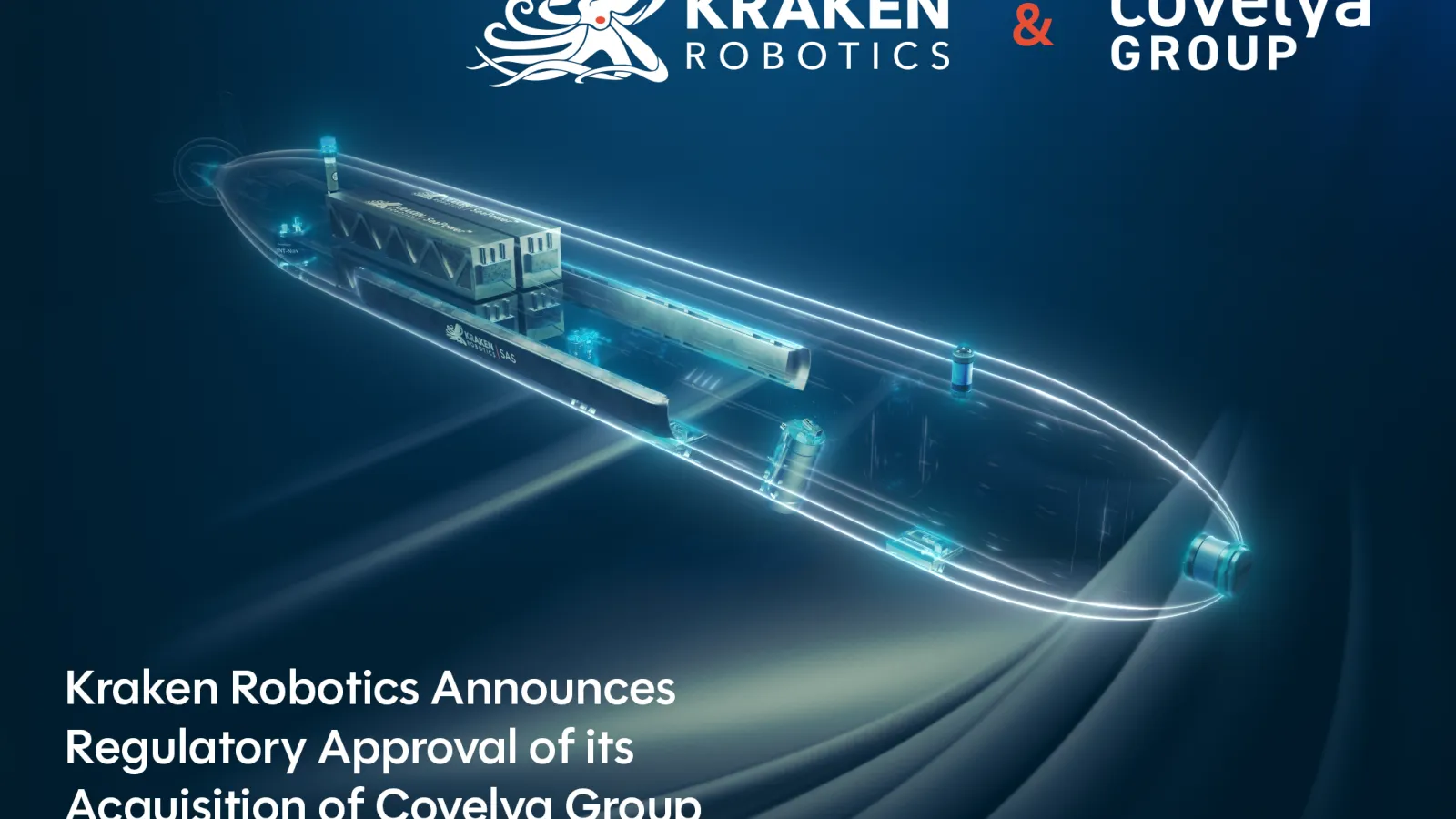
Kraken Robotics, the TSX Venture-listed subsea intelligence company headquartered in St. John's, Newfoundland, has received all regulatory and stock exchange approvals required to complete its acquisition of Covelya Group Limited. The deal is expected to close on 2 July 2026, subject to customary conditions. When it does, it will bring six established underwater-technology businesses under a single corporate roof, positioning Kraken as one of the largest independent players in the global subsea sensing and robotics market.
Covelya Group operates through subsidiaries that span the breadth of subsea operations: Sonardyne International (acoustic positioning and communications), EIVA (offshore survey software), Forcys (maritime autonomy systems), Wavefront Systems (sonar signal processing), Voyis Imaging (underwater optical systems), and Chelsea Technologies (ocean sensors). Each fills a distinct layer of the subsea technology stack, and together they give Kraken a vertically integrated offering that stretches from raw sensor data capture through to vehicle navigation and mission management.
A consolidation play in a strategically charged market
The timing of this acquisition is not incidental. Subsea sensing and autonomous underwater vehicle (AUV) technology has moved sharply up the priority list for both defence procurement agencies and offshore energy operators over the past 18 months. NATO members have accelerated investment in undersea domain awareness following sustained attention to the vulnerability of subsea cable and pipeline infrastructure. Meanwhile, the offshore wind build-out across the North Sea, the US East Coast, and the Asia-Pacific littoral zone is generating sustained commercial demand for the kind of high-resolution seabed mapping, inspection, and monitoring that Kraken and Covelya's combined portfolio can supply.
Greg Reid, Kraken's President and CEO, said the company's focus after closing will be on "creating a global leader in mission-critical solutions for underwater platforms and subsea sensors and monitoring systems." The language of mission-criticality is deliberate: it bridges the company's defence and commercial revenue streams, both of which are expanding.
Convergence of defence, energy and autonomous systems
For cross-sector strategists, this deal sits at the intersection of three converging forces. First, the growing militarisation of the subsea domain is pulling defence-procurement capital into robotics and sensor firms that previously operated largely on commercial contracts. Second, the offshore energy transition is creating a multi-decade inspection and monitoring market that rewards integrated platform providers over point-solution vendors. Third, the maturation of AUV technology and AI-driven sonar processing is compressing the cost of persistent underwater surveillance, making previously uneconomical use cases viable.
The consolidation logic mirrors a pattern visible across other dual-use robotics segments, where acquirers are racing to assemble full-stack capability before the market stratifies around a handful of dominant platforms. Kraken's move to absorb six complementary businesses in a single transaction is an attempt to leapfrog that stratification rather than grow organically into it.
Investors will watch the integration closely. Combining six distinct engineering cultures, software stacks, and customer bases carries execution risk that regulatory approval does not resolve. The company has not disclosed the financial terms of the acquisition publicly, so the leverage profile and dilution impact remain factors for capital-markets analysts to assess ahead of the July close. What is clear is that Kraken is placing a significant bet that the subsea intelligence market is large enough, and converging fast enough, to reward scale over specialisation.