
Mavenir launches agentic network assurance framework for telcos
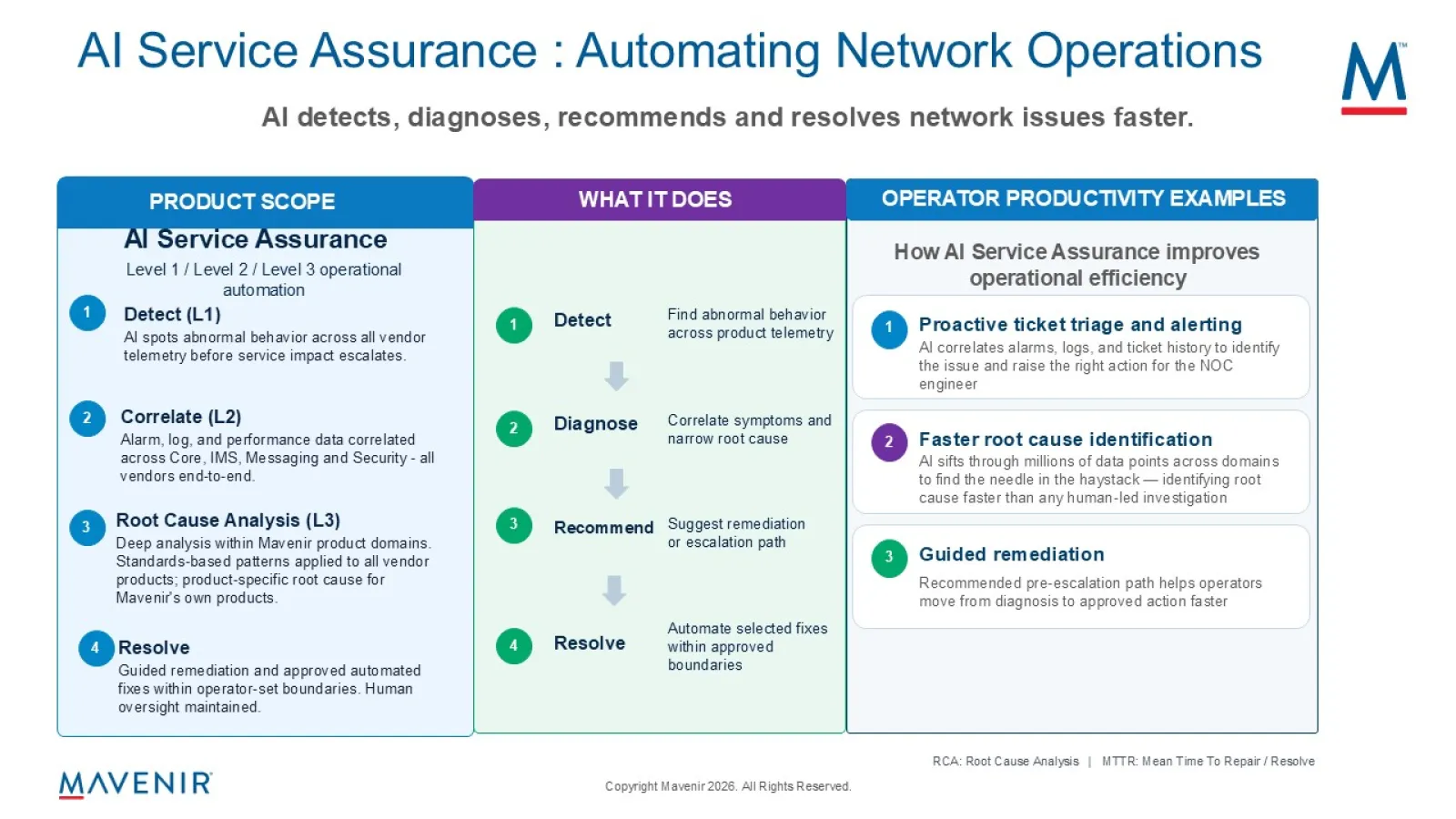
Mavenir has released an Agentic Service Assurance Framework designed to automate complex network operations across 5G, cloud-native, and IP domains. Built to TM Forum's IG1251 and IG1453 specifications, the system pairs an Intent Orchestrator with a multi-layer agentic architecture that the company says can detect, diagnose and resolve network faults without replacing operators' existing tooling.
At the heart of the framework is the Intent Ops engine, which observes how network operations centre (NOC) teams handle faults, extracts the patterns behind successful resolutions, and converts them into repeatable, auditable automation templates. Workflows are validated against a human baseline before any autonomous execution takes place, giving operators an audit trail for every remediation action. Mavenir says the approach extends beyond its own products via the Agent-to-Agent (A2A) protocol defined in IG1453, enabling integration with third-party OSS AI agents across the full network stack.
The operational problem
The release addresses a structural challenge facing mobile operators as 5G deployments mature. Networks spanning multiple vendors, cloud regions and protocol layers generate fragmented alarm data that legacy assurance systems cannot correlate effectively. At the same time, experienced network engineers are retiring, and the institutional knowledge they carry has historically been difficult to preserve or transfer at scale.
Mavenir's Intent Ops mechanism is designed to capture that expertise from live NOC workflows and from third-party vendor teams, publishing vetted automations to a growing orchestration catalogue. Operators can express desired network outcomes in natural language; the platform interprets, plans, executes and refines those outcomes continuously. Bejoy Pankajakshan, Mavenir's chief technology and strategy officer, said the framework means "the network runs on operators' best knowledge, not a frozen snapshot of it."
Andy Tiller, EVP Member Products at TM Forum, added that intent-based operations aligned to the forum's frameworks "can help turn proven NOC expertise into scalable automation," endorsing Mavenir's standards-native approach as the direction operators should follow.
Market context and competitive landscape
Network automation is a fiercely contested segment. Nokia's Network as Code platform, Ericsson's autonomous networks portfolio and a range of OSS vendors including Amdocs and NetCracker are all pursuing similar closed-loop automation capabilities. Open RAN initiatives have added further urgency, as disaggregated radio architectures create additional operational complexity that single-vendor management tools cannot easily address.
The alignment to TM Forum's IG1251 and IG1453 standards is a deliberate differentiator. Operators investing in autonomous networks increasingly favour interoperability frameworks over proprietary control planes, and standards compliance is becoming a procurement requirement rather than a marketing point. TM Forum's Autonomous Networks initiative, which targets full intent-driven, self-optimising operation, provides a shared vocabulary for comparing vendor solutions and negotiating scope.
From a regulatory perspective, network automation intersects with several active policy conversations. The EU's Network and Information Security 2 (NIS2) directive imposes incident-detection and reporting obligations on communications infrastructure operators, making auditable automated remediation logs a practical compliance asset rather than an optional feature. In the UK, Ofcom's ongoing review of network resilience standards and the government's critical national infrastructure framework similarly emphasise traceability and accountability in automated network management.
Mavenir did not disclose customer names, operator commitments or performance benchmarks in this release. The company was showcasing the framework at DTW Ignite 2026, the TM Forum's annual digital transformation event, which runs 23 to 25 June in Copenhagen. Operator reactions from that setting, along with concrete deployment case studies, will be the next significant signal of commercial traction.