
WeRide and GreenMobility target Level 4 autonomy in Denmark
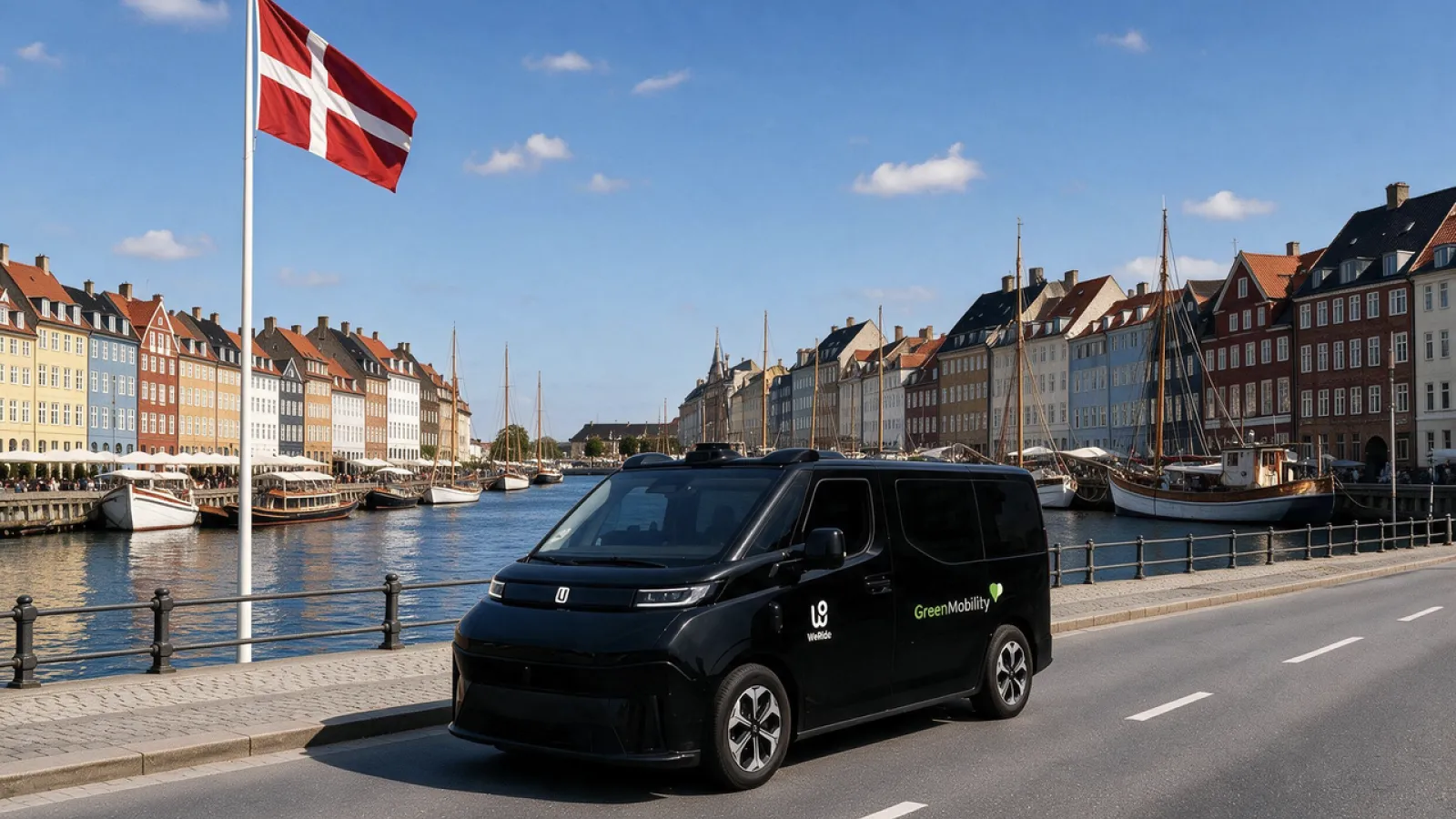
WeRide, the Nasdaq- and Hong Kong-listed autonomous driving company, and GreenMobility, Denmark's dominant shared electric vehicle operator, have announced a strategic partnership to deploy Level 4 self-driving mobility services in Copenhagen. The tie-up marks WeRide's entry into the Nordic region and adds Denmark as its sixth European market, following recent footholds in Spain and Slovakia.
Under the agreement, the two companies plan to launch a public ride service in the first half of 2027. Passengers will be able to hail rides fulfilled by the GXR, WeRide's latest EU-compliant fully autonomous vehicle. The service will operate subject to regulatory sign-off from the Danish Road Directorate and the Danish Road Traffic Authority, and must comply with both Danish national and EU-level regulations.
An asset-light model scales across borders
WeRide's European push is built on a deliberate asset-light framework: rather than owning and operating local fleets outright, it embeds its Level 4 software and hardware stack into established local fleet operators. GreenMobility, which runs the largest free-floating car-share network in the Nordic region with over 1,500 electric vehicles across Copenhagen and Aarhus, provides exactly the operational infrastructure WeRide needs to avoid heavy capital outlay in each new market.
Tony Han, WeRide's founder and CEO, described Denmark as "another important milestone in our European expansion," adding that the partnership aims to establish "a scalable model for deploying autonomous mobility in new international markets." For GreenMobility's part, group CEO Kasper Gjedsted framed the deal as a natural evolution: "This partnership lets us take that experience directly into our next growth phase in autonomous mobility."
WeRide's global footprint now spans more than 40 cities across 12 countries, backed by autonomous driving permits in eight of those and a fleet exceeding 3,000 Level 4 vehicles. The choice of Denmark as the Nordic entry point is deliberate: the country combines high EV adoption rates, a mature digital infrastructure, and a regulatory environment that has been relatively receptive to smart mobility pilots.
The convergence case: electrification, autonomy and urban infrastructure
This partnership sits at the intersection of three converging forces that cross-sector investors are tracking closely. First, the electrification of urban mobility is well advanced in Denmark, which removes the drivetrain complexity that has slowed AV deployment in markets still dominated by combustion vehicles. Second, the regulatory architecture for Level 4 autonomy is maturing across Europe faster than in some other major jurisdictions, creating a window for commercially viable deployments before the rules tighten or fragment. Third, the asset-light partnership model WeRide is deploying mirrors the franchise-style expansion logic that platform businesses have used to scale across geographies without proportional balance-sheet growth.
For capital allocators, the story raises a broader question about where the autonomous vehicle sector's value will ultimately accrue. The hardware-software platform providers, such as WeRide, are betting that the software stack and the permitting portfolio are the durable moats, while fleet operators like GreenMobility provide local density and regulatory relationships. Whether that division of value holds as the technology matures and more incumbents build or acquire their own AV capability is the central strategic tension in the space.
The Nordic region also carries a geopolitical dimension. As European regulators and sovereign capital seek to reduce dependence on US and Chinese technology platforms in critical infrastructure, an AV deployment backed by a Chinese-founded, US-listed company entering a Scandinavian market will invite scrutiny. How Danish and EU authorities assess that question as the service moves from pilot to commercial scale may shape the regulatory template for AV market access across the bloc more broadly.