
Carbon market value climbs as quality premium reshapes buyer strategy
The voluntary carbon market is splitting along a quality fault line. Sylvera, the independent carbon ratings and data provider, published its Q2 2026 Carbon Market Data Snapshot this week, revealing a market where shrinking volume and rising value are telling two very different stories about where corporate climate strategy is heading.
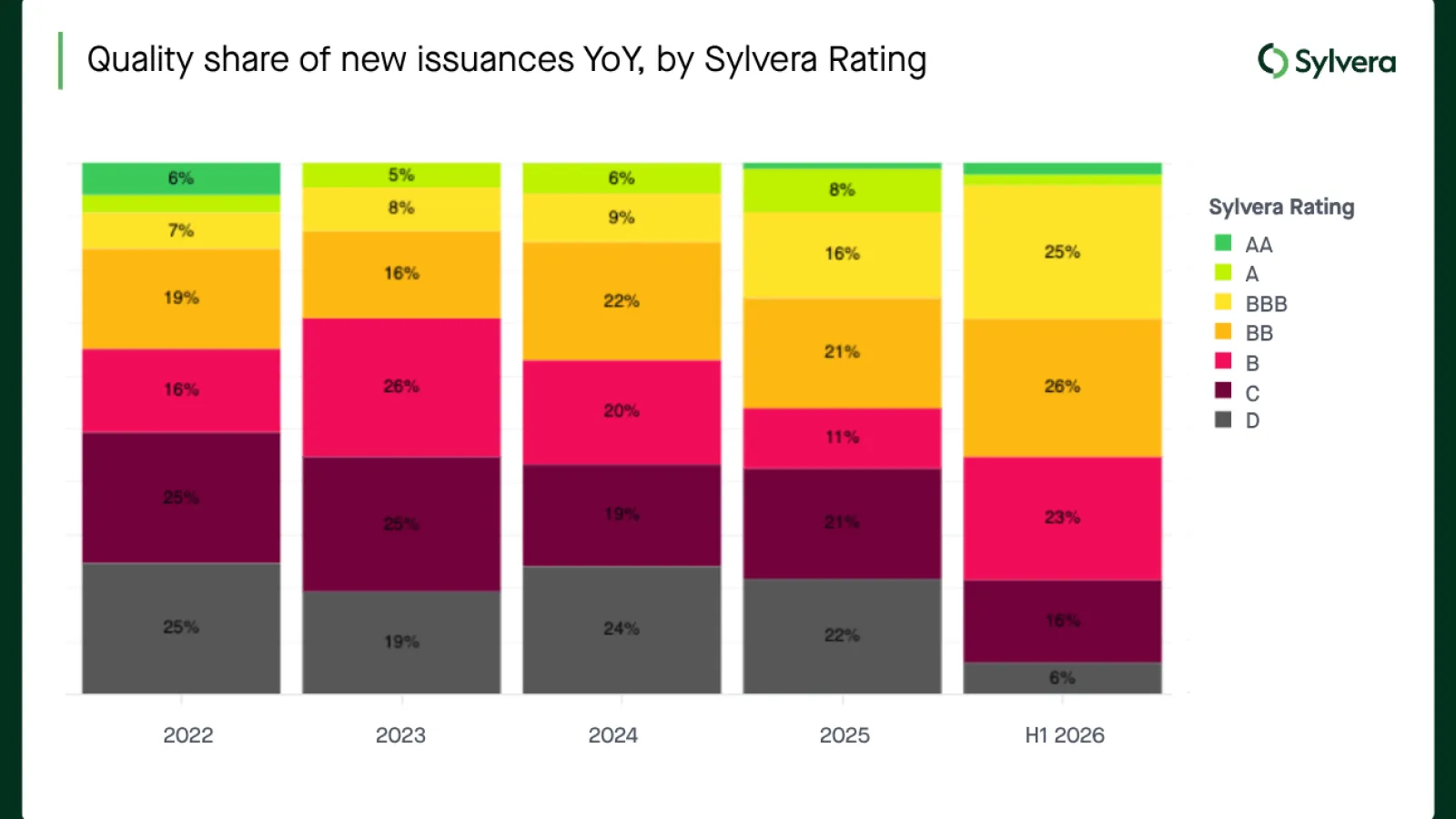
Carbon credit retirements fell 10% year on year to 38.55 million in Q2 2026, yet total retirement market value rose from $227 million to $247 million over the same period. The average price per retired credit climbed 21% to $6.41. Investment-grade credits (rated BBB or above) accounted for just 27% of rated retirement volume but captured 51% of rated market value. The market is not contracting uniformly; it is sorting.
Shell's exit and Microsoft's pullback reshape the landscape
Two dominant buyers pulling back explains much of the headline volatility. Shell, historically the market's largest retiree, retired just 494,100 tonnes in H1 2026 against 6.7 million in H1 2025. That single shift accounts for roughly two-thirds of the entire market's year-on-year retirement decline. In the forward offtake market, Microsoft's announced volumes fell 82% to 9.52 million tonnes, dragging headline offtake figures down 65% to 21.52 million tonnes for H1 2026.
Strip both out, however, and the picture is notably different. Non-Microsoft offtake volume rose 73% year on year to 12 million tonnes, and Woodside emerged as the second-largest offtaker at 6 million tonnes. The market's buyer base is broadening even as its two most prominent names step back.
Biochar is the standout growth story. Forward offtake volume rose 79% to 3.17 million tonnes, with value up 80% to $806 million. Biochar now represents around 15% of offtake volume but 36% of offtake value, a premium that reflects both perceived durability and scarcity of verified high-grade supply.
CORSIA supply crunch and the SBTi demand signal
Two structural forces are set to reshape carbon market capital flows well beyond 2026. The first is CORSIA, aviation's compliance offsetting scheme. CORSIA-aligned credits now represent 64% of new issuances in Q2 2026, up from 52% across 2025. But Sylvera's analysis finds that of roughly 300 million potentially eligible credits issued to date, only 38 million have cleared both hurdles required to become Eligible Emissions Units: a host-country Letter of Authorisation and either a corresponding adjustment or qualifying insurance. Against a base-case demand estimate of 163 million EEUs by the January 2028 compliance deadline, current supply covers around 23%. Sylvera's modelling places the median EEU price at $33, with a range of $15 to $53 depending on supply and demand outcomes. The European Commission's CORSIA review, due this month, could cut demand by as much as 24% if intra-European Economic Area flights revert to the EU Emissions Trading Scheme.
The second force is the SBTi Corporate Net-Zero Standard V2, released in Q2, which formally recognises carbon credits for the first time. Sylvera estimates that 11,000 SBTi-aligned companies, covering approximately 34.5 billion tonnes of Scope 1-3 emissions, retired just 20 million credits in the past year. That represents 0.06% of their aggregate footprint, against a 1% Engaged-status threshold. Even a moderate compliance scenario pushes SBTi-aligned demand to 55 million tonnes by 2030 and 293 million by 2035.
For cross-sector strategists, the convergence here is significant. Carbon credit integrity is becoming a due-diligence input for institutional capital, not merely a sustainability reporting footnote. As the SBTi standard embeds credit quality requirements into corporate net-zero frameworks, ratings infrastructure of the kind Sylvera provides begins to function more like fixed-income credit ratings: a prerequisite for any serious transaction. Sovereign wealth funds and infrastructure investors allocating into energy transition assets will increasingly need carbon data to price residual emissions exposure in their portfolios. The voluntary market's shift toward compliance-grade supply is, in effect, a financialisation of carbon integrity, and that process is still in its early stages.