
NEOPAY and Deem Finance link payments data to SME credit in UAE
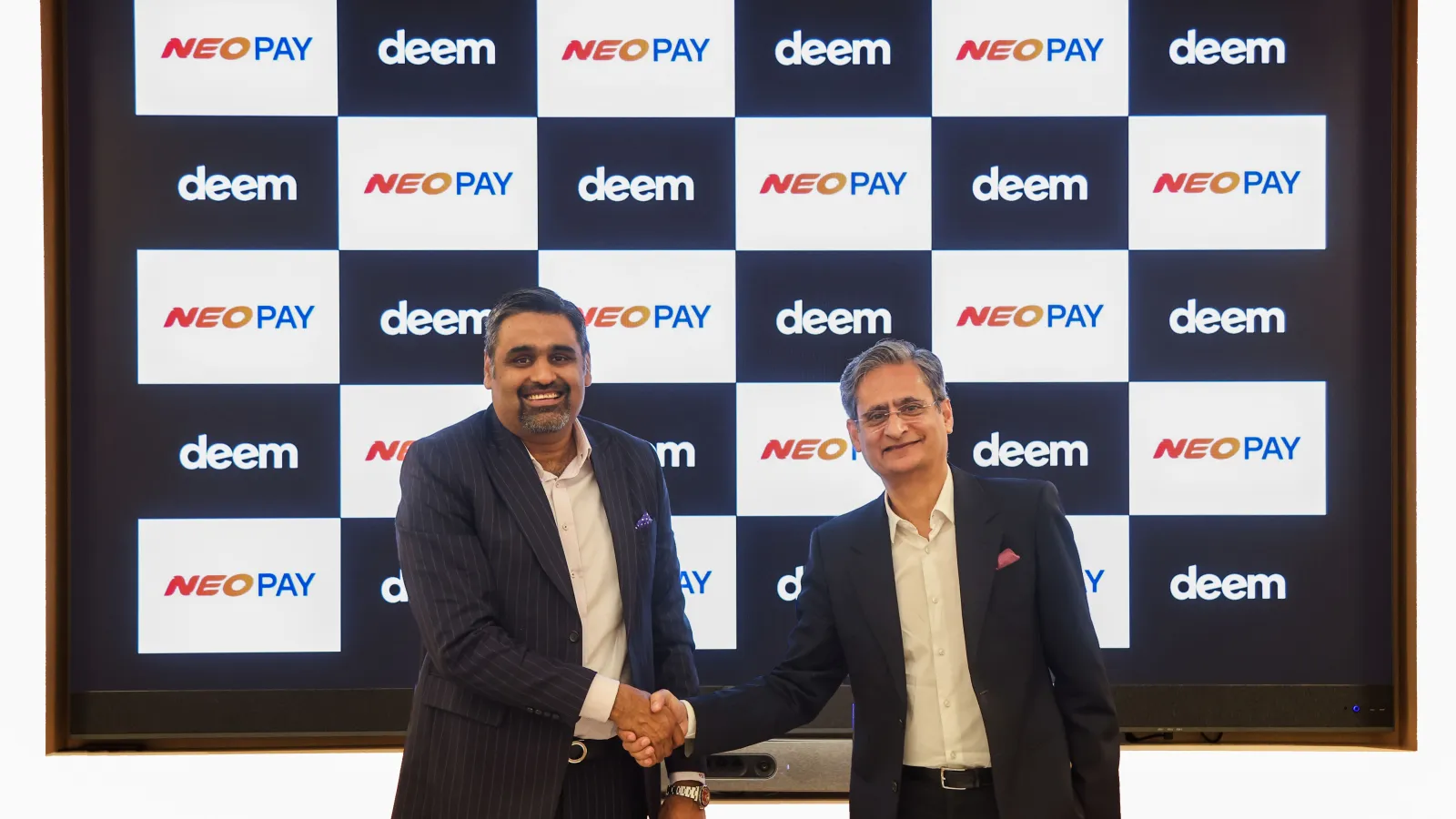
NEOPAY, one of the UAE's largest digital payments processors, and Deem Finance, a Central Bank of the UAE-regulated lender, have formalised a partnership designed to close the working-capital gap facing small and medium-sized businesses across the Emirates. The collaboration places NEOPAY's embedded lending platform at the centre: merchant payment and point-of-sale transaction data is used to generate pre-qualified financing offers, surfaced directly inside the merchant's digital interface, without requiring a separate loan application or institution.
The model belongs to a fast-maturing category sometimes called merchant cash advance or revenue-based lending, in which a borrower's actual transaction record replaces or supplements traditional credit-scoring. What distinguishes this deal is the regulatory wrapper: Deem Finance's Central Bank licence means that the speed and data-driven convenience of embedded finance is paired with the governance standards of a supervised lender, including mandated customer-protection rules.
Embedded finance meets regulated credit
For UAE merchants, the practical effect is a compressed lending journey. Where a traditional SME loan might require audited accounts, collateral valuations and weeks of processing, NEOPAY's platform compresses pre-qualification to the moment a merchant checks their dashboard. Zulfiqar Hamid, Interim CEO of Deem Finance, said the tie-up allows the firm to "use alternative transaction data and digital journeys to support SMEs with faster and more relevant working capital solutions, while maintaining governance, transparency and customer protection standards expected from a regulated lender."
The size of the financing gap the partnership is targeting is significant. The UAE government has repeatedly cited SME access to credit as a structural bottleneck in its broader push toward a diversified, entrepreneurship-led economy. SMEs account for roughly 94 per cent of businesses operating in the country, yet have historically been underserved by conventional bank lending, partly because short trading histories make credit assessment difficult. Transaction-data lending directly addresses that asymmetry.
Convergence implications beyond the UAE
The NEOPAY-Deem deal is a localised expression of a global structural shift: the progressive collapse of the boundary between payments infrastructure and credit provision. Globally, the same logic is playing out at much larger scale. Stripe Capital, Shopify Capital and Square Loans have demonstrated that payments rails, when enriched with real-time merchant data, become a more accurate underwriting signal than balance-sheet snapshots. The difference in the UAE context is the regulatory architecture: the Central Bank's framework imposes oversight obligations that marketplace lenders in less regulated jurisdictions do not face, which raises the compliance bar but also potentially the institutional trust ceiling for merchants operating across Gulf Cooperation Council markets.
For cross-sector investors watching the GCC, the deal sits within a wider theme of Gulf states using fintech regulation as a sovereign competitiveness tool. The UAE's approach, licensing specialist digital lenders alongside incumbents rather than restricting the category, is deliberately designed to attract embedded-finance infrastructure investment. NEOPAY itself is backed by Arcapita, a Bahrain-headquartered alternative asset manager with a broad GCC footprint, and Dgpays, a Turkish payments technology group, giving the platform a regional distribution reach that extends well beyond Dubai.
The second-order read-across is for retail and hospitality operators across the Gulf. NEOPAY already serves merchants in retail, e-commerce, hospitality and the public sector. As embedded working capital becomes a standard feature of payments acceptance rather than a separately procured product, the competitive calculus for payment processors shifts: the ability to offer credit directly inside the merchant interface becomes a retention lever as meaningful as settlement speed or interchange economics. Rivals without a regulated lending partner, or without the transaction-data density to power pre-qualification, face a structural disadvantage as this model scales.