
Paystack and Shoprite race to own Africa's full payments stack
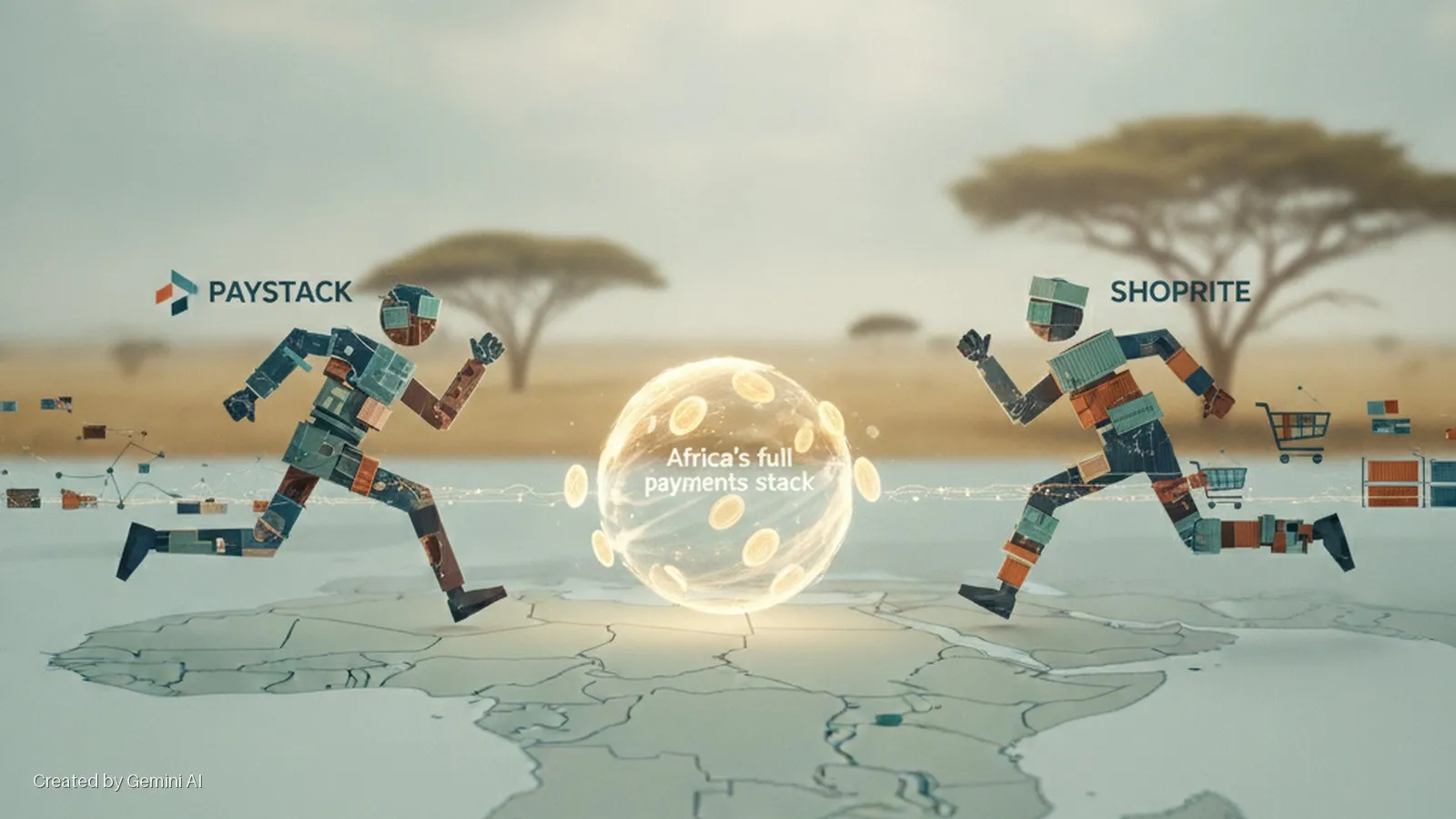
Paystack, the Stripe-owned Nigerian payments processor, and South African retail behemoth Shoprite have each made separate but strategically identical moves in the same week: buying their way out of reliance on third-party payment infrastructure. Taken together, the two acquisitions mark a structural inflection in how African commerce is being built, from the township spaza shop counter all the way up to the cloud-hosted digital ledger.
Shoprite, which already generates over $85 million annually in financial service commissions, acquired a controlling 51% stake in R&A Cellular, a distributor of handheld point-of-sale terminals widely used by informal township merchants across South Africa. The target market is not trivial: South Africa's informal township economy is estimated to move between $46 billion and $61 billion per year, the vast majority of it in cash transactions that never enter a formal retail channel. Rather than attempting to persuade merchants to adopt new hardware, Shoprite acquired the distribution network already sitting on their counters, one already trusted for airtime top-ups, electricity tokens, and bill payments.
Software meets hardware: the same playbook, different stack layer
Simultaneously, Paystack acquired Allawee, a corporate card-issuing startup, plugging its card-generation and ledger engine directly into Paystack Microfinance Bank and its consumer-facing Zap app. Building a standalone card-issuing business in Africa is structurally punishing: customer acquisition costs are high, margins are thin, and dependence on sponsor banks introduces chronic downtime risk. By internalising Allawee's infrastructure, Paystack now controls card issuance, the underlying ledger, deposit-holding, and transaction processing under a single roof. The middleware layer has been eliminated.
The strategic logic running through both deals is identical. Third-party payment rails, whether physical POS distributors or software-layer card issuers, represent chokepoints: they create margin leakage, reliability risk, and, critically, limit the data visibility that comes from owning the full transaction journey. Both Paystack and Shoprite have concluded that processing payments is insufficient. Controlling the entire pipeline, from the point of origination to settlement, is the only defensible position.
Cross-sector and capital implications
For investors and strategists watching African fintech, the week's moves signal a maturation phase that mirrors patterns seen earlier in Latin American super-app consolidation and Southeast Asian e-commerce-to-fintech integration. The $2.10 billion raised by African tech startups in the first eight months of 2026 reflects sustained capital confidence in the continent's digital infrastructure buildout, but the Paystack and Shoprite moves suggest that the next competitive layer is no longer about scale, it is about vertical ownership.
The convergence angle extends beyond Africa's borders. Shoprite's township POS acquisition is essentially an internet-of-things play: a network of connected terminals generating real-time transaction data from informal retail segments that have historically been invisible to formal financial systems. That data has underwriting value, credit-scoring value, and supply-chain value that extends well beyond simple payments processing. As formal and informal economies converge on a single connected infrastructure layer, the asset being accumulated is not market share in payments. It is the data pipe into the most underpenetrated consumer segment on the continent.
Meanwhile, the broader African fintech ecosystem is seeing parallel vertical-integration moves: Kotani Pay and DCSPay are linking stablecoin payout rails, Capitec has listed its business division on the A2X exchange, and Egypt's Central Bank-backed POS rollout drove a reported 60% surge in merchant transaction volumes in 2025. The race to own the full stack is not a Paystack and Shoprite story alone. It is the defining competitive dynamic of African fintech in 2026.