
Hatch and Maaden forge critical minerals pact in Canada-Saudi push
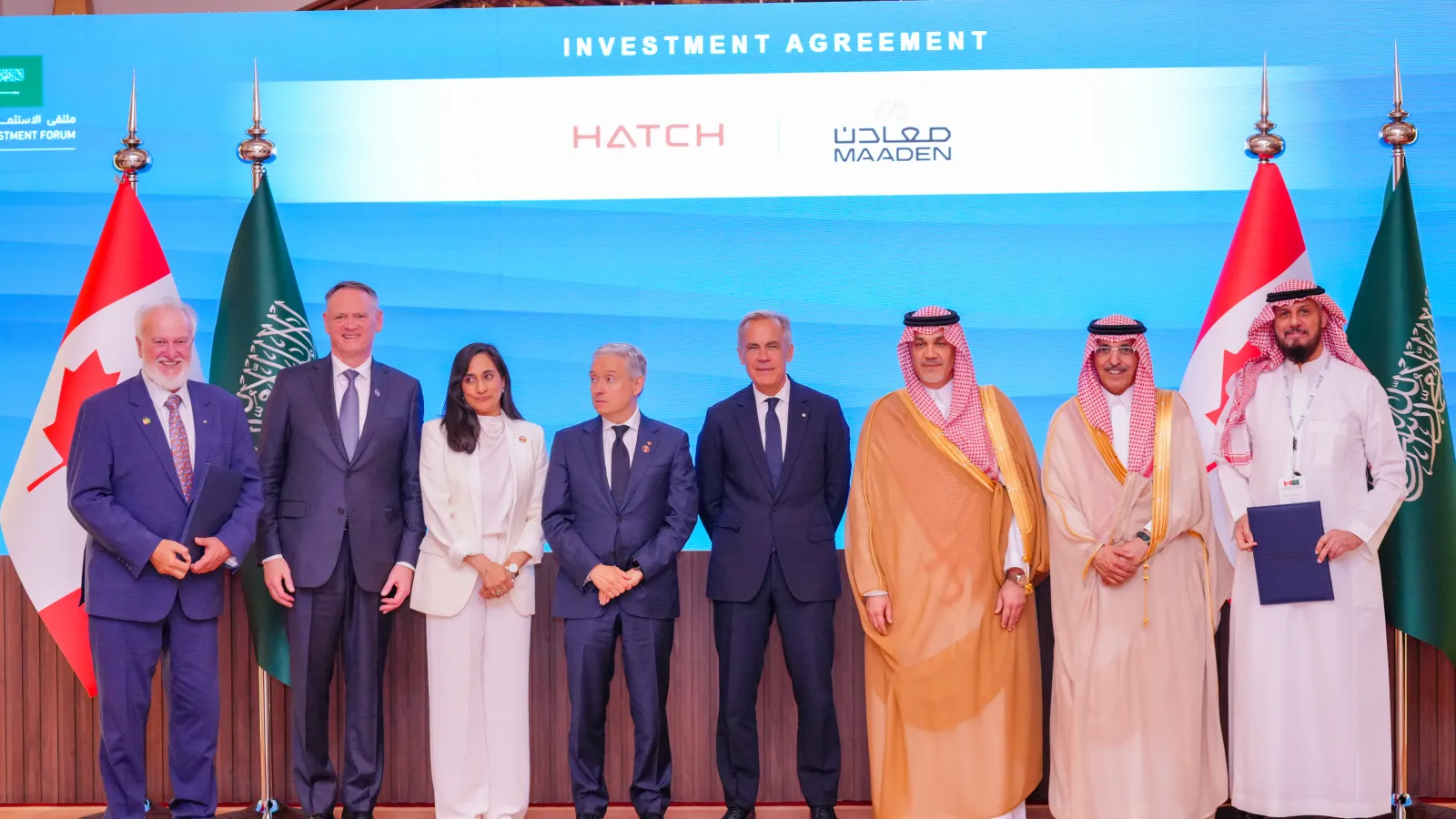
Canadian engineering and project delivery firm Hatch has signed a strategic delivery partnership agreement with Maaden, the Saudi Arabian Mining Company, positioning the Canadian firm as the primary execution partner for what is described as one of the largest mining growth programmes currently under development anywhere in the world. The signing, held in Jeddah on 13 July 2026, was attended by Canadian Prime Minister Mark Carney alongside senior ministers from both countries, signalling that this is as much a diplomatic inflection point as it is a commercial contract.
The agreement formalises a memorandum of understanding signed in January 2026 at the Future Minerals Forum in Riyadh. Hatch will deploy its global network of engineers and project specialists, with a significant portion of the capability base drawn from Canada, across Maaden's pipeline of projects spanning gold, phosphate, aluminium, alumina, and other metals. The company says it has worked with Maaden for more than three decades, giving it an unusual depth of institutional knowledge across the Kingdom's extractive and processing landscape.
Critical minerals, strategic geometry
The story is not, at its core, about a single engineering contract. It sits inside a rapidly consolidating global race to secure the upstream and midstream of the critical minerals supply chain that feeds energy transition technologies, advanced battery manufacturing, and defence-grade materials. Saudi Arabia, through Maaden and the broader Vision 2030 industrial agenda, is positioning itself as a swing producer in that supply chain, moving beyond hydrocarbon dependence by monetising its substantial mineral endowments in phosphate, bauxite, and base metals.
Canada's role here is instructive. The country has long been recognised for raw extraction, but this partnership explicitly frames Canadian value-add as the engineering, metallurgy, processing, and technology layers that sit above the mine mouth. Hatch chief executive John Bianchini made the point directly: "Canada is recognised internationally for its natural resources, but equally important is the means in which we transform mineral resources into the critical materials needed for modern economies." That framing matters for the bilateral relationship, as Canada seeks to diversify its economic partnerships at a moment when US trade policy remains unsettled.
Workforce, capital, and the convergence angle
A further dimension of the agreement is its explicit workforce development mandate. The partnership commits both parties to building the Saudi talent base needed to sustain a globally competitive metals sector over the long term, embedding capability rather than simply importing it. That focus on in-Kingdom human capital aligns closely with the localisation targets embedded in Saudi Arabia's Vision 2030 framework and reflects a broader pattern across Gulf industrial partnerships: foreign expertise is welcome, but technology and skills transfer is increasingly a contractual condition rather than an afterthought.
For cross-sector investors, the macro read-across is significant. Critical minerals have become a chokepoint across multiple technology verticals simultaneously: electric vehicle battery supply chains, grid-scale energy storage, semiconductor substrates, and defence procurement all compete for the same upstream material flows. Any large-scale expansion of Gulf mining and processing capacity therefore has compounding downstream effects on sectors far removed from the mine site itself. Sovereign wealth flows in the region have already begun to reflect this logic, with Gulf states looking to convert hydrocarbon revenues into stakes in the material foundations of the next industrial era. Hatch's role as delivery partner, rather than a passive contractor, suggests Maaden is betting on embedded expertise as the mechanism to compress project timelines and reduce execution risk on a programme of this scale. How quickly the pipeline converts to producing assets will be closely watched by the energy-transition investment community tracking Gulf industrial capacity.