
HII's Ingalls hosts Navy commission amid US shipbuilding capacity review
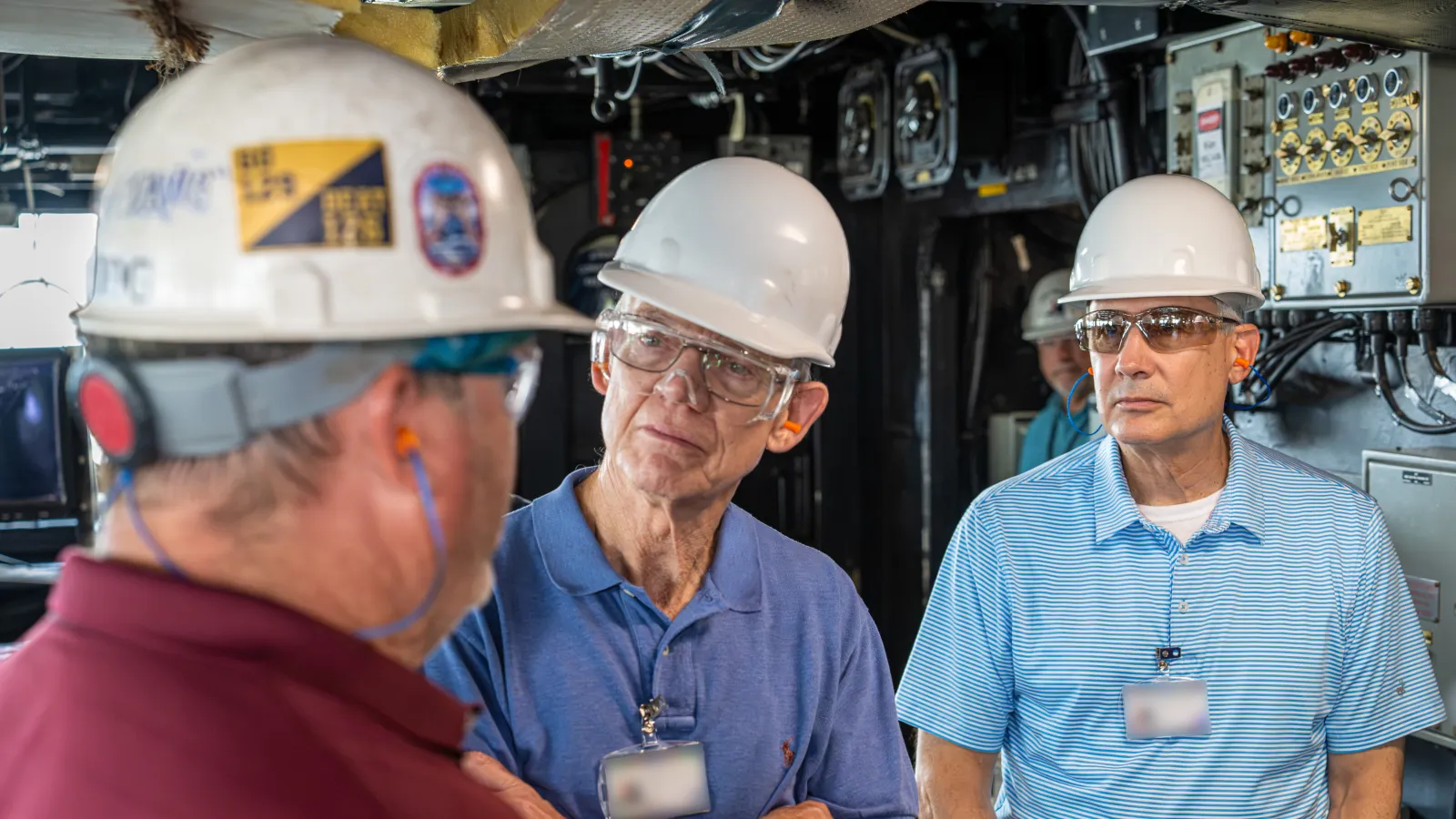
HII's Ingalls Shipbuilding division in Pascagoula, Mississippi, hosted members of the National Commission on the Future of the Navy (FNC) this week, offering the independent review body a ground-level assessment of the shipyard's production scale, workforce capability, and infrastructure investments. The visit is part of the commission's nationwide tour to shape recommendations on US seapower ahead of initial findings expected in January 2027.
With 13 vessels currently in active construction and three deliveries scheduled within the next twelve months, Ingalls represents one of the most significant nodes in the US maritime industrial base. Commission members toured the Flight III Arleigh Burke-class destroyer Jeremiah Denton (DDG 129), a Virtual Reality Welding Lab, and a Maritime Training Academy, areas that illustrate both the pace of current output and the investments being made in next-generation production techniques.
Industrial base under the microscope
Commissioner Mitch Waldman framed the visit in terms that go well beyond procurement. "A strong Navy relies on a capable and resilient industrial base," he said. "We are grateful for the opportunity to see firsthand the significant industrial capacity and workforce capability that Ingalls Shipbuilding provides as the commission continues to assess the nation's ability to design, build and sustain the future Navy."
Congress established the FNC precisely because questions about that ability have become uncomfortable. Public hearings began in March 2026, and the commission's scope covers naval force structure, shipbuilding performance, and industrial-base requirements in full. The visit to Ingalls, HII's surface-combatant yard, distinct from its nuclear-submarine work at Newport News, signals that destroyer production throughput and workforce depth are among the variables under sharpest scrutiny.
Eric Crooker, Ingalls' vice president of programme management, pointed to the yard's 87-year track record and its distributed shipbuilding programme as evidence of structural capacity rather than short-term surge. The distributed model, which parcels fabrication work across supplier tiers, has become a recurring theme in US naval industrial strategy as the service weighs how to expand output without bottlenecking at a handful of major yards.
Convergence of workforce, automation, and defence procurement
The Ingalls visit carries implications that extend beyond a single shipyard's order book. The broader context is a bipartisan consensus, visible across multiple congressional cycles, that the US defence-industrial base, covering not just shipbuilding but munitions, armoured vehicles, and hypersonic components, has been structurally under-invested relative to peer-competitor production capacity. The FNC's mandate puts naval shipbuilding at the centre of that debate, but its findings will set a precedent for how Congress and the Pentagon think about industrial-base sufficiency across all major platform categories.
There is a technology dimension here too. HII has publicly positioned Ingalls as a testbed for advanced digital and automated production methods, including AI-assisted quality inspection and augmented-reality-guided assembly. The VR Welding Lab shown to commissioners is part of that narrative: if the yard can demonstrate that technology-enabled training compresses the time to produce a skilled welder, it addresses one of the most acute constraints on scaling output, the human workforce. Shipbuilding is among the last major industries where certified manual craft skills remain largely irreplaceable by robotics at scale, making workforce development infrastructure a genuine bottleneck rather than a talking point.
For capital allocators watching the defence-industrial landscape, the commission's eventual recommendations will matter. A report that quantifies a structural shortfall in US naval production capacity would likely translate into multi-year authorisation language, accelerated procurement timelines, and expanded industrial-base investment accounts, all of which flow directly to primes such as HII and to a tiered supplier ecosystem that spans steel, electronics, and specialised coatings. The January 2027 publication date gives investors and procurement strategists a firm horizon to watch.