
Greece's Hellenic Fire System captures first thermal image from orbit
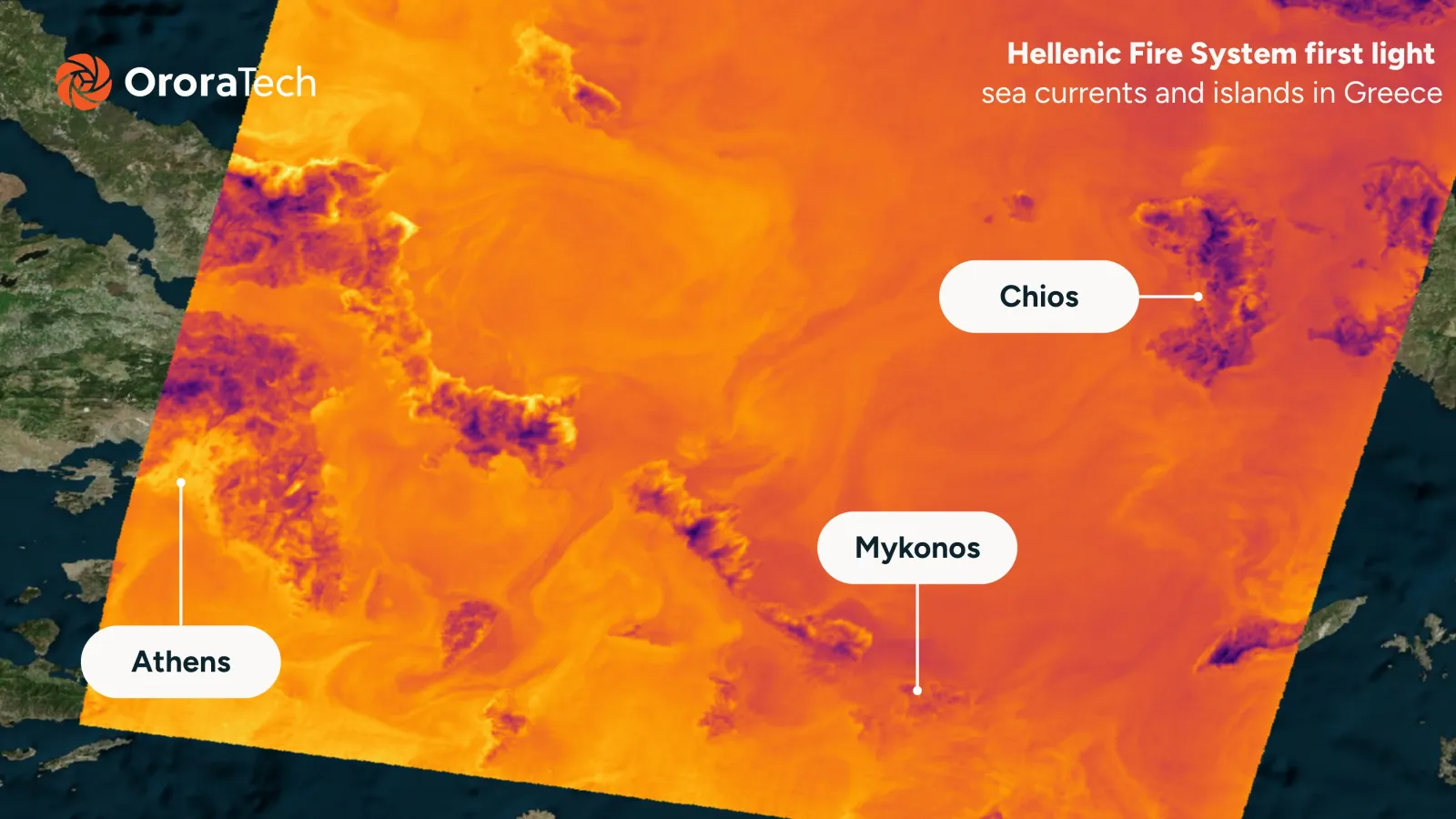
OroraTech, the Munich-headquartered thermal intelligence company, has confirmed that its Hellenic Fire System achieved first light over Greece less than one month after satellite launch, capturing the thermal signature of the Athens metropolitan area and a sweep of Aegean islands including Chios, Skyros, and Andros. The milestone, delivered under a European Space Agency contract and funded through the EU's NextGenerationEU recovery programme, marks the first operational demonstration of a nationally sovereign space-based wildfire monitoring system on European soil.
The speed of delivery is notable. Two weeks of imaging calibration preceded the imagery capture, meaning the sensor was producing calibrated thermal data within roughly a fortnight of commissioning. For a low Earth orbit thermal constellation, that is a compressed timeline, and it signals that OroraTech's engineering pipeline is maturing beyond prototype status into reliable operational deployment.
Satellite meets climate resilience
Once the constellation is fully operational, it will scan the entirety of Greece twice daily, delivering continuous thermal monitoring that feeds wildfire detection algorithms, emergency response coordination, and climate science across the wider Mediterranean basin. The Hellenic Ministry of Digital Governance and Artificial Intelligence is the implementing body, an unusual pairing of institutional titles that reflects the increasingly blurred boundary between climate infrastructure and digital sovereignty infrastructure in European policy.
The system's ability to observe both terrestrial and maritime thermal phenomena adds a secondary capability beyond wildfire detection. Sea-surface temperature anomalies, atmospheric convection over the Aegean, and land surface temperature datasets are all byproducts of the mission, creating a scientific data commons that researchers studying Mediterranean environmental change will be able to draw on.
"We have spent years refining thermal sensing systems that deliver both unmatched image quality and operational performance," said Martin Langer, OroraTech's CEO. "This milestone shows our ability to rapidly bring sophisticated space assets into service while providing the high-quality thermal data needed for wildfire detection, environmental monitoring, and scientific research."
The convergence angle: climate risk, digital sovereignty, and EU capital
This project sits squarely at the intersection of three macro trends that cross-sector investors and geopolitical risk analysts are tracking closely. First, there is the broader European push toward space-based climate infrastructure. As extreme heat events intensify across the Mediterranean, the economics of real-time orbital monitoring are shifting from scientific luxury to critical national infrastructure. Greece's decision to anchor this system in its National Recovery and Resilience Plan is a signal that sovereign climate-risk monitoring is becoming a line item in EU fiscal policy, not just a research grant.
Second, the funding mechanism itself is instructive. NextGenerationEU's Recovery and Resilience Facility is routing capital into space assets via national digital governance ministries. That channel, somewhere between defence procurement and green infrastructure spend, is relatively new and increasingly attractive to dual-use space operators looking for stable sovereign offtake.
Third, OroraTech's intelligence-as-a-service model positions the company at the commercial intersection of satellite operations and data analytics, a convergence that is drawing growing attention from climate-tech investors and infrastructure funds alike. The company operates across six geographies, including the US, Australia, Brazil, and Canada, and its Wildfire Solution platform is designed to scale horizontally across any jurisdiction facing elevated fire risk. For capital allocators weighing exposure to climate adaptation infrastructure, sovereign-contracted orbital data services represent a relatively de-risked entry point compared with physical climate-resilience assets on the ground.
The broader competitive landscape for thermal satellite intelligence is still forming. OroraTech's ability to demonstrate rapid commissioning under an ESA contract strengthens its position as a preferred operator for similar national programmes across southern Europe, North Africa, and the Gulf, regions where wildfire and extreme heat risk is rising fastest and where sovereign appetite for space-based situational awareness is growing accordingly.