
Firefly Aerospace wins $144m NASA contract for rapid Moon return
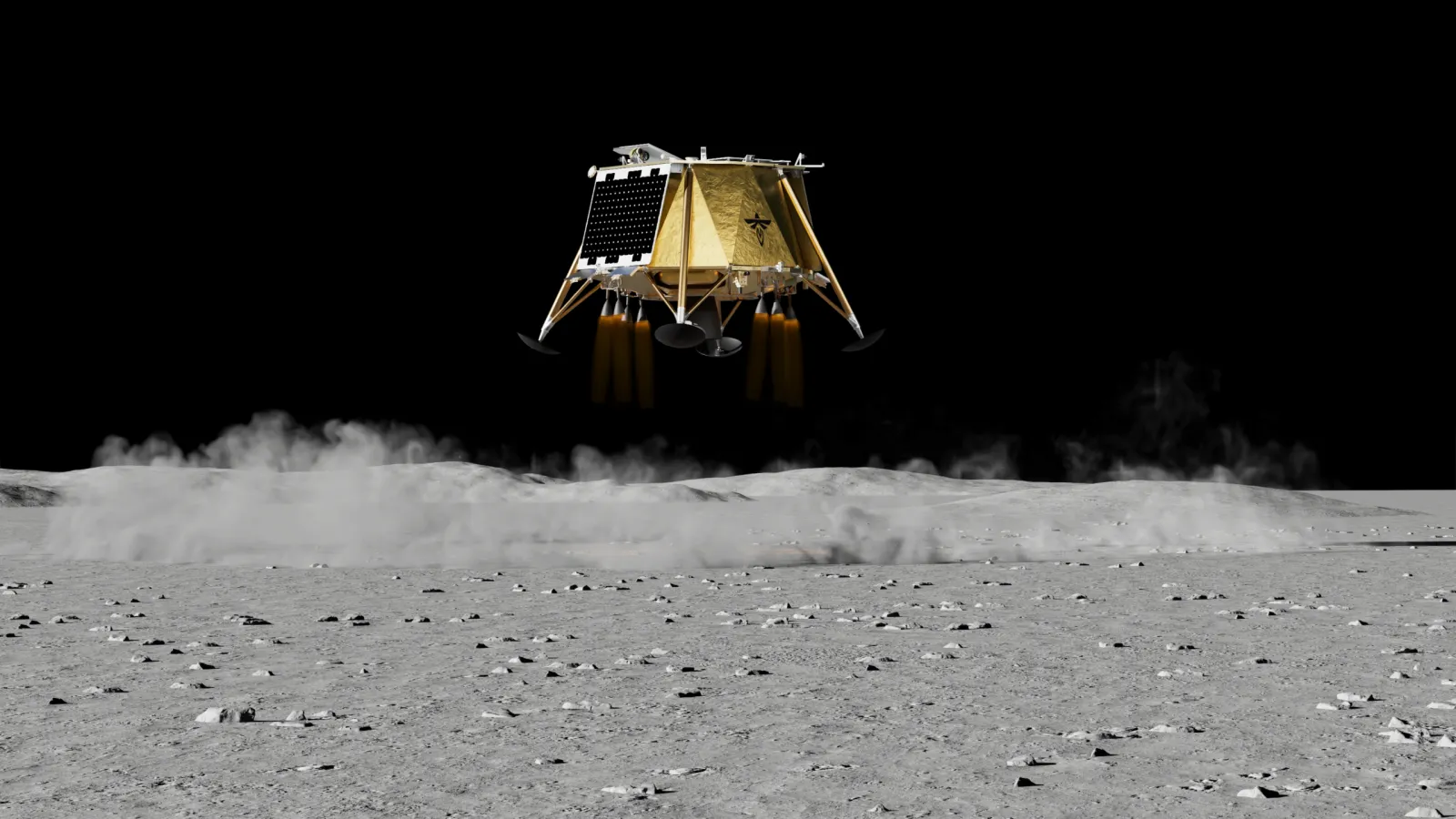
Firefly Aerospace, the Cedar Park, Texas-based space and defence company listed on Nasdaq under the ticker FLY, has secured a $144 million NASA Commercial Lunar Payload Services (CLPS) contract to deliver a second Blue Ghost lunar lander mission to the Moon's near side by 2028. The contract is the company's sixth lunar mission award to date, and the headline figure is the speed: Firefly says it will complete the mission in roughly two years, approximately half the time taken by its first successful Blue Ghost landing earlier this year.
The deal is not simply another government cheque for a rocket firm. It is a proof-of-concept for the industrialisation of lunar logistics, a model in which a commercial operator reuses a proven lander design, amortises engineering cost across multiple missions per year, and competes on delivery cadence rather than on novelty of hardware. That model, if it holds, has significant implications for who controls access to the lunar surface and at what price.
Templating the Moon run
The key operational shift Firefly is executing is what its VP of Spacecraft, Ray Allensworth, describes as a "build-to-print" approach: standardising the Blue Ghost lander architecture so that production cycles accelerate without a full redesign between missions. Flight telemetry from Mission 1 is being fed back into optimised thermal systems and refined operational procedures, effectively turning each landing into an R&D dataset for the next. The company says it is already planning missions to the Moon's far side, the Gruithuisen Domes, and the lunar south pole, with its Elytra orbital vehicle also contracted to carry NASA's MoonFall drone deployment above the south pole.
The three science instruments aboard this latest mission, a laser retroreflector array for precision ranging, a radiation spectrometer, and stereo cameras to study plume-surface interactions on touchdown, are relatively modest payloads. Their scientific value is secondary to the mission's strategic purpose: demonstrating repeatable, rapid, reliable access at a known cost. Jason Kim, Firefly's CEO, put it directly: "With amplified demand signal from NASA and commercial customers, Firefly extended our growth strategy from one annual Moon landing to multiple a year."
The convergence angle: lunar logistics meets capital allocation
The broader significance for cross-sector investors and geopolitical risk analysts sits in what "repeatable lunar access" unlocks downstream. NASA's Artemis programme and its Moon Base initiative are predicated on a supply-chain logic that mirrors terrestrial infrastructure development: establish reliable, cost-competitive logistics first, then layer in scientific, commercial, and eventually resource-extraction operations. Firefly's cadence play positions it as a potential Tier 1 supplier in that supply chain.
For capital allocators, the CLPS contract structure itself is noteworthy. NASA's CLPS programme is explicitly a commercial procurement model, spreading mission risk across multiple vendors (Astrobotic and Intuitive Machines are the other primary awardees) rather than concentrating it in a single prime contractor. That distributed architecture mirrors sovereign-wealth and institutional-capital strategies in deep tech: back multiple operators, let execution separate the field. Firefly's publicly listed status on Nasdaq gives institutional investors a direct instrument to track whether the build-to-print thesis converts into margin improvement across successive missions.
The lunar economy also has a material intersection with the energy and sustainability sectors that is rarely foregrounded. Lunar south pole missions, including several in Firefly's pipeline, are partly motivated by water-ice prospecting: ice that could be converted to rocket propellant in-orbit, dramatically reducing the cost of deep-space missions and potentially reshaping the economics of the entire cislunar transport layer. That makes Firefly's production cadence a variable not just for space investors, but for anyone modelling long-run space-energy infrastructure.
The 2028 launch target carries execution risk, the forward-looking disclaimer in the release is extensive, and the two-year timeline will be the first real test of whether the build-to-print model survives contact with a compressed schedule. The next meaningful data point will be Firefly's progress review milestones under the NASA contract, expected to be publicly reported through its SEC filings as a listed entity.