
Azizi and Dubai Islamic Bank tie up on UAE green real estate finance
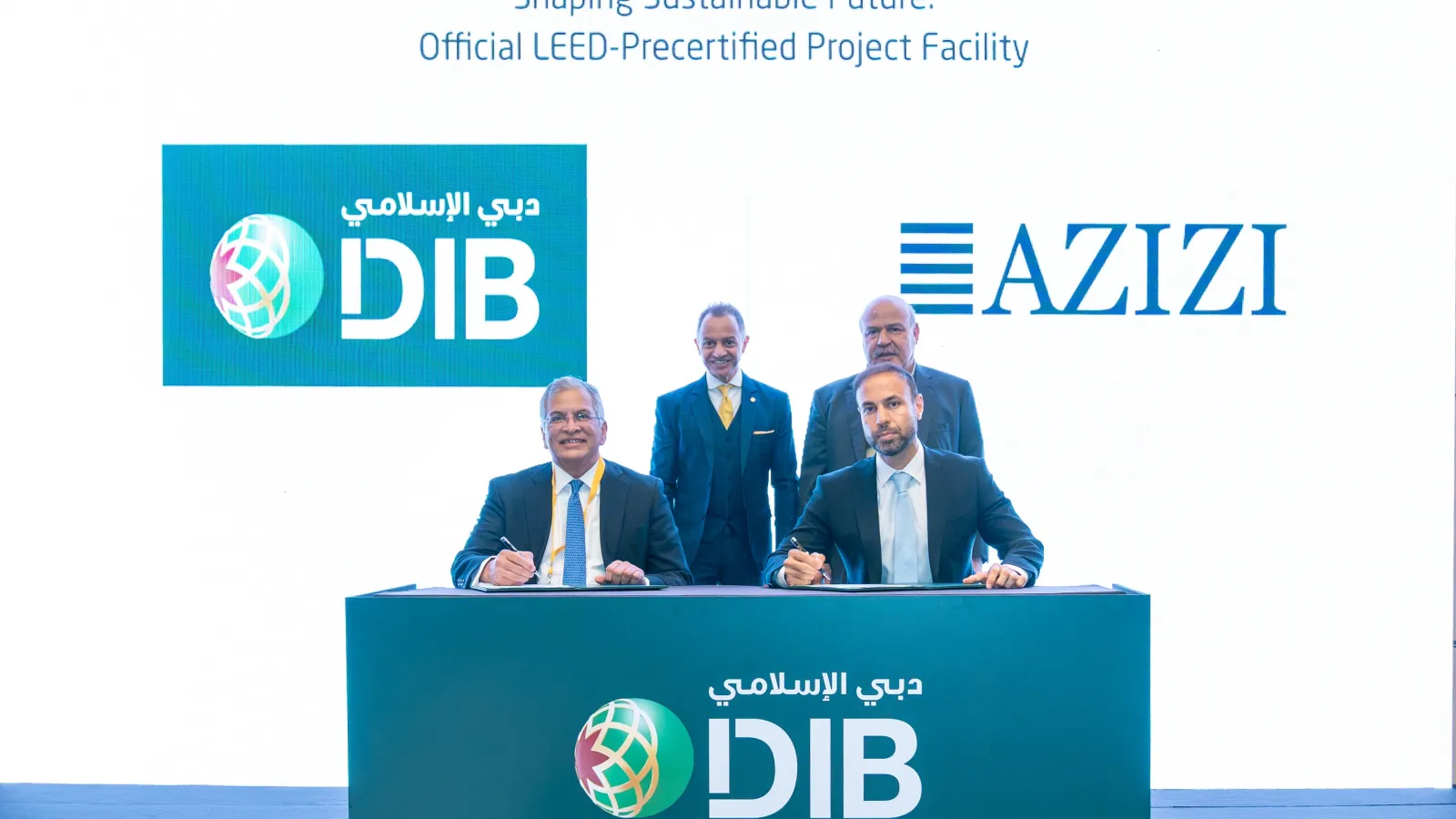
Azizi Developments, one of Dubai's largest private developers, has signed a sustainable financing agreement with Dubai Islamic Bank (DIB), formalised at the bank's inaugural real estate sustainability roundtable in late June. The deal positions both institutions at the intersection of Islamic finance, green capital, and the UAE's breakneck built-environment expansion, a convergence that is beginning to attract attention well beyond the Gulf's property sector.
The agreement was executed by Farhad Azizi, Group CEO of Azizi Developments, and Naveed Ali, Executive Vice President and Head of Corporate Banking at DIB. Founder and Chairman Mirwais Azizi and DIB Group CEO Dr. Adnan Chilwan also attended the signing at Park Hyatt Dubai.
Green finance meets Gulf-scale construction
Azizi currently has approximately 150,000 residential units under construction, valued at what the company describes as "several tens of billions of US dollars." That pipeline, which spans MBR City, Palm Jumeirah, Dubai South, and several other master-planned communities, makes the developer one of the more significant borrowers in the UAE's corporate banking market. Routing even a portion of that financing through a sustainability-linked structure would represent a material shift in how Gulf real estate debt is priced and structured.
DIB's roundtable, themed "Unlocking Sustainable Finance: Transitioning Real Estate," drew senior figures from government bodies, master developers, contractors, architects, and engineers. Workshops focused on data-driven retrofit financing and waste management protocols, with participants also exploring circular real estate practices, a signal that the event was designed to seed an industry-wide standards conversation, not merely to announce a bilateral deal.
Mirwais Azizi framed the agreement in explicitly strategic terms: "Our partnership with Dubai Islamic Bank marks an important step in advancing innovative financing solutions that support the UAE's sustainability agenda and contribute to a more resilient and future-ready real estate sector."
The convergence read-across: Islamic finance, ESG capital, and sovereign mandates
The broader significance sits at the intersection of three capital-allocation trends that Disrupts readers will recognise from other geographies. First, the Gulf's sovereign and quasi-sovereign balance sheets are under growing pressure to demonstrate ESG credentials to international limited partners and index providers, a dynamic that is now filtering down to the Islamic finance instruments (sukuk, murabaha facilities) that underpin Gulf real estate lending. Second, green building certification (LEED, Estidama, the UAE's own Mostadam framework) is moving from optional to effectively mandatory for premium residential and commercial assets, meaning developers who cannot access sustainability-linked financing face a structural cost disadvantage as the cycle matures. Third, the UAE's COP28 legacy commitments have created political momentum for regulators at the UAE Central Bank and the Dubai Financial Services Authority to formalise green-finance taxonomies, which would in turn determine how sustainability agreements like this one are reported and verified.
For cross-sector investors, the story is less about any single developer-bank pairing and more about whether Gulf Islamic finance can develop the green-loan product depth that European and Asian markets have already built. The European green-bond and sustainability-linked-loan market is well over a trillion euros in outstanding issuance; the Gulf equivalent remains nascent, which means deals of this type set precedents for documentation standards, covenant structures, and third-party verification norms that will shape how the next generation of Gulf real estate capital is structured.
The immediate question is whether the Azizi-DIB agreement will be followed by a publicly disclosed sustainability-linked loan or sukuk with explicit key performance indicators, or whether it remains a framework agreement without hard green covenants attached. The press release does not specify, which limits the ability to assess how meaningful the commitment is in practice. Nonetheless, as UAE Vision 2031 infrastructure targets accelerate and the built environment's share of national carbon emissions comes under greater scrutiny, the pressure on large developers to tie financing costs to measurable sustainability outcomes is only likely to intensify.