
Aemetis secures $1.1bn tax-exempt bond pathway for California biofuels
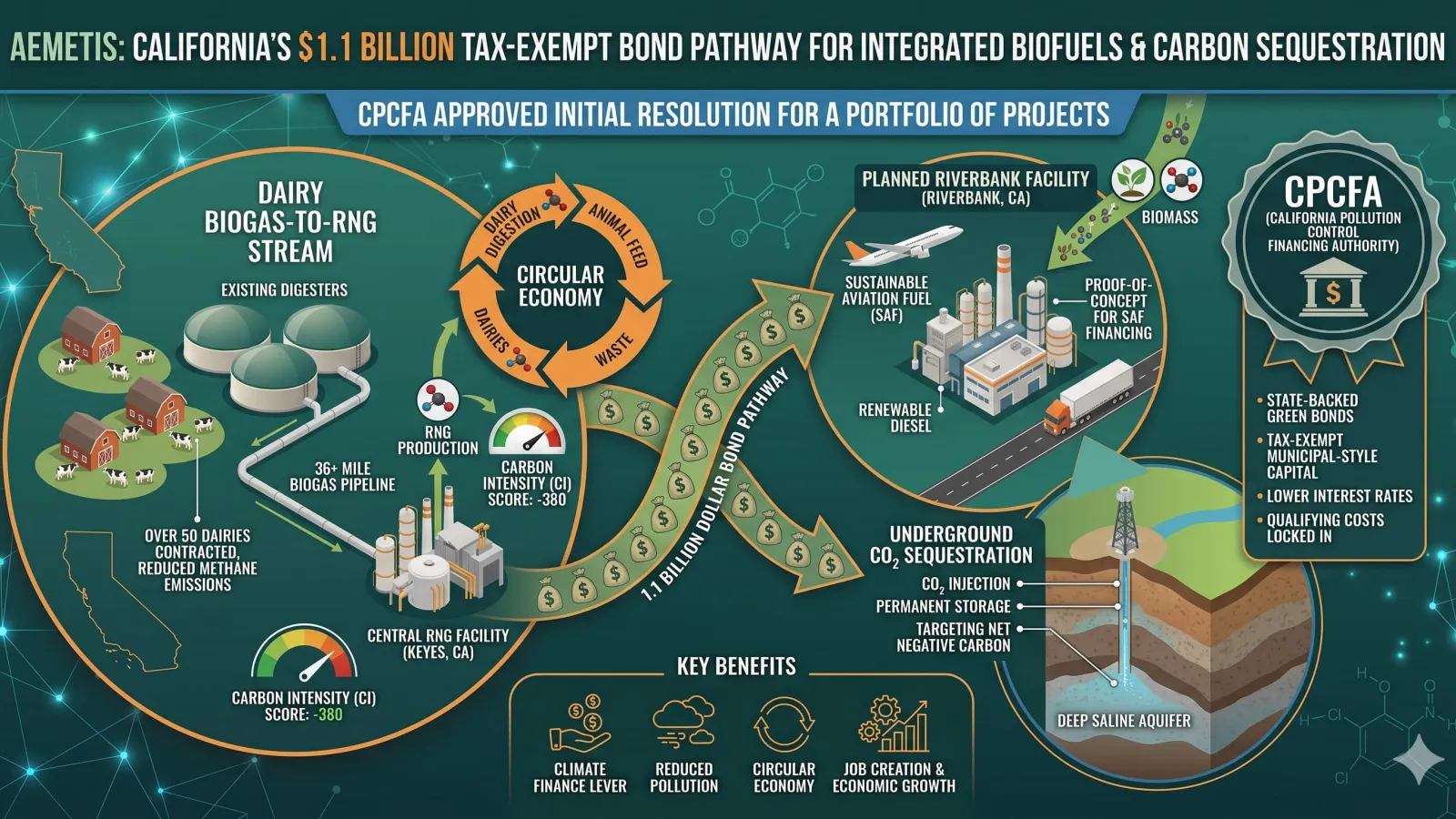
Aemetis (NASDAQ: AMTX), a California-based renewable fuels company, has cleared a significant financing hurdle after the state's Capital Programs & Climate Financing Authority (CPCFA) adopted an Initial Resolution supporting up to $1.1 billion in tax-exempt bond issuance for a portfolio of the company's clean-energy projects. The move positions Aemetis to access lower-cost municipal-style capital for infrastructure that spans dairy-waste biogas capture, sustainable aviation fuel (SAF) production, and underground carbon sequestration — a convergence of agricultural, energy, and climate-finance streams that is increasingly attracting institutional attention.
The resolution covers the construction of more than 40 additional dairy digesters and expanded biogas pipeline connections feeding Aemetis's renewable natural gas (RNG) facility in Keyes, California, as well as a planned SAF and renewable diesel plant and a CO₂ sequestration project in Riverbank. Aemetis already operates 12 anaerobic digesters collecting manure waste from 15 dairies, a 36-mile biogas collection pipeline, and a central biogas-to-RNG plant that feeds directly into the PG&E utility gas network. More than 50 dairies are contracted to supply feedstock; a further 80 receive animal feed as an ethanol-production byproduct, illustrating the circular-economy logic underpinning the firm's model.
Green bonds as a biofuels lever
The financing structure is notable beyond the headline number. Tax-exempt bond issuance — typically the domain of municipal infrastructure and social housing — is being deployed here as a climate-finance instrument for private biofuel infrastructure. That is a deliberate strategic choice: lower coupon rates versus conventional project finance or corporate debt could materially improve the unit economics of RNG and SAF production at a time when both sectors face margin pressure from volatile commodity feedstock prices and shifting federal subsidy landscapes.
"The use of tax-exempt bonds at lower interest rates than other sources of financing has potential to enhance our financial position as we implement a variety of projects that are expected to strengthen our balance sheet and generate profitability," said Eric McAfee, Chairman and CEO of Aemetis.
There are meaningful caveats. CPCFA's Initial Resolution establishes eligibility for bond proceeds — locking in the tax-exempt treatment for qualifying costs incurred from the resolution date onward — but it does not guarantee final approval. Actual issuance requires allocation from California's statewide volume cap on tax-exempt private-activity bonds, a competitive pool that funds everything from affordable housing to broadband infrastructure. Final documentation must still be completed before any bonds are sold.
Macro read-across: SAF demand and the capital gap
The wider significance for cross-sector investors lies in the SAF and carbon-sequestration components. Aviation decarbonisation is one of the most capital-intensive transitions in any industrial sector: the International Air Transport Association estimates the industry will need hundreds of billions in SAF infrastructure investment globally by 2050. Yet today the overwhelming majority of SAF capacity is funded through a patchwork of tax credits, blending mandates, and project-by-project debt — there is no mature, liquid capital market for SAF project finance at scale.
Aemetis's attempt to route green-bond financing into SAF production is therefore a small but instructive proof-of-concept for whether state-backed tax-exempt structures can bridge that gap. If California's CPCFA model is replicated — by other states or in modified form under EU green-bond frameworks — it could open a new channel for institutional fixed-income capital (pension funds, insurance balance sheets) to flow into biofuels infrastructure that has historically been too operationally complex for vanilla bond markets.
For energy-transition investors already tracking the convergence of agricultural waste streams, carbon markets, and aviation-sector decarbonisation mandates, the Aemetis resolution is a data point worth filing. The bond issuance itself remains conditional, but the financing architecture it sketches — circular-economy feedstock, multiple low-carbon output streams, and climate-labelled public-market debt — is the template that larger players are watching closely.