
T3 Defense acquires Project35 to scale drone and counter-UAV portfolio
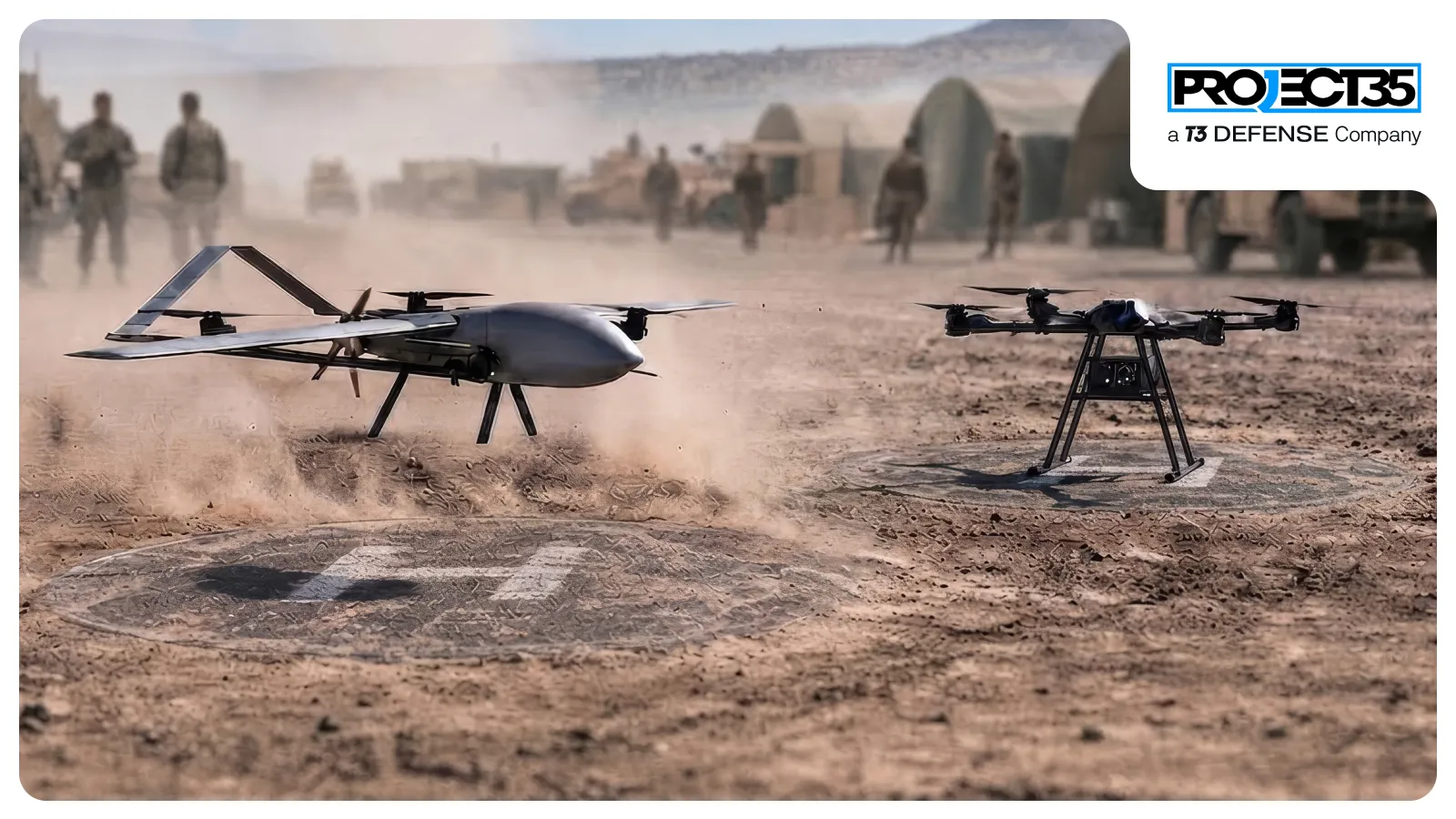
T3 Defense Inc. (Nasdaq: DFNS), a US-listed acquirer of mission-critical defence businesses, has taken a 60% stake in Project35, an Israeli developer and manufacturer of drones, aerial interceptors, and counter-UAV systems. The deal marries American capital-markets access with Israeli defence engineering pedigree, at precisely the moment that unmanned aerial systems and the technologies designed to defeat them are consuming an expanding share of global defence procurement budgets.
The transaction is structured as a share-and-debt deal: T3 Defense issued roughly 21 million shares of common stock alongside a 12% promissory note of $1.25 million, and has committed a further $2.5 million in direct operational investment over the next twelve months. Project35 reported unaudited revenues of approximately $1.4 million for 2025 and expects around $2.4 million for 2026, indicating early-stage commercial traction rather than mature scale.
Battlefield context: the drone-on-drone problem
Project35's headline product is an autonomous aerial interceptor designed to neutralise hostile UAVs within seconds of detection. The system uses a proprietary AI tracking and guidance suite and has, the company says, completed a series of successful live-fire field trials in high-intensity conflict conditions. Its broader platform range spans heavy-lift cargo multirotor drones, long-endurance fixed-wing VTOL aircraft for intelligence, surveillance and reconnaissance, and high-speed first-person-view tactical systems.
Crucially, Project35 already supplies Israel's top-tier prime contractors, including Israel Aerospace Industries, Rafael Advanced Defense Systems, ELTA Systems, and Elbit Systems, as well as the Israel Ministry of Defense. Those relationships represent validated procurement channels that T3 Defense intends to scale, rather than build from scratch. The company holds AS9100 aviation quality certification and is built to Western supply-chain standards, including Blue UAS and NDAA compliance, which broadens its eligibility for US and allied government programmes.
"Two forces are reshaping the modern battlefield: the rapid spread of unmanned aerial systems, and the urgent need to intercept them before they reach their targets," said Menny Shalom, Chief Executive Officer of T3 Defense. "Project35 brings operational, field-deployed platforms and a purpose-built autonomous interceptor validated in successful live-fire testing."
Capital strategy and cross-sector read-across
T3 Defense's acquisition model is structurally interesting for cross-sector investors. The company is not a prime contractor building bespoke sovereign programmes; it is a defence roll-up, aggregating capacity-constrained manufacturers with proven order books and using centralised capital allocation to remove the scaling constraint. That model, more familiar in private equity than in defence, is now appearing on public markets via small-cap Nasdaq listings, lowering the entry point for investors who want exposure to the drone and counter-drone market without betting on a single prime.
The timing reflects a broader shift in defence procurement. The conflicts in Ukraine and the Middle East have accelerated institutional demand for attritable, low-cost UAV systems and the layered counter-measures to defeat them. NATO member states, Gulf sovereign procurement offices, and Indo-Pacific security partners are all expanding line items for both offensive drone capability and C-UAV infrastructure. That demand signal is reaching capital markets: venture and growth investment into drone and counter-drone technology has risen sharply since 2022, and a cohort of specialist defence-tech acquirers are now competing for the same pool of engineering-rich, revenue-thin Israeli and European deep-tech companies.
For cross-sector strategists, the convergence angle here is the intersection of autonomous systems, AI-guided targeting, and the restructuring of Western defence supply chains toward NDAA-compliant, allied-nation manufacturers. The Blue UAS compliance requirement, in particular, is quietly reshaping which drone vendors can access US government and allied procurement, effectively creating a regulatory moat that favours established Israeli and European suppliers over lower-cost Asian alternatives. T3 Defense is positioning itself to aggregate precisely those compliant assets before that moat becomes widely priced in.