
Refined Energy reports maiden drill results at Saskatchewan uranium site
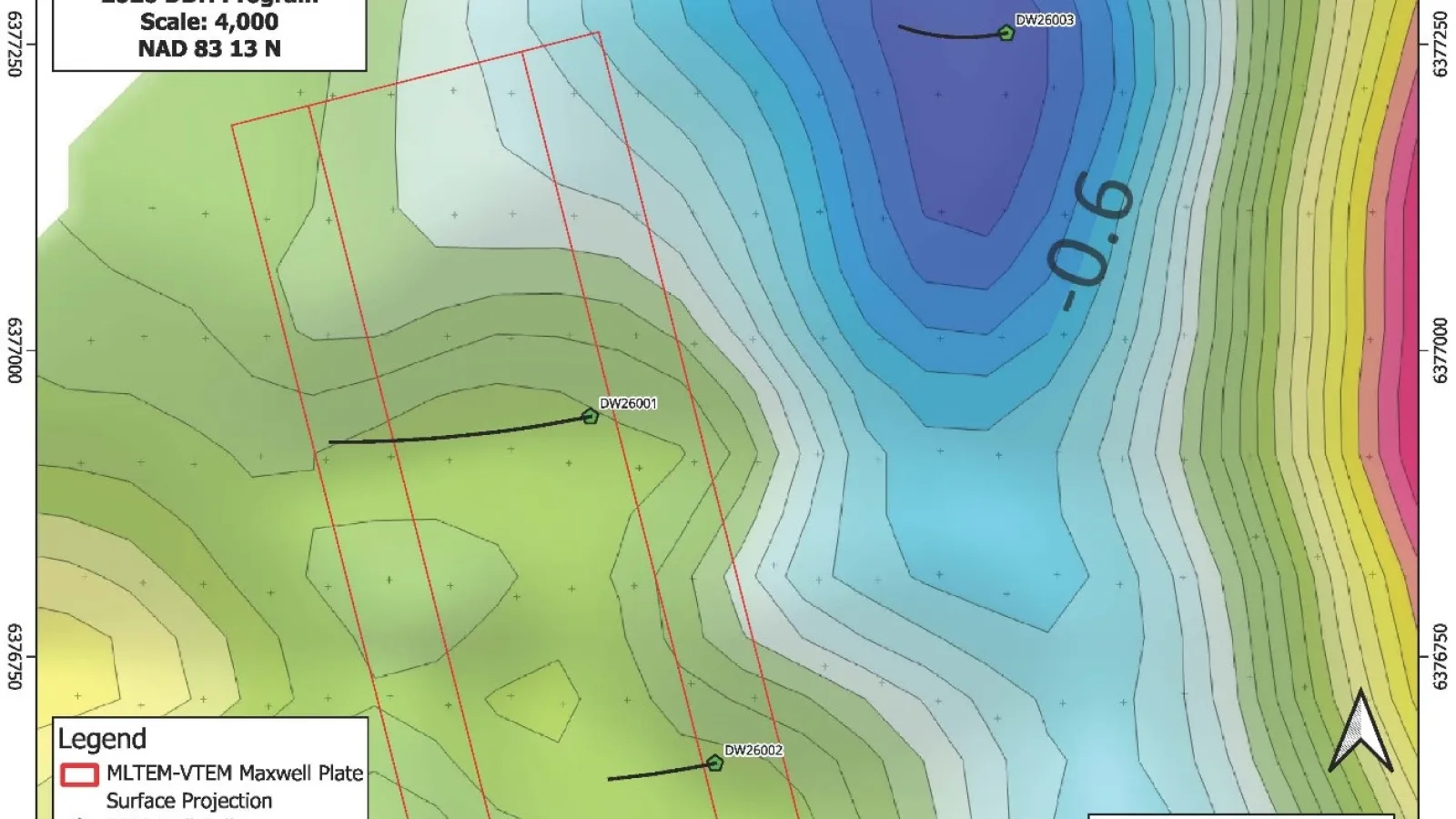
Refined Energy Corp., the Vancouver-listed mineral exploration company, has published final assay results from its maiden Winter 2026 drill programme at the Dufferin West property in Saskatchewan's Athabasca Basin, one of the world's most prolific uranium districts. The programme, completed on budget at approximately $1.7 million, drilled three holes across 975 metres and successfully intersected the Athabasca unconformity in two of them.
Of 87 samples submitted to ALS Canada Ltd. for geochemical analysis, ten returned weakly anomalous uranium values. The highest single assay came in at 5 parts per million uranium, recorded immediately below the unconformity in hole DW26-001. Drill hole DW26-003 reached the unconformity at 312 metres and encountered two brecciated fault zones, one in the sandstone section and one in the basement, with associated bleaching and clay gouges. The third hole, DW26-002, was terminated before reaching target depth to allow the programme to remain within budget.
Modest results, ongoing evaluation
The figures are exploratory rather than commercially definitive. No resource estimate or grade corridor has been established. A detailed geochemical review incorporating uranium-to-thorium ratios, lead-isotope data and alteration indicators such as boron confirmed ten anomalous intervals, with uranium enrichment relative to thorium noted directly below the unconformity. Refined holds an exclusive option to acquire up to a 75% interest in the project, which covers 10,140 hectares across the North and West Dufferin blocks, both held 100% by Eagle Plains Resources.
Chief Executive Mark Fields described the programme as completing the company's planned drill testing and generating additional geological and geochemical information, stopping short of characterising the results as a discovery. The programme was managed by TerraLogic Exploration of Cranbrook, British Columbia.
Why the Athabasca Basin warrants a macro lens
Taken in isolation, a sub-$2 million maiden drill campaign by a junior explorer is specialist mining news. Placed in its macro context, however, it sits within a substantially larger capital reallocation story. Uranium has moved from the margins of the energy transition debate to its centre as governments across Europe, North America and Asia respond to AI-driven electricity demand growth with renewed commitments to nuclear baseload. The International Energy Agency and multiple sovereign energy ministries have revised nuclear capacity targets upward since 2023, and the Athabasca Basin, which hosts tier-one deposits including Cameco's Cigar Lake and the McArthur River mine, has seen a corresponding uptick in junior exploration activity and option agreements.
For cross-sector investors tracking the intersection of energy security and digital infrastructure, uranium supply-chain visibility is becoming a strategic variable alongside lithium and rare earths. AI data centres require uninterrupted, high-density power; nuclear is increasingly positioned as the only scalable zero-carbon baseload option capable of meeting that demand without the intermittency constraints of wind and solar. That framing is driving capital, including sovereign wealth and utility-backed funds, toward both operating uranium producers and early-stage exploration vehicles in established jurisdictions.
Dufferin West's weakly anomalous results do not change that macro picture, but they illustrate the broader pattern: the Athabasca Basin is absorbing junior exploration capital at a rate not seen since the uranium bull market of the mid-2000s, and every programme that refines the geological model of the basin, even modestly, contributes to the regional dataset that larger operators and off-take buyers ultimately rely on. Whether Refined Energy advances to a follow-up drill campaign or revises its targeting strategy will depend on the ongoing property evaluation now underway.