
EVE Energy and Stark Future expand EV motorcycle battery pact
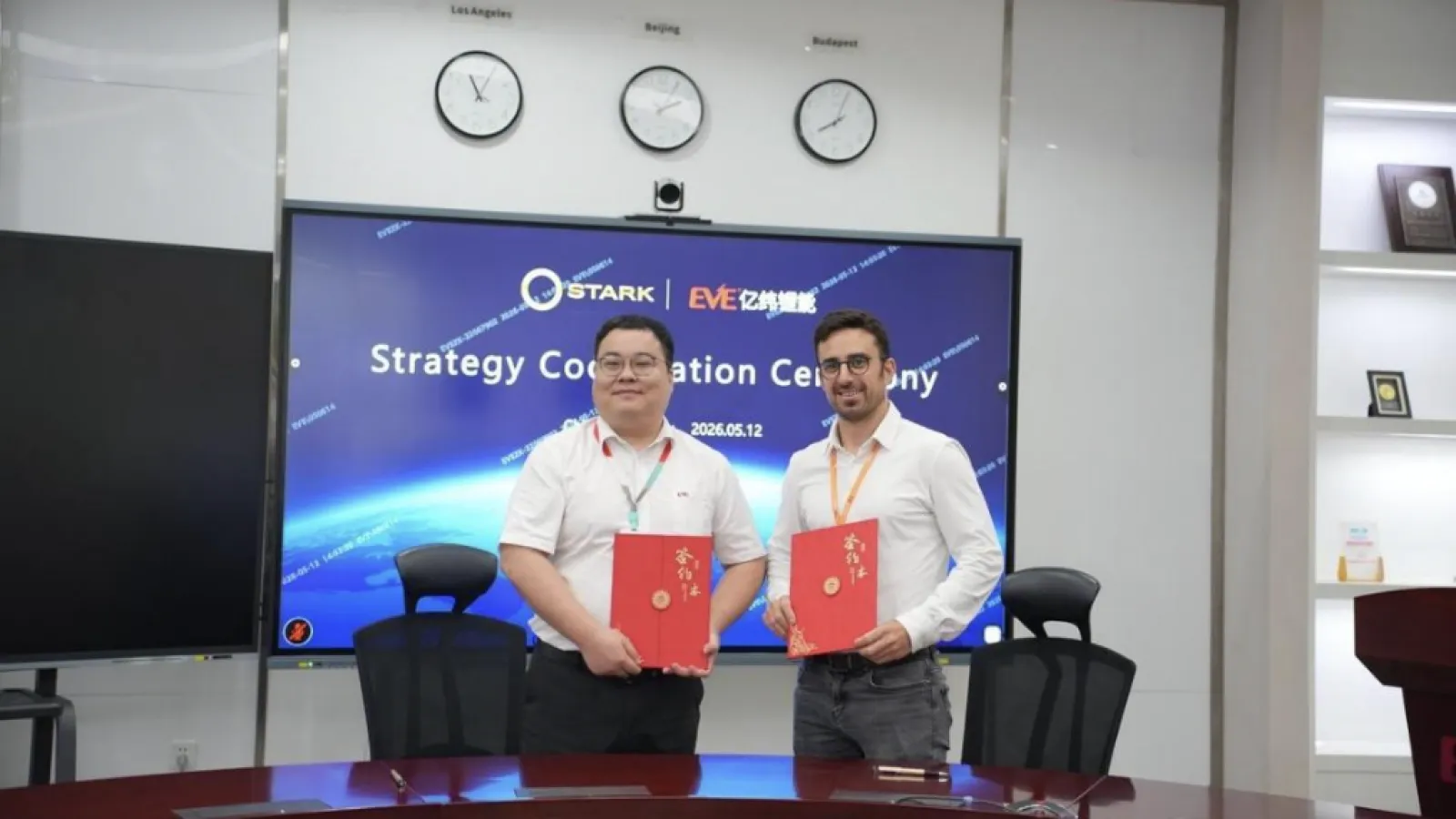
EVE Energy, the Chinese battery manufacturer, and Barcelona-based electric motorcycle maker Stark Future have broadened their strategic partnership, extending both technical co-development and competitive racing activity across the 2026 FIM World Championship season.
The deal places EVE's 26120 cylindrical cell — the company says it offers 310 Wh/kg energy density and a 10C peak discharge rate — at the core of Stark's VARG platform, which spans motocross, enduro, and supermoto variants.
The collaboration covers four of off-road racing's most demanding formats: World Supercross (WSX), SuperEnduro, HardEnduro, and EnduroGP. The stated logic is straightforward: race conditions serve as a live testing ground for battery behaviour under sustained high loads, frequent charge-discharge cycles, and thermal stress — conditions that are difficult to replicate fully in a laboratory environment.
Battery chemistry meets competitive sport
The 26120 cell format — a larger-diameter cylindrical geometry than the familiar 18650 or 21700 cells common in consumer electronics and early EV packs — is positioned for high-power-density applications where weight matters as much as capacity. The company claims industry-leading peak discharge capability, though independent third-party validation of the 10C and 310 Wh/kg figures has not been cited in the announcement. The VARG EX enduro variant, designed for long-distance technical terrain, places particular demands on thermal stability and energy density, making it arguably the more commercially instructive test bed of the three models.
Stark Future, founded in Barcelona and backed by venture investment from the European motorsport and electric vehicle ecosystem, has positioned the VARG as a challenger to incumbent combustion-engine off-road bikes. The partnership with EVE Energy — headquartered in Huizhou, Guangdong, and a major supplier to EV and energy storage markets globally — reflects a broader pattern: European high-performance mobility start-ups sourcing advanced cell chemistry from Chinese manufacturers with the scale and R&D depth to deliver bespoke formats that Western cell producers have not yet commercialised at comparable cost.
Cross-sector read-across: from motorsport to mainstream EV supply chains
The strategic significance here extends beyond two-wheel racing. Motorsport has historically served as an accelerated proving ground for battery technology that subsequently migrates into passenger EVs and industrial applications. The same dynamic is now playing out in the electric motorcycle segment: pack architectures, thermal management approaches, and charge-rate tolerances validated on a race circuit in 2026 tend to inform volume production decisions within two to three development cycles.
For cross-sector investors, the EVE–Stark partnership is a small but indicative data point in a larger capital story. European OEMs and mobility start-ups are increasingly reliant on Chinese cell supply for performance-tier applications, even as the EU's Critical Raw Materials Act and battery regulation framework attempt to incentivise domestic cell manufacturing. The tension between supply-chain pragmatism — Chinese cells are often faster to specification and more cost-competitive at low volumes — and regulatory pressure toward European sourcing is one of the defining procurement dilemmas facing the continent's EV sector through the late 2020s.
The broader EV two-wheel market is also growing faster than the passenger-car segment in several emerging economies, particularly in South and Southeast Asia, where EVE Energy has existing distribution and supply relationships. A proven high-performance cell validated in European championship racing carries commercial signalling value well beyond the Barcelona headquarters of either partner.
The partnership's next inflection point will be competitive results during the 2026 FIM season. Battery performance claims made in press releases are routine; podium finishes in HardEnduro — one of the most physically and technically punishing formats in motorsport — would carry considerably more weight with both performance customers and prospective B2B cell buyers evaluating EVE's cylindrical chemistry for their own platforms.