
HII christens DDG 131 as US Navy Flight III destroyer pipeline grows
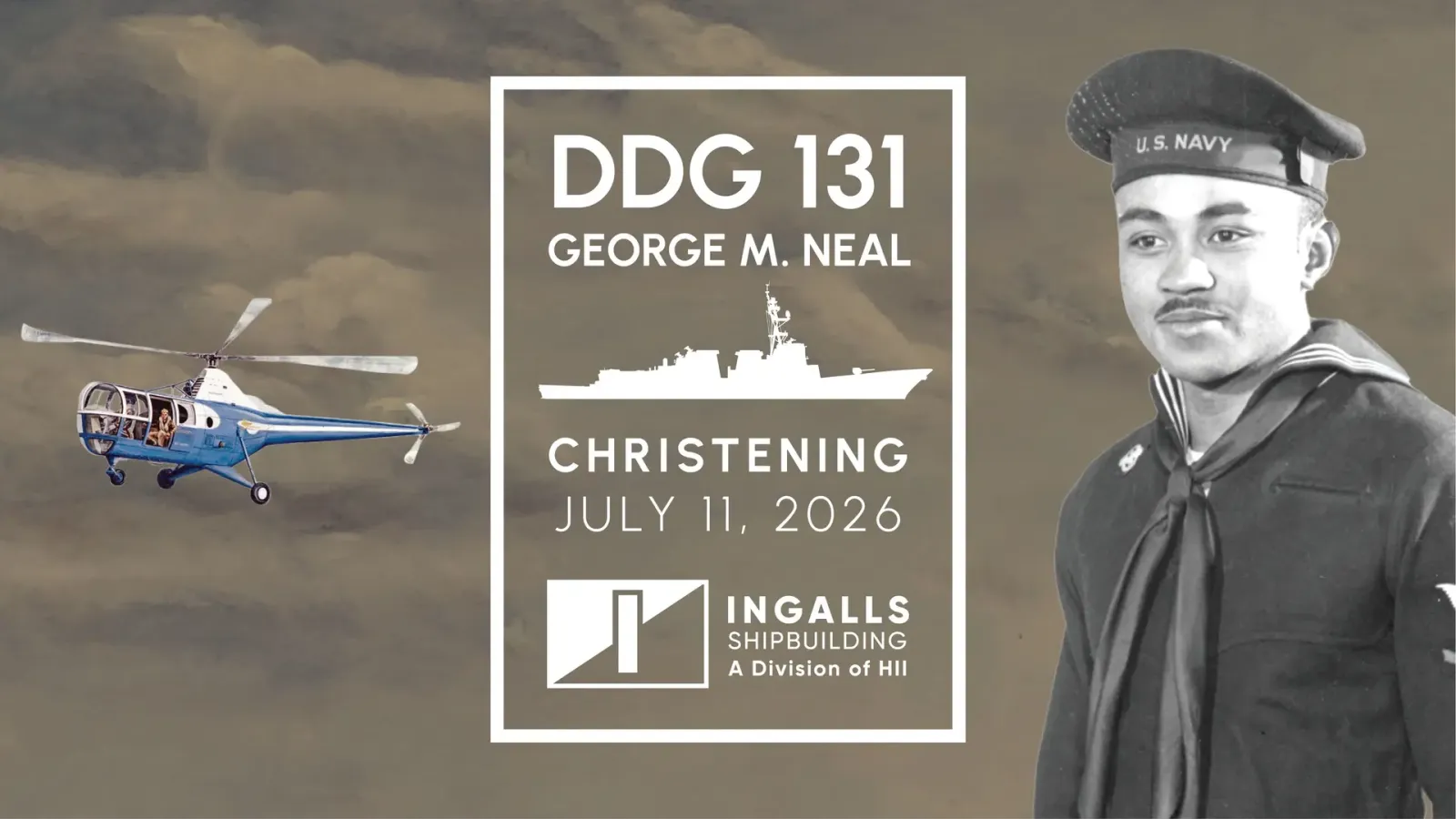
HII's Ingalls Shipbuilding division is set to christen the future USS George M. Neal (DDG 131) on 11 July 2026 in Pascagoula, Mississippi, marking the fourth Flight III Arleigh Burke-class guided missile destroyer completed at the yard and the latest milestone in one of the US Navy's most consequential near-term surface-combatant programmes.
The ship is named for George M. Neal, a Korean War veteran and aviation machinist's mate third class who received the Navy Cross for his attempt to rescue a fellow service member under enemy fire. The naming convention reflects the Navy's broader effort to anchor modern capital-ship programmes to the sacrifices of earlier generations, a practice that carries strategic communication weight as much as ceremonial significance.
The Flight III upgrade and what it signals
DDG 131 is equipped with the AN/SPY-6(V)1 radar, a system widely regarded as the most capable shipborne air and missile defence radar in the US inventory, and the Aegis Baseline 10 combat system. The Flight III configuration represents a substantial step beyond earlier Burke variants: the SPY-6 radar is reported to offer a significant improvement in detection sensitivity over the legacy SPY-1D(V), a capability directly relevant to countering the hypersonic and ballistic missile threats that now define the Indo-Pacific threat calculus.
Ingalls currently has five Flight III destroyers under active construction, with a further seven vessels in early pre-planning and material procurement. That pipeline, totalling twelve hulls, represents years of sustained shipyard throughput and hundreds of millions of dollars in committed sub-contractor supply chains stretching well beyond Mississippi, encompassing combat-systems integrators, propulsion suppliers, and electronics manufacturers distributed across multiple US states.
Convergence and capital implications
For cross-sector observers, the DDG 131 programme is worth watching beyond the ceremonial. HII, which describes itself as America's largest shipbuilder with a 44,000-strong workforce, frames its broader portfolio explicitly around the convergence of physical platforms and digital capability: C6ISR (command, control, communications, computers, cyber, combat systems and intelligence, surveillance, reconnaissance), AI/ML integration, electronic warfare, and synthetic training environments are all cited as current business lines. That positioning mirrors a wider industry shift in which the traditional defence prime is no longer simply a manufacturer of hulls and weapons but an integrator of data, sensing, and autonomous systems.
That shift has capital-allocation consequences. Defence budgets in NATO and allied nations have accelerated since 2022, and the US Navy's surface-combatant recapitalisation sits at the intersection of that spending trajectory and a parallel race to field AI-enabled, networked warfighting capability. Investors with exposure to defence primes and their tier-two supply chains are increasingly pricing in not just platform volume but the software and integration content per hull, which carries structurally higher margins than steel-and-propulsion alone.
Broader strategic read-across
The Arleigh Burke Flight III pipeline also has implications that extend into the industrial-base and geopolitical layer. Shipbuilding capacity is a sovereign constraint: the US has repeatedly struggled to grow throughput at the rate the Navy's force-structure plans require. With peer competitors expanding their own surface-combatant fleets at pace, the question of whether Ingalls and its sister yard, Newport News, can accelerate without compromising quality is as strategically important as the capability of the individual hulls. Any supply-chain bottleneck in combat-systems electronics, which are heavily concentrated among a small number of US and allied manufacturers, would directly affect the programme's delivery cadence.
The christening itself is a media event, not a delivery milestone, and DDG 131 will require further fitting-out and sea trials before commissioning. Nevertheless, the ceremony represents a public commitment point in a programme that will shape US naval surface power projection well into the 2040s, and it comes at a moment when allied navies from the Royal Australian Navy to the Japan Maritime Self-Defense Force are watching US destroyer production timelines closely as they plan their own fleet architectures around interoperable Aegis systems.