
Factorial and Tulip extend solid-state battery gains from road to UAV
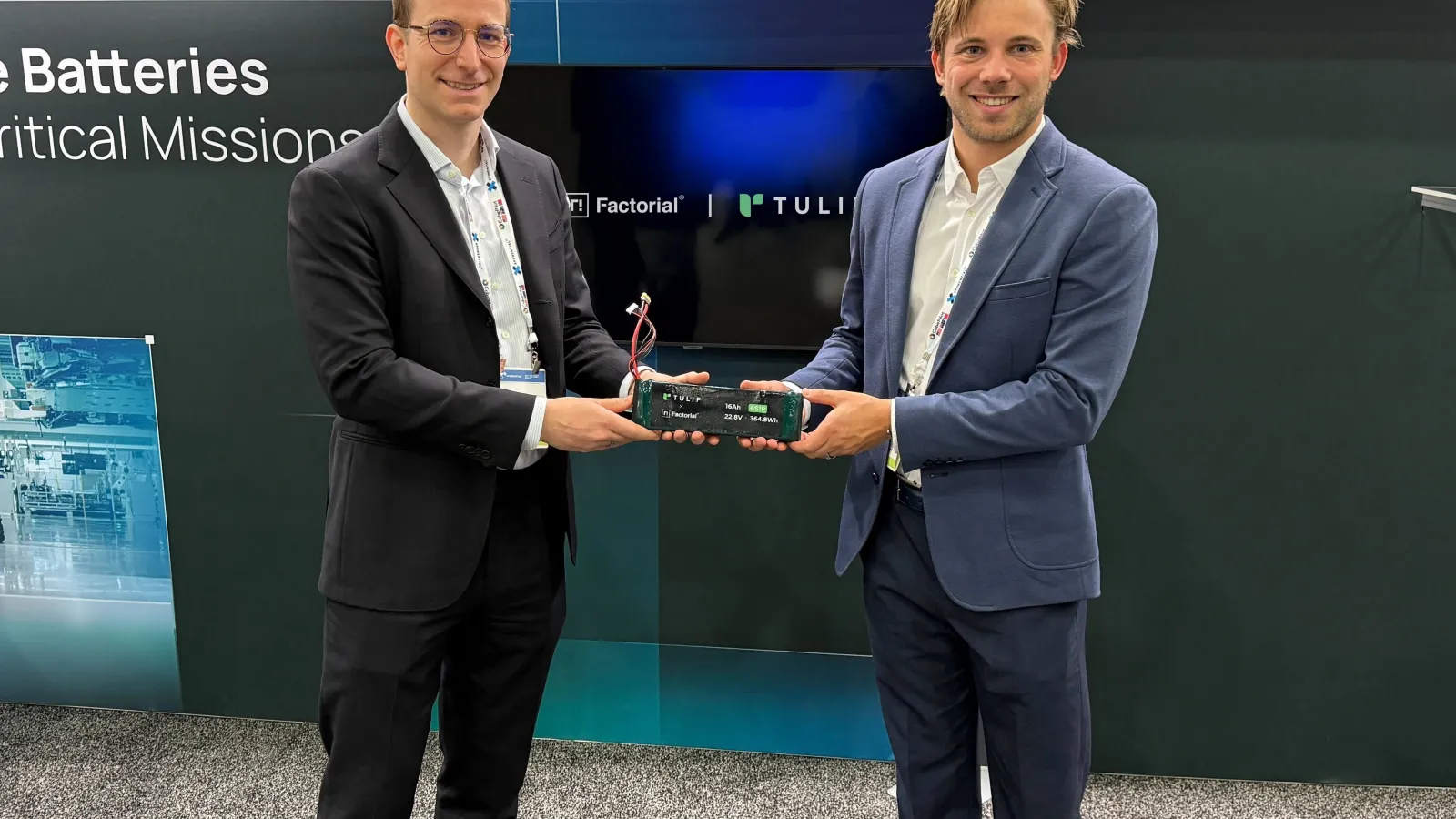
Factorial Energy, the Nasdaq-listed solid-state battery developer backed by Mercedes-Benz, Stellantis, Hyundai and US national-security investor IQT, has formalised a strategic partnership with Dutch UAV battery integrator Tulip Tech after initial flight tests showed its lithium-metal cells extending drone range by more than 30 per cent before any engineering optimisation. The agreement covers joint customer engagement and a roadmap towards volume production, marking Factorial's most explicit move beyond automotive into aerospace applications.
The partnership brings together two distinct but complementary competencies. Factorial supplies the cell chemistry, notably its FEST and Solstice platforms engineered for high energy density and scalable manufacturing. Tulip Tech, founded in 2020 and headquartered in Den Bosch in the Netherlands, handles the mission-specific integration side, having shipped more than 100,000 battery packs in a single month to over 250 customers across defence, security and commercial sectors, including NASA. That production scale and integration experience is precisely what a cell-technology company needs to move from laboratory results to fleet deployment.
Battery performance as the UAV bottleneck
The commercial logic is straightforward and increasingly urgent. As airframe design, onboard autonomy and sensing payloads advance, energy storage has emerged as the primary constraint on what unmanned systems can actually do. Longer mission radius, heavier payload capacity, the fleet economics that make large-scale operations viable, and the regulatory clearances that require demonstrated endurance standards all feed back to the same variable: how much energy a drone can carry per kilogram of battery weight.
Bernd Rietberg, CEO of Tulip Tech, was direct on the result: "Battery performance is the ceiling on almost every drone mission, and Tulip's job is to raise that ceiling by matching each mission to the best cell technology available. In this program, Factorial's solid-state and lithium-metal platform delivered more than a 30% range gain in initial testing, a standout result that has earned its place in our portfolio."
The press release cites a projected global UAV market exceeding $160 billion by 2034, a figure that should be read as an industry consensus range rather than a fixed forecast, given the wide variance in how defence and commercial drone markets are segmented by different analysts.
Cross-sector read-across: automotive chemistry meets defence airspace
The convergence angle here runs deeper than a single product partnership. Factorial's cell platforms were originally developed for automotive applications, and the company's most cited proof point remains a Mercedes-Benz real-world road test that achieved more than 1,200 kilometres of range on a single charge. The deliberate transfer of that chemistry into UAV applications illustrates a structural pattern emerging across the deep-tech investment landscape: performance breakthroughs achieved in high-volume, well-capitalised automotive programmes are increasingly being redeployed into defence and aerospace adjacencies where price sensitivity is lower and mission criticality justifies premium cell costs.
That dynamic matters for capital allocators tracking the battery supply chain. Sovereign wealth funds and defence-oriented venture investors have been building exposure to solid-state and lithium-metal developers not solely for the EV transition, but because the same cell technology underpins next-generation UAV fleets, long-endurance surveillance platforms and, as Factorial's own materials suggest, space applications. IQT's position on Factorial's cap table is the most explicit signal of that dual-use thesis in this story.
For the broader drone sector, the Factorial-Tulip partnership adds competitive pressure on lithium-ion incumbents supplying UAV battery packs, particularly as Tulip's portfolio explicitly includes multiple cell partners. If solid-state range gains prove repeatable at production volumes, fleet operators in defence logistics, border surveillance and commercial delivery will face a genuine technology inflection point that reshapes procurement criteria well beyond unit price.
The next milestones to watch are the engineering optimisation results Factorial and Tulip plan to build on following the initial flight data, and whether the volume production roadmap attracts further sovereign or defence-programme capital into either company.