
CSG and Poland's PZL-KALISZ forge defence powertrain alliance
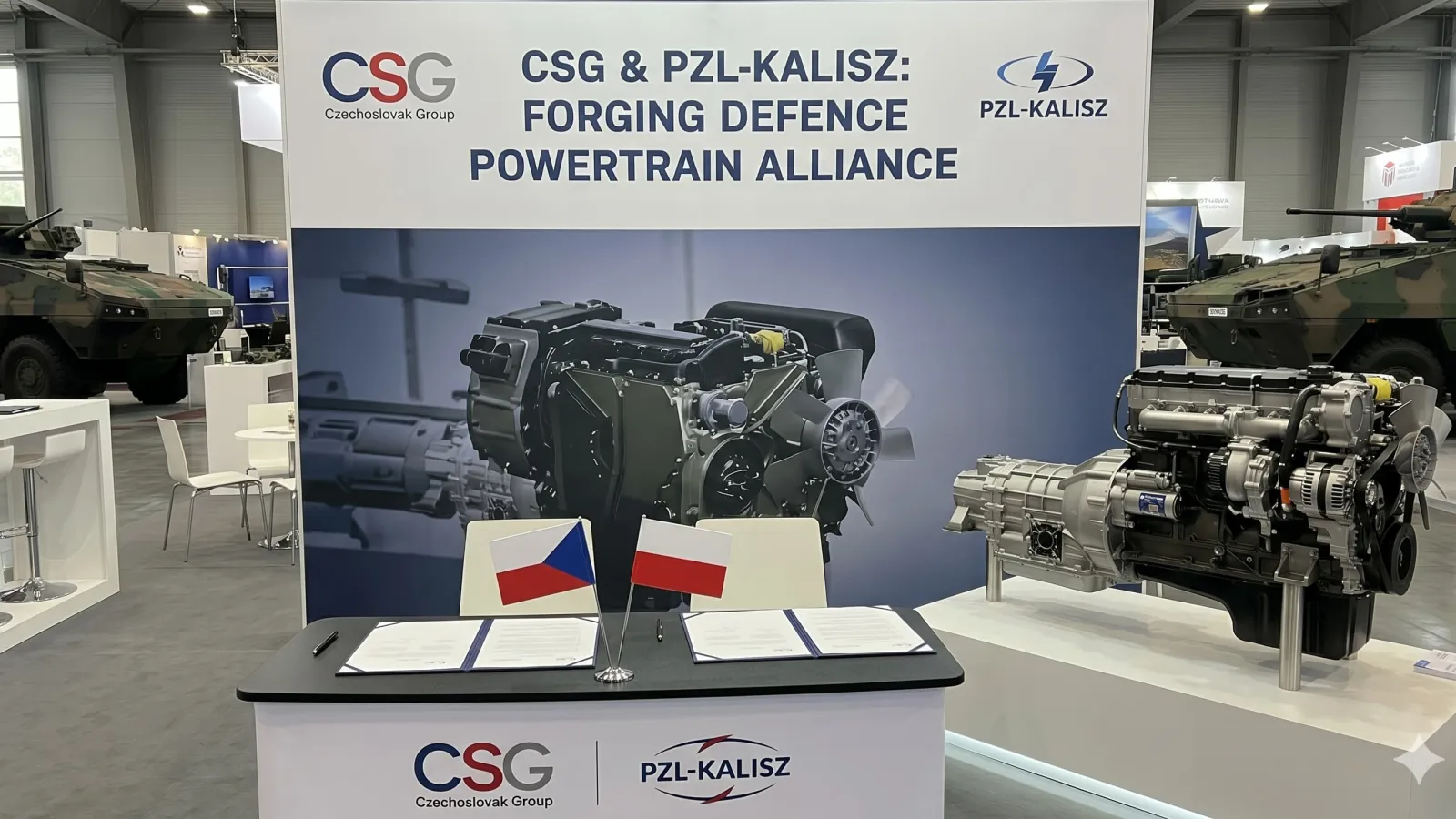
Czechoslovak Group (CSG) and Polish state-owned engine manufacturer WSK "PZL-KALISZ" have signed a letter of intent to co-produce powertrains and components for heavy-duty off-road vehicles, including military platforms. The agreement — which builds on a broader framework deal struck between CSG and Poland's PGZ armaments group in March 2026 — positions Central Europe as a growing node in NATO's effort to onshore defence manufacturing and reduce dependency on legacy, often single-source, supply chains.
The letter of intent covers production, servicing, and joint research and development of modern engine and powertrain systems applicable to military equipment, specialised platforms, and heavy off-road trucks. Crucially, both parties have flagged that outputs may ultimately be directed at export customers across NATO and EU member states — a signal that the partnership is designed not merely to serve Poland's own armed forces but to compete for a broader European rearmament wallet.
Defence industrialisation meets supply-chain geopolitics
The timing is deliberate. European governments have spent the post-2022 period scrambling to replenish depleted weapons stockpiles and underwrite domestic industrial bases capable of sustaining prolonged conflict scenarios. Poland, which has committed to spending 4% of GDP on defence, has become one of the most aggressive re-armament spenders on the continent, making its state-owned PGZ group an increasingly attractive industrial partner for foreign defence primes seeking a manufacturing footprint inside the EU.
For CSG — headquartered in Czechia but operating across Central and Eastern Europe — the deepening of its Polish presence follows an established pattern. The group has already enabled 155mm artillery ammunition production for Krab self-propelled howitzers at PGZ facilities and co-established production of 4×4 tactical vehicles at Huta Stalowa Wola. The engine cooperation is described by CSG's Chief Operating Officer, Łukasz Malicki, as a further step in a multi-domain industrial partnership: "Through the transfer of technologies for the production of modern powertrain systems, [WSK PZL-KALISZ] has an opportunity to secure a strong position in the European market."
WSK "PZL-KALISZ" brings seven decades of engine manufacturing heritage to the deal, including sole-source production of the ASz-62IR piston engine family used in Polish military aviation. Its existing workforce and machinery base are positioned as the foundation for an expanded capability in next-generation propulsion systems — including, per the March framework agreement, engines for unmanned systems and missiles.
Cross-sector convergence: from military to civilian mobility
The agreement's stated scope extends beyond pure defence procurement. Both parties have flagged the potential for civilian automotive industry involvement, pointing to the dual-use nature of heavy-duty powertrain technology. This matters for investors and industrial strategists tracking where defence and mobility converge: the same engine architecture that powers an armoured truck can, with modification, underpin mining, forestry, or large-scale construction equipment — markets that are themselves undergoing electrification pressure and supply-chain restructuring.
There is a broader capital geography story here too. Central and Eastern European defence manufacturers are attracting increasing attention from pan-European private equity and from EU-backed defence investment instruments, particularly as the European Commission accelerates its push for a Defence Industrial Strategy. For cross-sector allocators, the CSG-PGZ-WSK cluster represents an emerging industrial ecosystem — one that sits at the intersection of advanced manufacturing, geopolitical risk hedging, and the reshaping of European sovereign supply chains. Whether that ecosystem can compete with the scale of Western European primes such as Rheinmetall or BAE Systems remains the open question, but the direction of capital and political will is increasingly clear.
No financial terms were disclosed for the letter of intent, and the partnership remains at framework stage pending the conversion of intent into formal contracts.