
Aemetis revenue jumps 27% as US tax credits reshape biofuel economics
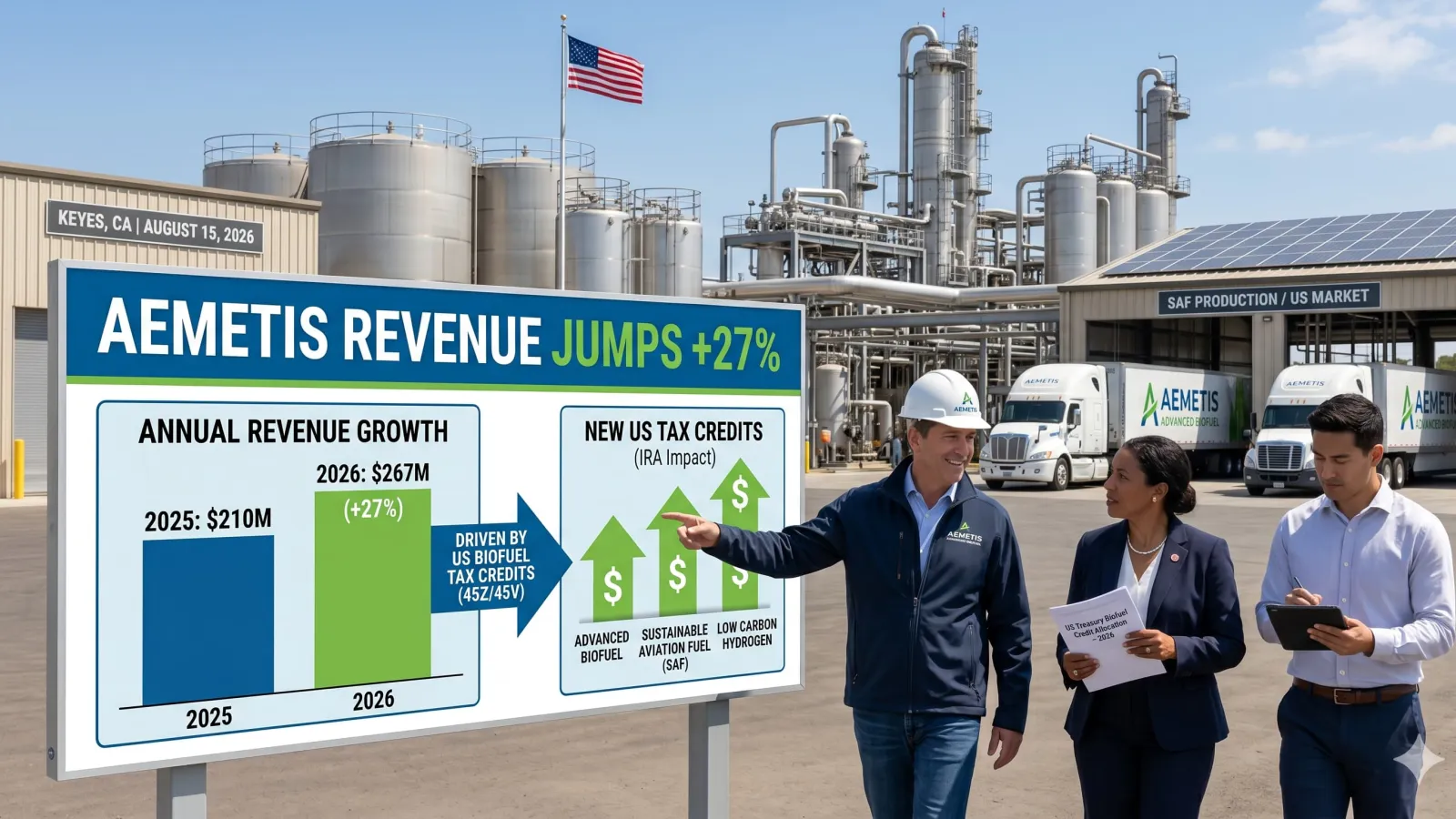
Aemetis (NASDAQ: AMTX), the California-based renewable fuels operator, reported first-quarter 2026 revenues of $54.6 million — a 27% year-on-year increase — as its three operating segments all contributed to a swing from a gross loss of $5.1 million to a gross profit of $2.8 million. The result marks the company's first quarter of normalised quarterly accrual under the Section 45Z Production Tax Credit regime, a US federal incentive that ties credits directly to clean-fuel output rather than capital expenditure, and which Aemetis says generated $4.0 million in revenue during the period.
The numbers are modest in absolute terms — the company still posted a net loss of $21.7 million against $293 million of current long-term debt — but the directional shift is significant. Operating loss narrowed by roughly 60% to $6.3 million, and Adjusted EBITDA improved from negative $10.7 million to negative $1.3 million. For cross-sector investors tracking the US clean-energy policy landscape, the 45Z credit normalisation is the macro signal: it suggests that production-linked incentives, rather than the investment-tax-credit model that preceded them, are beginning to flow predictably into biofuel operators' income statements.
Policy architecture meets production economics
The 45Z credit — introduced under the Inflation Reduction Act and formally clarified for transferability in late 2025 — represents a structural shift in how Washington prices carbon intensity in transport fuels. Unlike older blenders' credits, 45Z rewards producers for the lifecycle emissions of their output, scored via the Department of Energy's GREET model. Aemetis notes that an updated 45ZCF-GREET model is still pending publication, meaning current credit values may not yet fully reflect the company's lowest-carbon pathways.
That carbon-intensity angle matters because it connects directly to the California Low Carbon Fuel Standard (LCFS) market, where Aemetis' dairy biogas network is generating credits at an average score of negative 380 — well below the negative 150 default that applied a year ago. The company has seven fully approved LCFS provisional pathways and six more approaching approval. LCFS credit prices have softened (from $72.50 per credit in Q1 2025 to $55.00 in Q1 2026), compressing per-unit economics even as volume grows; RNG sales volumes rose 55% to 110,000 MMBtu. That price-volume tension is a recurring theme across US clean-fuel markets as new supply enters faster than low-carbon demand mandates expand.
Convergence angles: capital, geopolitics, and the India IPO
For macro investors, the more strategically interesting disclosure is the planned IPO of Aemetis' India subsidiary, Universal Biofuels Private Limited. The company says it has retained legal, accounting, and IPO advisors, with an investment-banking engagement expected to be named shortly. India's biodiesel segment — which produced zero revenue in Q1 2025 due to suspended government tender orders and rebounded to $10.5 million this quarter — operates within a state-directed procurement system where oil-marketing companies (OMCs) issue tenders for blended fuel. That model positions the India business as a play on New Delhi's accelerating biofuel-blending mandates rather than on open-market commodity dynamics, a distinction that will matter to public-market investors assessing the IPO.
The broader convergence picture is a study in how US policy architecture, sovereign energy mandates, and carbon-market microstructure are simultaneously reshaping the economics of second-generation biofuels. Aemetis is small relative to the integrated energy majors now building renewable-fuel divisions, but its multi-geography, multi-feedstock model — dairy waste in California, agricultural biodiesel in Andhra Pradesh — mirrors the diversification logic that larger capital allocators are applying across the clean-energy transition. With the Keyes ethanol plant's mechanical vapour recompression upgrade on track to displace roughly 80% of fossil gas consumption using on-site solar and geothermal grid electricity, the California segment is also edging toward the kind of low-carbon intensity scores that could unlock higher 45Z and LCFS credit values in future quarters.