
Stellar Alpina raises CHF 3.5M for detonation propulsion in-space
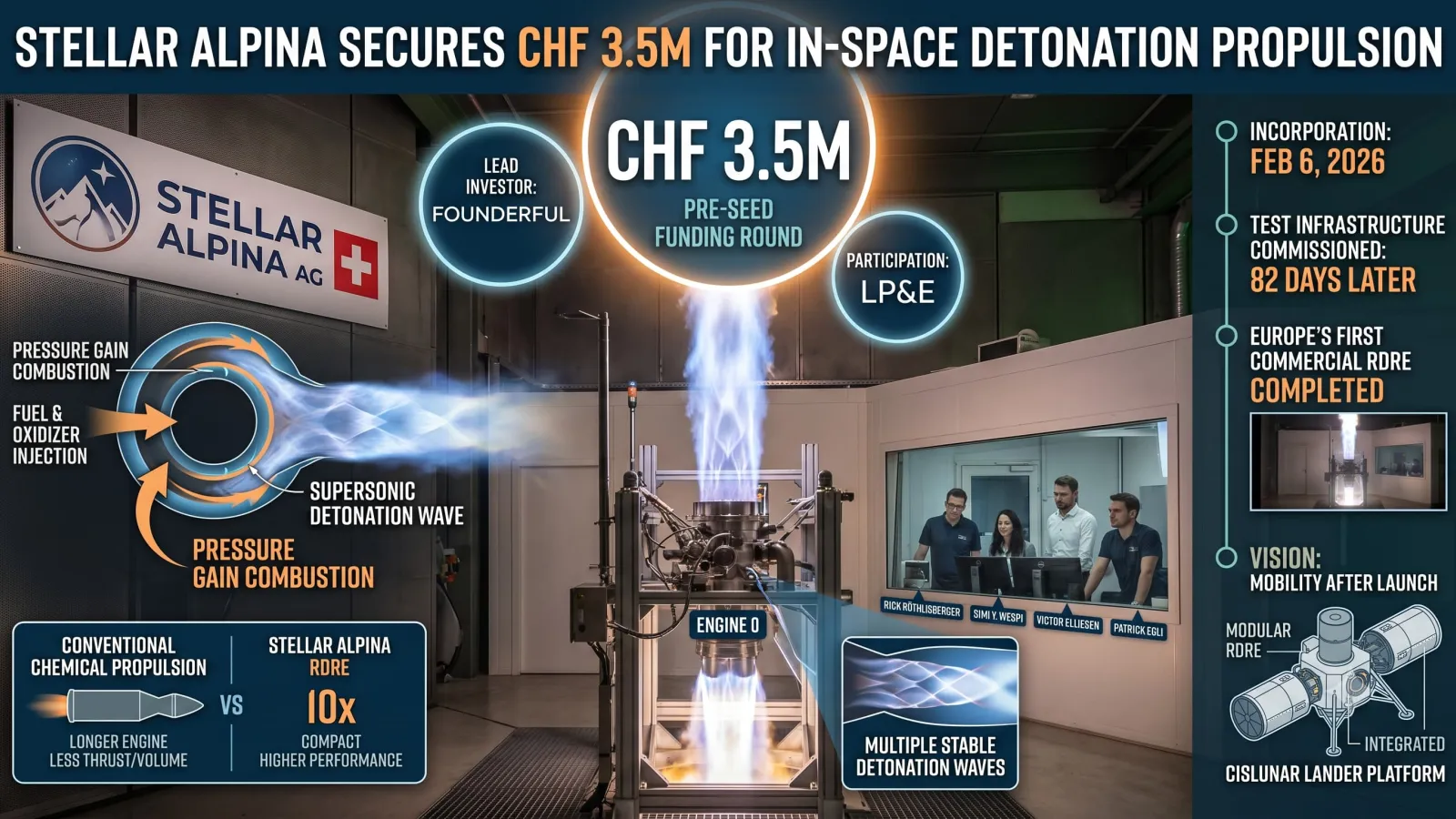
Stellar Alpina, a Zurich-based deep-tech startup, has closed a CHF 3.5 million (approximately USD 4.5 million) pre-seed round to commercialise rotating detonation rocket engines (RDREs) — a propulsion technology the company argues will define the next frontier of in-space mobility. The round is led by Founderful, Switzerland's leading pre-seed venture fund, with participation from LP&E, a deep-tech investor whose existing portfolio spans Isar Aerospace, Quantum Systems, and Impulse Space. The raise arrives at an inflection point: as launch costs continue to fall, the bottleneck in the space economy is shifting decisively from getting to orbit to moving around once there.
The founding team — four alumni of ARIS, the Academic Spaceflight Initiative Switzerland — completed eight detonative hotfires of their first engine, Engine 0, and recorded up to five stable simultaneous detonation waves in a single test. The company describes this as the first known commercial RDRE hotfire campaign in Europe. That the milestone was reached just 82 days after incorporation is the headline strategic signal: in a sector where development timescales are routinely measured in decades, speed of iteration is itself a competitive moat.
The orbital mobility gap
The economics of launch have been transformed over the past decade by reusable rocket programmes and the commoditisation of small-satellite manufacturing. Hundreds of new payloads now reach low Earth orbit (LEO) each year. But the propulsion systems needed to move those payloads — to geostationary orbit, cislunar space, or on repositioning and servicing missions — have remained largely static. Current in-space propulsion architectures were engineered for an era of infrequent, high-value missions; they are poorly suited to the higher cadence, greater flexibility, and tighter mass budgets that characterise the new space economy.
RDREs offer a potential step-change here. Unlike conventional combustion engines that burn propellant in a steady deflagration, rotating detonation engines exploit supersonic detonation waves — releasing energy faster and more efficiently, which translates theoretically into higher specific impulse (the rocket-science proxy for fuel efficiency) in a smaller, lighter package. Victor Elliesen, co-founder of Stellar Alpina, frames the ambition plainly: "We believe detonation-based propulsion can provide the step change this requires by making rocket engines smaller, more efficient, and more capable."
Convergence capital and the European deep-space stack
The investment landscape around in-space mobility is worth reading as a cross-sector capital story, not merely an aerospace one. Sovereign wealth funds, defence-adjacent corporates, and infrastructure-focused private equity are all circling the "space-as-infrastructure" thesis — the idea that orbital logistics will eventually mirror terrestrial logistics networks, requiring a full stack of transfer vehicles, servicing platforms, and propulsion commodities. LP&E's portfolio posture, spanning launch (Isar Aerospace), autonomous systems (Quantum Systems), and now in-space transfer (Impulse Space and Stellar Alpina), reflects a deliberate bet on that entire stack rather than a single point solution.
Europe is a notably underdeveloped node in this ecosystem compared with the US and, increasingly, the Gulf states. The UAE's Mohammed bin Rashid Space Centre and Saudi Arabia's nascent space programme are drawing both commercial and sovereign capital into the sector, partly as a hedge against US-centric supply chains. A credible Swiss RDRE programme, backed by ETH Zurich's institutional pedigree — Thomas Zurbuchen, former NASA Head of Science, is a named supporter — positions Stellar Alpina as a potential anchor for European sovereign and institutional capital that wants exposure to deep-space infrastructure without routing through US primes.
The immediate roadmap involves extended hotfire campaigns across multiple engine configurations and development of a flight-ready engine. The longer arc — cislunar mobility, on-orbit servicing, and what Elliesen calls "the space between worlds" — is a market that analysts broadly agree is large but has yet to produce a category-defining commercial operator. At CHF 3.5 million, this pre-seed is a small but symbolically significant step towards filling that gap from European soil.