
Ming Yang eyes BC offshore wind stake in Indigenous-led 2 GW project
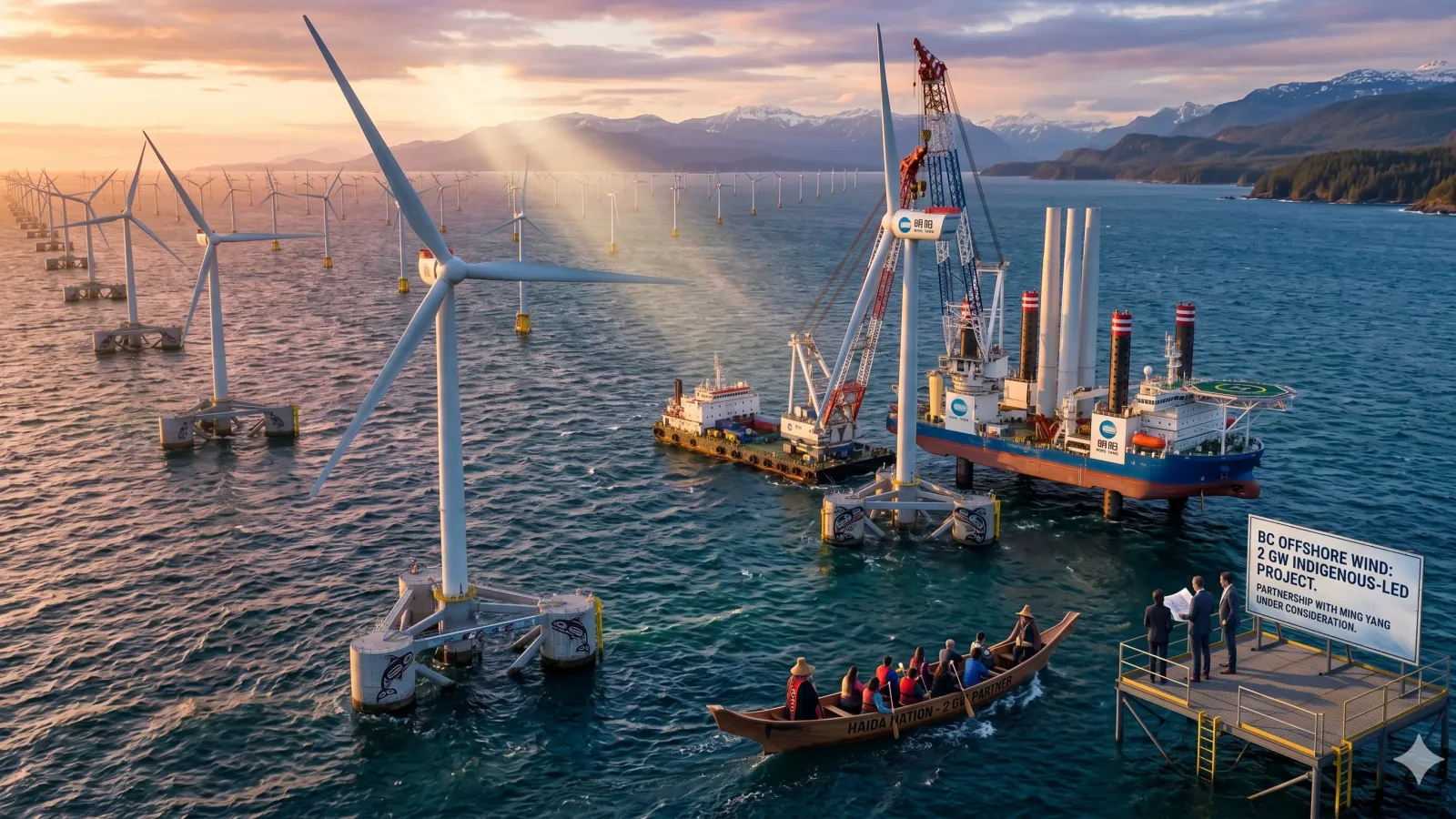
Ming Yang Smart Energy Group, one of China's largest offshore wind turbine manufacturers and dual-listed in Shanghai and London (MYSE.L), has signed a memorandum of understanding with Canadian developer Oceanic Wind Energy to explore equity investment, debt financing, and long-term operational support for a proposed offshore wind project in the Hecate Strait off British Columbia's northwest coast.
The project is co-developed with Coast Tsimshian Enterprises (CTE), a 50/50 partnership between the Metlakatla and Lax Kw'alaams First Nations, and is described as one of Canada's largest Indigenous-led renewable energy initiatives. The scheme targets between 1.5 GW and 2 GW of installed capacity — comparable in scale to some of the largest offshore wind farms currently operating in Europe — harnessing what the parties say is one of the world's most consistent wind resources, with annual capacity factors above 50% and winter capacity factors reaching 65%.
Strategic Capital Meets Geopolitical Complexity
The MOU is non-binding and triggers a 90-day due diligence window during which the precise scale and structure of Ming Yang's investment will be determined. Separately, Oceanic Wind has retained Falkirk Environmental Consultants to begin the regulatory and environmental approvals process, starting with preparation of an Initial Project Description — an early but necessary step in British Columbia's environmental assessment framework.
For cross-sector investors tracking clean energy capital flows, the Ming Yang move is notable on several levels. Chinese renewable-energy manufacturers have faced accelerating scrutiny in Western markets: US and EU procurement rules increasingly exclude Chinese-origin turbines and components on national-security grounds, and Canada has been navigating its own tensions around Chinese investment in critical infrastructure. An MOU structured around an Indigenous-partnership vehicle may offer a more politically durable entry point than a direct corporate acquisition — though regulatory watchers will note that Canadian foreign-investment review (under the Investment Canada Act) applies to large energy-sector transactions regardless of the partnership wrapper.
Convergence of Green Finance, Indigenous Sovereignty and Supply Chain Geopolitics
The broader significance of this deal sits at the intersection of three converging forces. First, sovereign and institutional capital is actively seeking gigawatt-scale offshore wind assets in stable jurisdictions; British Columbia's grid operator BC Hydro has identified offshore wind as a strategic winter-peaking resource, aligning the Hecate Strait's capacity-factor profile directly with provincial demand curves. Second, Indigenous equity ownership in major infrastructure projects is increasingly a de facto prerequisite in Canadian project finance — lenders and institutional co-investors are embedding Indigenous partnership structures as a risk-mitigation mechanism, not merely a social-licence courtesy. Third, Chinese wind-turbine manufacturers including Ming Yang and CSSC Haizhuang are seeking to internationalise manufacturing and capital deployment as domestic margins compress and Western protectionism tightens, making partnership structures in markets like Canada, Southeast Asia, and the Middle East their primary growth vector.
For macro investors, the Hecate Strait project also highlights a structural tension in the global energy transition: the technology supply chain for offshore wind — turbine nacelles, blades, monopile foundations, subsea cabling — remains heavily concentrated in China and a small number of European specialists. A project of this scale in British Columbia would need to resolve localisation questions at the procurement stage, creating potential downstream opportunities for Canadian fabrication capacity and port infrastructure that has historically served the LNG sector.
Oceanic Wind's CEO Michael O'Connor framed the agreement in terms of international confidence: "By working together with Ming Yang and Coast Tsimshian Enterprises, we are taking an important step toward building a globally significant offshore wind industry that creates sustainable economic opportunities while supporting British Columbia's transition to clean energy."
The next meaningful milestone will be the conclusion of the due diligence period and any binding term sheet, alongside the outcome of BC's environmental assessment screening — a process that, for a project of this magnitude, is likely to run over multiple years before construction finance can be assembled.