
CECO Environmental absorbs Thermon in industrial-green convergence deal
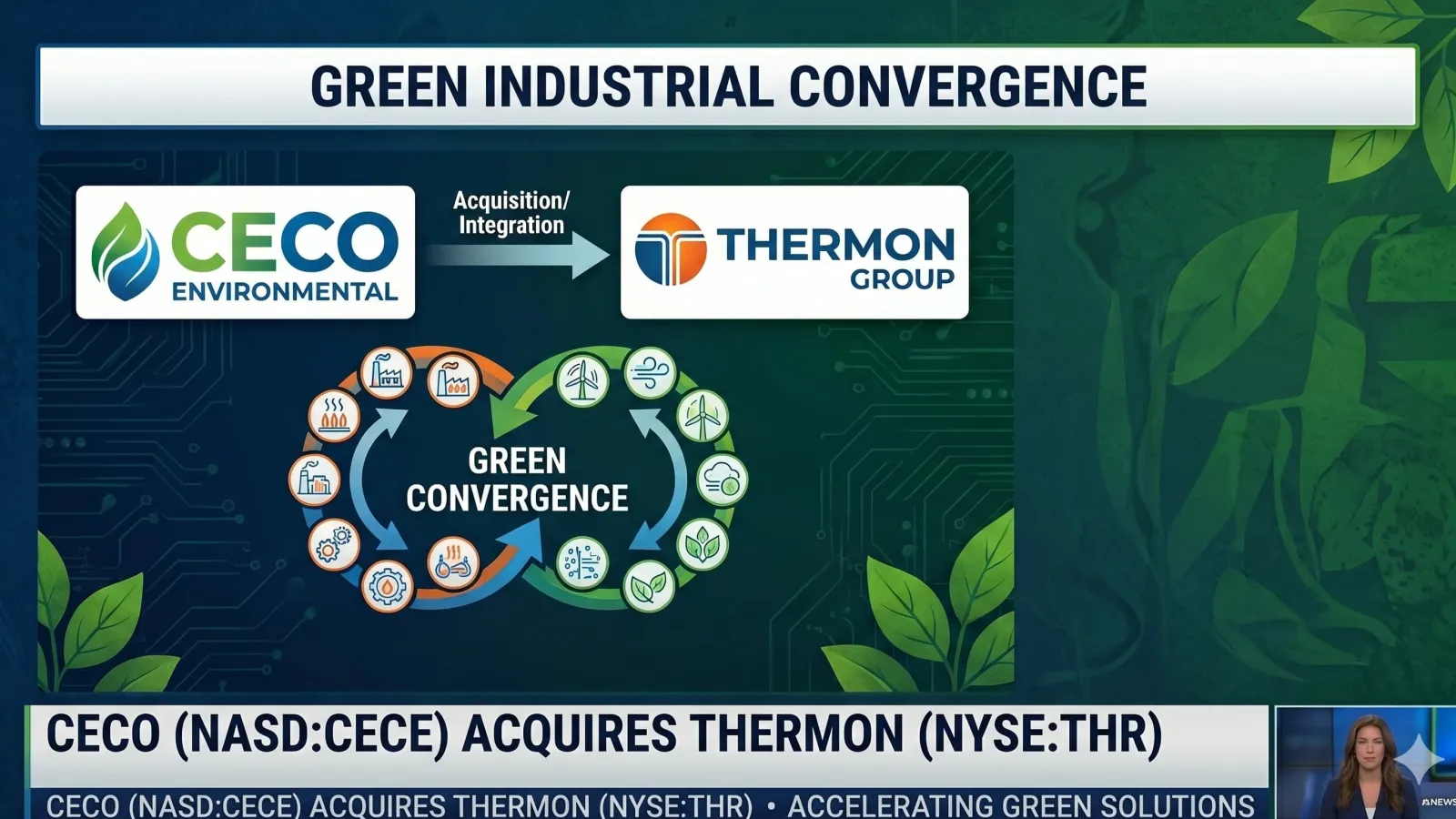
CECO Environmental Corp. has completed its acquisition of Thermon Group Holdings, combining two Nasdaq-listed industrial technology companies into a single platform spanning air quality, water treatment, energy-transition infrastructure, and industrial process heating. The deal, announced earlier this year, closes as industrial decarbonisation spending accelerates across petrochemical, power generation, and advanced manufacturing sectors — markets where the two companies' product lines overlap and, in places, interlock.
Thermon, headquartered in San Marcos, Texas, built its reputation as a global supplier of electric heat-tracing and industrial process-heating systems — the kind of infrastructure that keeps pipelines flowing in sub-zero conditions and maintains precise temperatures in chemical processing plants. CECO, by contrast, has grown through acquisitions into a broader "clean industrial" platform: its engineered systems address industrial air emissions, produced-water treatment, and energy-value-chain optimisation. CEO Todd Gleason described the combination as "a transformative milestone," saying the enlarged group is "well positioned to deliver long-term value for shareholders, expand our exposure to key global trends, and further establish CECO as a premier provider of engineered solutions."
Two platforms, one energy-transition thesis
The strategic logic sits squarely in the energy-transition trade. As legacy hydrocarbon infrastructure ages and simultaneously faces pressure to reduce its emissions footprint, operators are spending on retrofits rather than greenfield builds — a market that rewards suppliers able to offer integrated solutions across heating, emissions control, and water management. CECO's existing exposure to EV battery production, polysilicon manufacturing, and battery recycling also means the combined entity straddles both the fossil-fuel optimisation cycle and the clean-energy build-out, a positioning that is increasingly attractive to cross-sector industrial investors who need exposure to the transition without betting solely on renewable capacity additions.
Thermon's former shareholders received cash and/or CECO common stock under the merger terms, with the combined company retaining the CECO Environmental name and Gleason at the helm. Two former Thermon directors — Victor Richey and Marcus George — join the CECO board, bringing continuity on the acquired side and signalling that integration is designed to preserve rather than absorb Thermon's operational identity.
Convergence capital and the clean-industrial thesis
The broader capital landscape is worth noting. Industrial decarbonisation has emerged as a structurally distinct asset class for infrastructure and private-equity allocators, sitting between pure-play renewable energy (now crowded and yield-compressed) and traditional industrials (discounted on ESG screens). Platforms that can credibly serve both the legacy-retrofit market and the clean-energy build-out — as CECO now claims to — attract a wider pool of institutional capital than either segment alone. Sovereign wealth funds in the GCC and institutional allocators in Europe have been actively seeking exposure to this "clean industrial" thesis, particularly in companies with global service footprints in petrochemical-heavy geographies such as the Middle East, Southeast Asia, and the US Gulf Coast.
The integration roadmap will be discussed on a 9 June webcast, where management is expected to address synergy targets and cross-selling opportunities. For now, the deal is a signal that the industrial sector's response to decarbonisation pressure is consolidation as much as innovation — assembling broad-capability platforms rather than relying on point-solution specialists. That logic, familiar in software and pharmaceuticals, is arriving late but with force in heavy industry.
Whether CECO can extract meaningful synergies across two previously distinct product cultures — heat tracing and emissions control are not obvious bedfellows at the engineering level — remains the operational question. The capital markets will get their first structured read on 9 June.