
CECO and Thermon win near-unanimous shareholder backing for merger
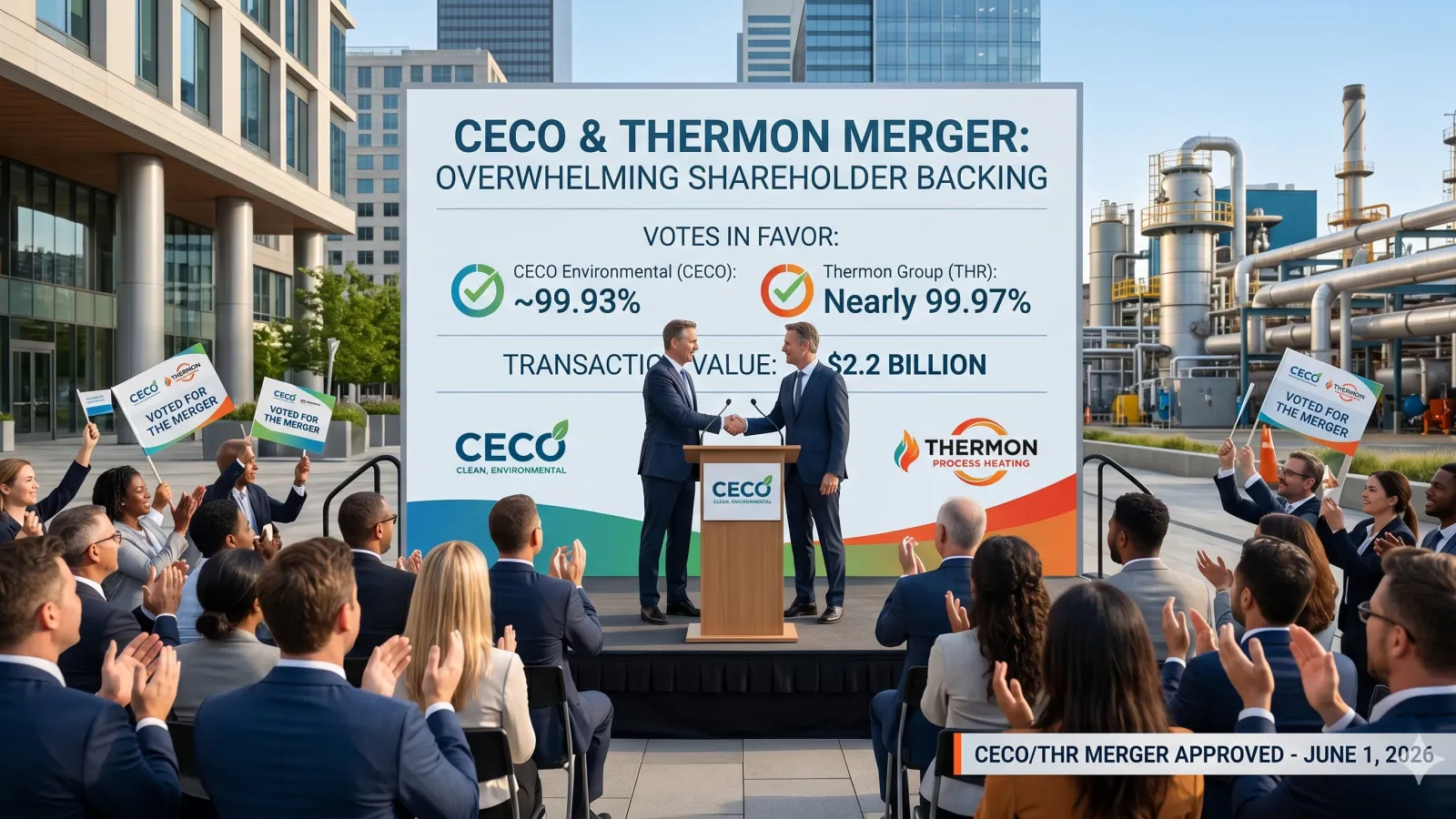
CECO Environmental Corp. and Thermon Group Holdings have received near-unanimous stockholder approval for their planned merger, with both Nasdaq-listed CECO and NYSE-listed Thermon reporting votes in favour of above 99.9% at their respective shareholder meetings on 28 May 2026. The transaction is expected to close on or around 1 June 2026, subject to standard closing conditions.
The combination brings together two Texas-headquartered industrial technology businesses: CECO, which focuses on engineered air, water and energy-transition systems across petrochemical, power, and battery-materials sectors; and Thermon, a specialist in industrial process heating, temperature maintenance, and environmental monitoring. The merged entity is positioned as a scaled provider of what both companies describe as "mission-critical" industrial solutions.
Merger mechanics and shareholder elections
The vote also finalised the consideration elections made by Thermon stockholders ahead of the 22 May deadline. Roughly 41% of outstanding Thermon shares opted for the stock consideration — receiving approximately 0.7920 of a CECO share plus a small cash top-up of $1.48 per share after proration — while around 6.5% elected the full cash option of $63.89 per share. The remaining 19.2% chose the mixed consideration of $10.00 cash plus 0.6840 of a CECO share; stockholders who missed the election deadline also default to this mixed option.
"We appreciate the strong support from both companies' stockholders and remain excited about bringing together complementary environmental and thermal capabilities to create a scaled platform of mission-critical solutions," said Todd Gleason, Chief Executive Officer of CECO.
Convergence context: industrial decarbonisation and energy-transition capital
The deal is worth reading in the context of accelerating capital flows into industrial decarbonisation infrastructure. CECO's existing portfolio already spans battery recycling, EV and battery production, and polysilicon manufacturing — all supply-chain-critical nodes for the energy transition. Thermon's process-heating and environmental-monitoring capabilities add an operational layer that is increasingly in demand as industrial operators face tighter emissions compliance requirements and grid-reliability pressure simultaneously.
This convergence of environmental compliance and energy-transition infrastructure is attracting a broadening investor base. Industrial decarbonisation has moved from a niche ESG allocation to a mainstream infrastructure thesis for pension funds, sovereign wealth vehicles, and cross-sector private equity in the past 18 months, driven in part by US Inflation Reduction Act incentive structures and parallel regulatory tightening in the EU and GCC. A combined CECO-Thermon entity, with exposure to petrochemical, power generation, and battery-materials markets across multiple geographies, would be positioned to compete for that capital as a single scaled platform rather than two mid-cap specialists.
The second-order question is whether the combined entity's broader application footprint — spanning clean air, industrial water, process heat, and temporary power — gives it the cross-sell leverage to compete for larger, multi-discipline EPC (engineering, procurement, and construction) contracts that have historically been the preserve of much larger industrial conglomerates. If integration delivers on the synergy thesis, the deal could accelerate a consolidation dynamic across the fragmented industrial environmental-technology sector, prompting further M&A among players seeking comparable scale ahead of a regulatory and capital-allocation cycle that increasingly rewards breadth of compliance solutions over single-point product lines.