
ABO-Group pivots to defence and nuclear as construction slows
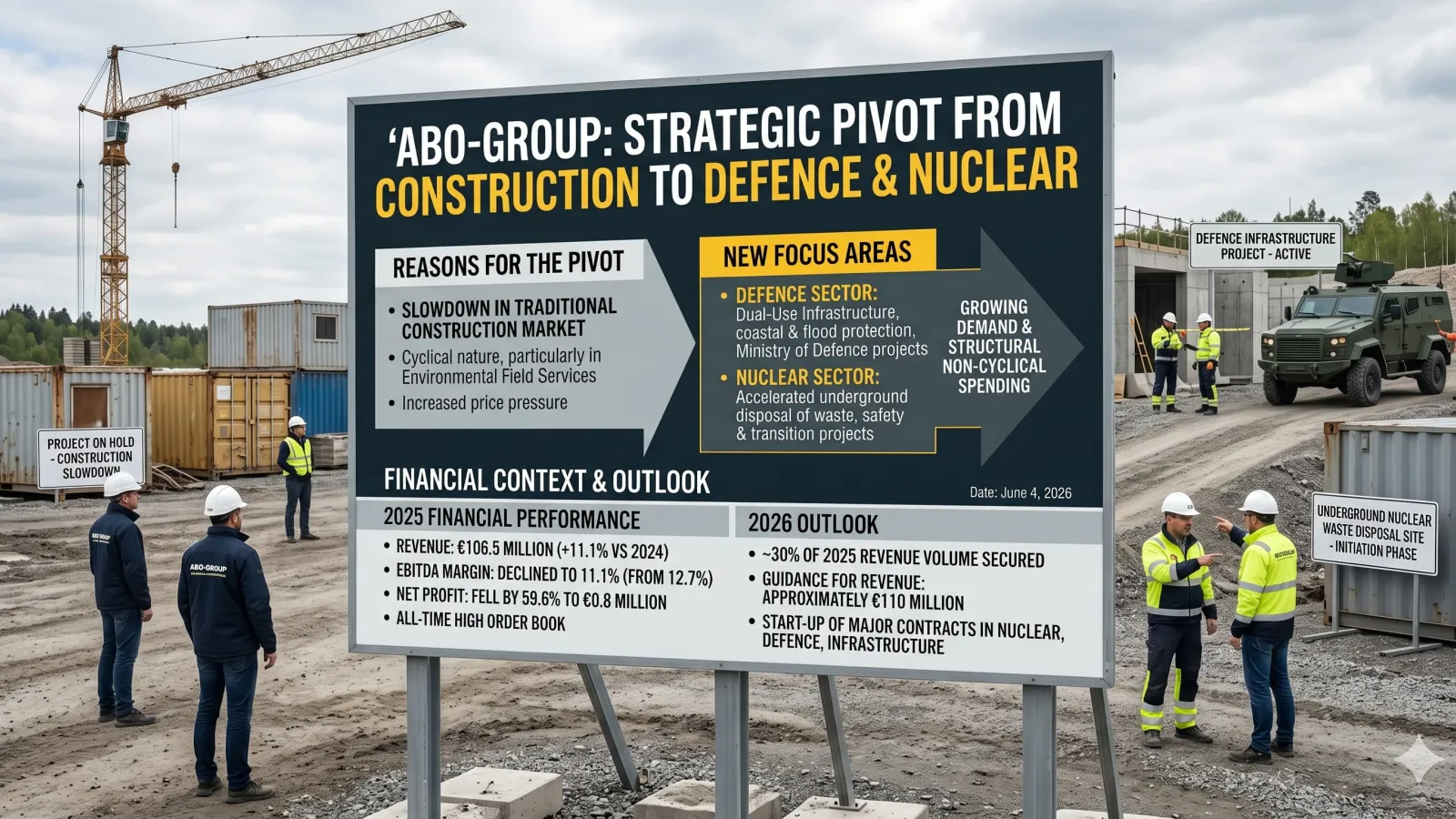
ABO-Group Environment, the Ghent-headquartered geotechnics and environmental engineering firm listed on Euronext Brussels and Paris, reported full-year 2025 revenues of €106.5 million — an 11.1% increase on 2024 — while simultaneously announcing a deliberate strategic pivot away from the construction sector towards defence, nuclear waste disposal, and climate-resilience infrastructure. The shift is a textbook convergence-era reallocation: a mid-cap industrial services company repositioning its soil science and subsurface monitoring expertise into the spending categories that geopolitical instability and climate risk are making structurally non-cyclical.
The headline growth figure flatters a more complicated picture. EBITDA margins compressed from 12.7% to 11.1%, net profit fell 59.6% to €0.8 million, and EBIT margin halved to 3.1%. Two proximate causes: intense price competition in commoditised environmental drilling services, and the delayed start-up of a major French contract that left machine fleets underutilised in Q4 2025. Operating cash flow, however, rose 58% to €12.2 million on improved working capital discipline — and net financial debt fell to €22.2 million, reducing the leverage ratio to 1.89x EBITDA.
Defence, nuclear and coastal resilience: the new order book
The more strategically significant signal is in the forward guidance. ABO-Group says its order book is at an all-time high, with approximately 30% of 2025 revenue already secured for 2026 — and that the new pipeline is "mainly driven by major contracts linked to today's macroeconomic and geopolitical themes." Named categories include nuclear waste disposal, Ministry of Defence projects, coastal flood-protection infrastructure, and mining and quarrying. The company is guiding for 2026 revenue of approximately €110 million.
CEO Frank De Palmenaer framed the shift explicitly: "Geopolitical instability and the increasingly tangible effects of climate change are leading to increased investments in defence, mining & quarries and infrastructure, including coastal defence and flood protection." The company secured multidisciplinary contracts in France covering defence and nuclear sectors, while in the Netherlands strict environmental-regulation enforcement around major infrastructure projects — including the closure of the Groningen gas fields — is generating a pipeline of remediation and monitoring work.
Convergence angle: engineering talent as the binding constraint
For the cross-sector strategist, the ABO-Group story illustrates a constraint that will increasingly bind across the defence-tech, energy-transition, and critical-infrastructure investment themes: the shortage of engineering talent. The company flagged a "growing shortage of engineering talent" in each of its three markets as the primary bottleneck on its own growth — and the same scarcity applies to the broader ecosystem of firms competing for sovereign-funded infrastructure and nuclear programmes across Europe.
This talent dynamic has direct read-across to the technology convergence debate. ABO-Group noted active pilots deploying AI as "a productivity lever" to complement specialist geotechnical expertise — an acknowledgement that the sector, like most engineering-intensive industries, is exploring automation not as a cost play but as a capacity play. The PFAS contamination remediation pipeline (driven by tightening EU regulatory standards) adds a further demand vector: the company noted that improved measurement and analysis methods are generating higher-capacity utilisation as the number of parameters requiring investigation rises. That translates directly into demand for both human specialists and data-processing tools.
The broader capital-allocation implication: as European governments accelerate spending on nuclear decommissioning, coastal defence, and dual-use infrastructure, the mid-cap engineering services firms with the relevant subsurface and geophysical expertise are being re-rated from construction-adjacent cyclicals into quasi-defence-and-infrastructure defensives. ABO-Group's deliberate pivot — reducing dependence on construction from a majority of revenues towards a more diversified base — may be an early indicator of a structural reclassification across the sector.