
HII ROMULUS USV enters Navy at-sea testing in autonomous fleet push
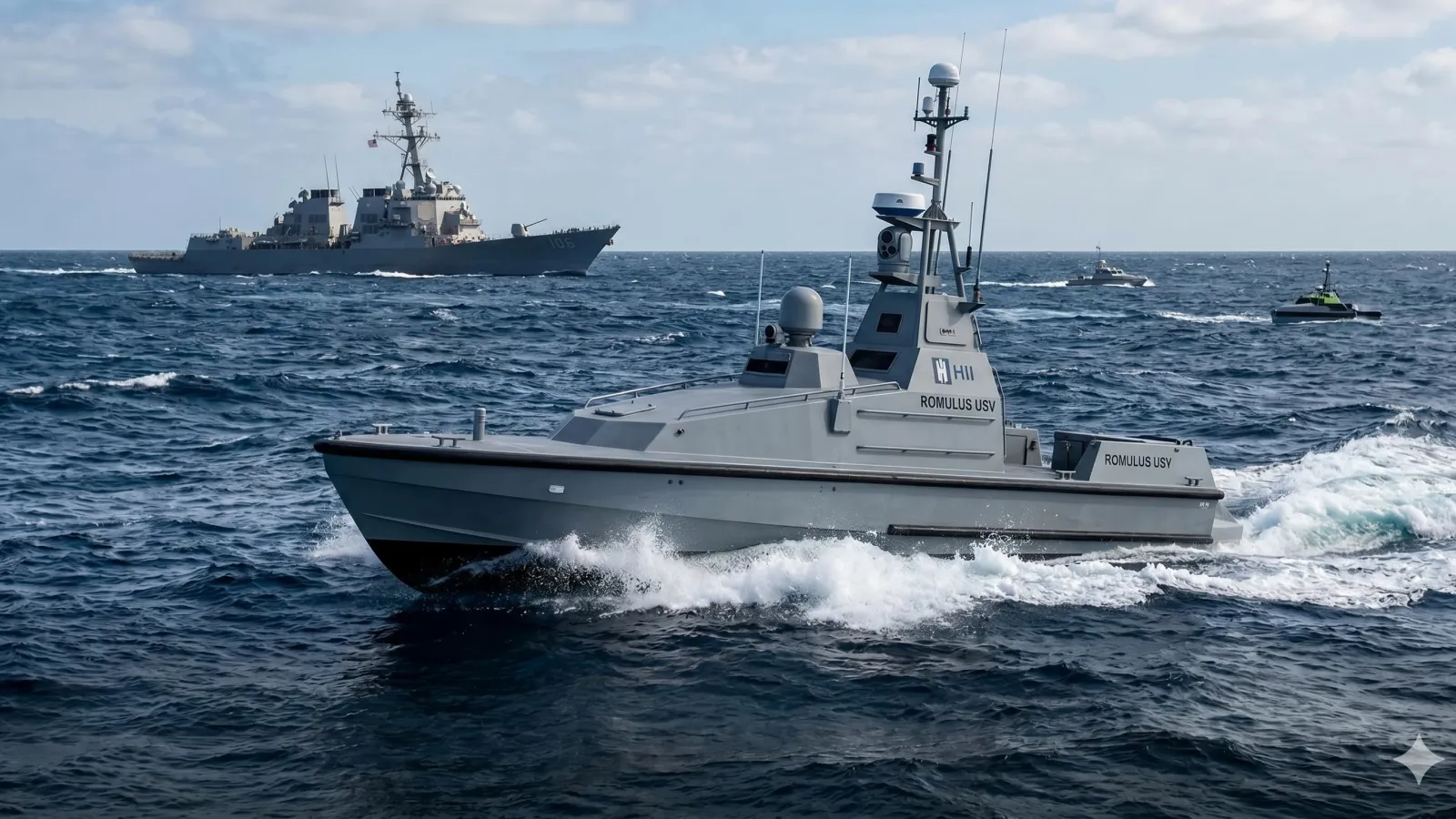
HII, America's largest shipbuilder, has confirmed that its ROMULUS Unmanned Surface Vessel (USV) has been selected by the US Navy to advance to the at-sea testing phase of the Medium Unmanned Surface Vessel (MUSV) programme — a milestone that places autonomous maritime systems firmly at the centre of the Pentagon's distributed-force doctrine.
The ROMULUS platform is built around HII's Odyssey Autonomous Control Solutions, a software suite the Virginia-headquartered company says is already deployed across 30 countries on both surface and underwater unmanned vehicles. The system is designed to command individual platforms and coordinated swarms across domains — a capability the US Navy is increasingly treating not as experimental, but as operationally essential.
Autonomy software as the strategic differentiator
The press release's most revealing detail is not the vessel itself, but the autonomy stack underneath it. HII positions Odyssey as the connective tissue between its ROMULUS USVs and its REMUS unmanned underwater vehicles (UUVs) — enabling what it calls a "dual-domain force package" capable of sustained open-ocean operations without persistent human crew oversight. For cross-sector observers, this is the maritime equivalent of the agentic-AI debate playing out in enterprise software: the question is no longer whether autonomous systems can operate, but how much decision-making latitude they are granted in contested environments.
Andy Green, executive vice president of HII and president of its Mission Technologies division, described ROMULUS as "a production-ready solution engineered to meet the demands of distributed maritime operations and integrated manned-unmanned teaming" — language that reflects the US Navy's broader shift toward a larger number of cheaper, more dispersed assets rather than a smaller fleet of expensive capital ships.
Convergence of AI, defence procurement and allied industrial strategy
The strategic stakes extend well beyond a single procurement milestone. The MUSV programme sits within a wider US defence posture that is restructuring naval force composition in direct response to Indo-Pacific threat assessments — particularly the pace of Chinese naval expansion and Beijing's own investment in autonomous maritime capabilities. That geopolitical context is reshaping allied procurement patterns: the Odyssey suite's deployment across 30 countries suggests that US autonomous maritime technology is already functioning as a soft-power and interoperability instrument, binding allied navies into shared command-and-control architectures.
From a capital-allocation perspective, the convergence of AI software, unmanned platforms, and defence contracts represents one of the most active cross-sector investment corridors of 2025–26. Traditional defence primes such as HII are competing — and increasingly partnering — with AI-native autonomy startups for contract share, while sovereign wealth funds and defence-adjacent private equity are accelerating commitments to dual-use robotics and autonomy software. The MUSV programme outcome will be watched closely by that investor community as a signal of whether established shipbuilders with proprietary autonomy stacks can hold ground against leaner software-first challengers.
The broader defence-AI ecosystem also has implications for the semiconductor and cloud-infrastructure sectors: real-time multi-vehicle autonomy at sea demands low-latency edge compute and ruggedised AI inference hardware, creating downstream demand signals for chipmakers and embedded-systems suppliers operating in the defence supply chain.
The at-sea evaluation phase does not carry a confirmed contract award timeline, and the MUSV programme remains competitive. The next critical data point will be the formal evaluation results and whether HII's production-ready positioning translates into a programme-of-record win — a decision that would accelerate the US Navy's transition to a genuinely mixed manned-unmanned fleet architecture at meaningful scale.