
Farseer Co-Founder Answers the Bank of England's AI Warning

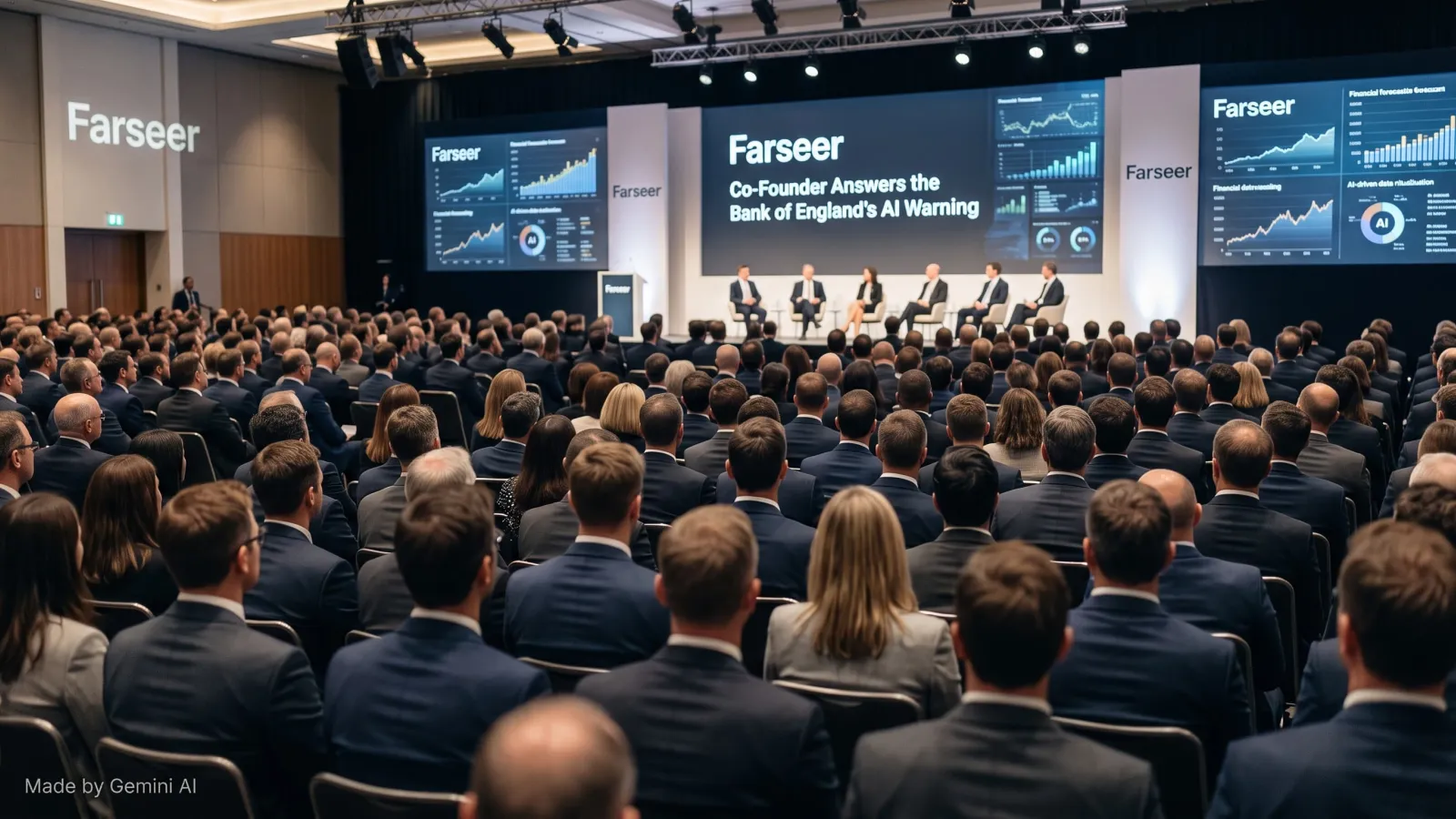
The Bank of England has warned that the adoption of artificial intelligence could pose risks to financial stability, including the danger that firms converging on similar models and similar data end up making the same mistake at the same moment. The warning lands as finance teams adopt AI at pace across planning, forecasting and reporting.

Co-founder,
Farseer
Farseer is an AI-native financial planning and analysis (FP&A) platform, which puts its co-founder, Matej Trbara, on both sides of the argument: warning about opaque AI in financial decision-making while selling AI that drives financial decision-making. The Fintech Times put that tension to him directly in a set of written questions. His answers are below.
Farseer is an AI-native FP&A platform, so you are warning about opaque AI in financial decision-making while selling AI that drives it. What separates Farseer from the thing the Bank of England is worried about?
The Bank of England is not warning against the use of AI itself. Its concern is what happens when AI becomes a black box in critical financial decision-making, with businesses unable to understand, challenge or verify the outputs it produces. That is an important distinction.
Farseer has been built differently. We have created what we call a Finance Operating System for the AI era, bringing live financial data, forecasting, planning, reporting and AI together in one connected platform. Rather than layering AI on top of fragmented legacy systems, we built the underlying infrastructure from scratch, including our own real-time financial data warehouse.
The aim is not to replace financial judgement with opaque automated decisions. It is to give finance teams more reliable data, clearer visibility and faster ways to test assumptions and scenarios. That allows businesses to make better-informed decisions than they could using disconnected spreadsheets and manual processes, which are themselves highly susceptible to error.
The Bank's concern is not one bad model, it is many firms running similar models on similar data and making the same mistake at the same moment. Does convergence on a handful of foundation models not make correlated forecasting error more likely? What breaks the correlation?
It is a valid concern, particularly if the market converges around a small number of general-purpose foundation models trained on similar datasets. If every platform is relying on the same models, there is a greater risk that similar assumptions, biases or errors could be replicated across the market.
That is not how Farseer is built. We have developed our own AI model specifically for financial planning and forecasting, rather than relying on the same underlying foundation models used by many other AI applications. Because our model has been purpose-built for FP&A, it is designed around the realities of financial planning rather than general-purpose reasoning. That helps reduce the risk of every platform interpreting information in the same way or producing the same forecasting assumptions and errors at the same time.
A CFO takes an AI-generated forecast to the board. Who actually checks it, and what happens in the teams that cannot reconstruct why the model produced that number?
The CFO remains accountable. AI doesn't change that.
Before any forecast is presented to the board, finance teams need to understand which data informed it, which assumptions have changed, why the forecast has moved and, ultimately, whether the outcome makes commercial sense.
The important test is not whether the team could reproduce every calculation manually. A sophisticated planning platform will process more data, dependencies and scenarios than would be practical to recreate in a spreadsheet. The test is whether the team can trace the result: identify the underlying data and assumptions, understand the key drivers, and explain why the forecast differs from the previous version or from the operating plan.
In our experience, teams using Farseer can validate forecasts through those inputs and drivers and, where the same logic and data are applied, arrive at the same result. If a team cannot explain a forecast at that level, it should not be presented to the board as a decision-ready number. The appropriate response is to investigate the data, assumptions and model behaviour, not simply defer to the AI.
That isn't an AI problem; it is a governance problem. AI should strengthen financial decision-making by making planning faster, more informed and more transparent, not by replacing human judgement with outputs that nobody can explain.
When the model and an experienced finance director disagree, which one wins in the firms you see? How often does the human turn out to be right?
Farseer's Finance Operating System is exceptionally good at identifying patterns, trends and anomalies in financial data. Finance leaders, however, bring context that the data alone cannot capture, whether that's customer conversations, supplier issues, regulatory developments, or strategic decisions.
When the two disagree, neither should automatically be treated as right. A difference in opinion should prompt further investigation, with finance teams testing assumptions, validating the data and understanding why the conclusions differ.
The strongest organisations don't treat AI as the final decision-maker. They treat it as another expert around the table, helping finance leaders make better-informed decisions, while ensuring accountability always remains with people.
Geopolitical events, energy volatility and cyber threats are exactly the tail events with the thinnest historical data. Is that not where these models are weakest, and where the confidence they project is most misleading?
AI is generally strongest at identifying patterns in historical data and weakest when history is no longer a reliable guide to the future.
That's why finance teams shouldn't rely on AI to predict the next geopolitical crisis or cyberattack. Instead, they should use it to understand the financial impact if one occurs and evaluate how different scenarios could affect the business.
This is where AI adds real value. It enables finance teams to model scenarios, stress-test assumptions and quickly assess the potential implications of rapidly changing events, helping them respond with greater speed and confidence when uncertainty arises.
What should the Bank of England actually do that it is not doing now?
Regulators should require firms to show that any AI-assisted forecast used in a material financial decision can be traced back to its underlying data, assumptions and business logic. If a forecast cannot be explained or challenged, it should not be relied on.
They should also stress-test concentration risk across the market, assessing whether firms are becoming too dependent on the same foundation models, datasets or technology providers. That would help identify where a shared weakness could create correlated errors across multiple organisations.
Finally, regulators should expect firms to monitor AI performance over time, including forecast accuracy, model drift and the frequency with which human decision-makers override its recommendations. That would provide a much clearer picture of whether these systems are genuinely improving decision-making or simply adding another layer of risk.
What would have to happen for you to conclude that AI in financial planning had made decision-making worse rather than better, and would anyone notice in time to act on it?
AI is a tool, and finance teams have been using machine-learning algorithms to support forecasting for more than 20 years. We therefore have far more experience with algorithm-assisted decision-making than the current debate sometimes suggests.
Generative AI is the latest evolution. It can analyse information, generate scenarios and surface insights far more quickly, with the potential to improve forecasting accuracy. However, its outputs must still be tested, challenged and validated.
I would reconsider my view if AI consistently produced poorer forecasts, made teams slower to respond to changing conditions or reduced people's curiosity about what was driving the numbers. If it begins to replace critical thinking rather than strengthen it, then it is being applied in the wrong way.
Finance teams should assess AI using the same discipline they already apply to other forecasting tools: comparing forecasts with actual results, monitoring errors, revisiting assumptions and challenging any output that does not make commercial sense.
Ultimately, accountability cannot be delegated to an algorithm. A person must remain responsible for every number used in a material decision. That responsibility, and the judgement required to exercise it, is precisely what will keep humans relevant in the age of AI.