
Constellation Software snaps up Finastra's US banking unit
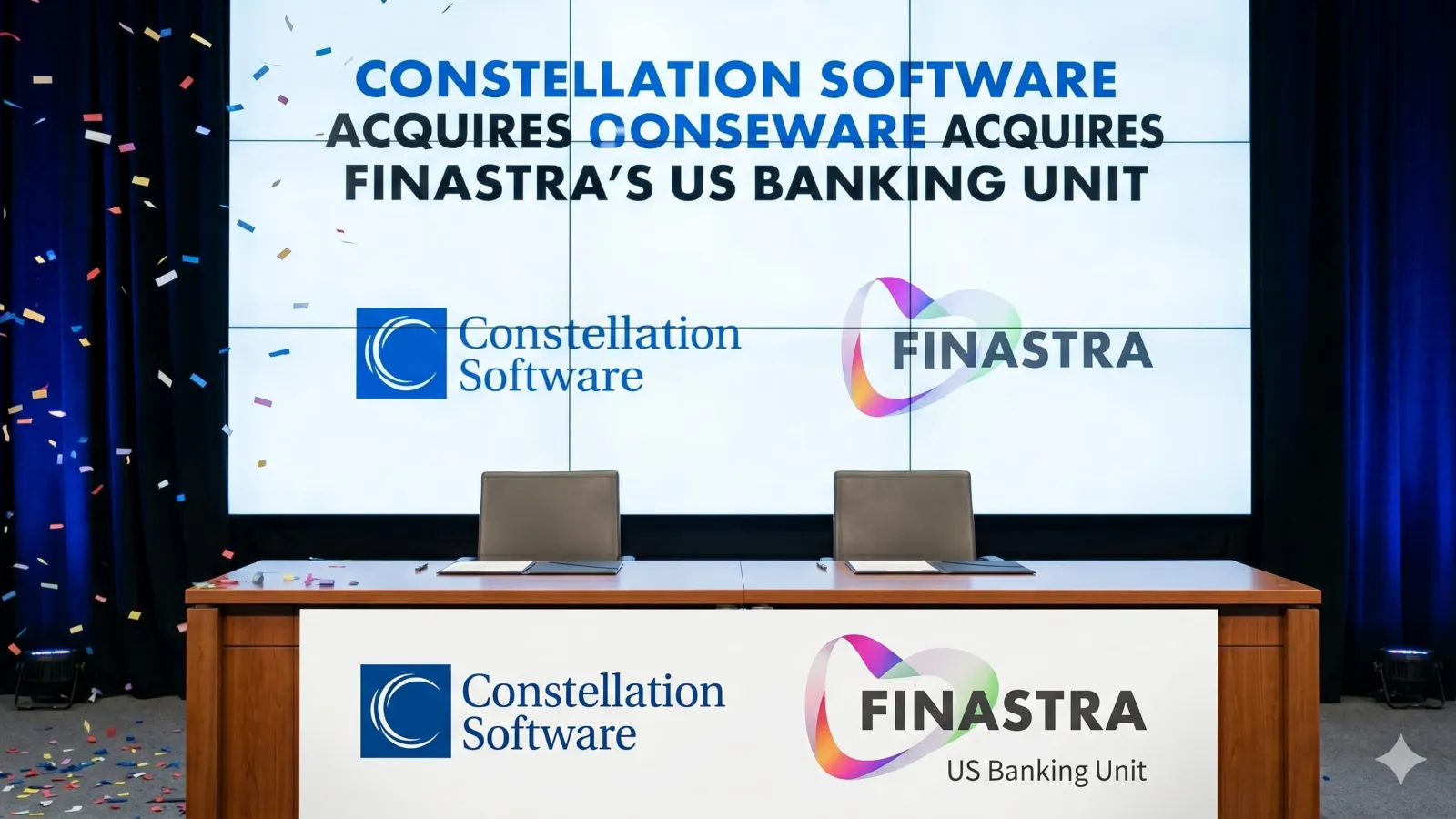
Constellation Software's CORA Group has acquired the US mid-market banking division of Finastra, folding three product lines — Phoenix Core Banking, Malauzai Digital Banking, and Fusion Analytics — into its portfolio of more than 40 enterprise software brands. The deal, announced on 3 June 2026, extracts a business that serves hundreds of US community banks and credit unions from one of the world's largest fintech software houses, and places it inside one of the most systematically acquisitive software conglomerates on the planet.
The transaction is a textbook application of the Constellation playbook: acquire mission-critical vertical software, resist the urge to integrate it into a monolith, and compound returns over a decade-plus holding horizon. CORA Group's portfolio CEO Denis Brosnan was explicit: "We don't acquire businesses to change what's working. We give them a permanent home, the resources to keep delivering, and the space to stay close to their customers." The business will operate as a standalone entity with existing product lines, staff, and client relationships intact.
What Finastra is shedding — and why
For Finastra — itself backed by private equity firm Vista Equity Partners and serving more than 7,000 financial institutions globally, including 40 of the world's top 50 banks — the divestiture is a strategic pruning exercise. The US mid-market segment, while profitable enough to attract a buyer of Constellation's calibre, sits at the margin of Finastra's stated priorities in lending, payments, and universal banking for large institutions. CEO Chris Walters described the move as sharpening focus "on the areas where we lead and where we can deliver the greatest value."
The assets being sold are not trivial. Phoenix was cited in Gartner's 2025 Magic Quadrant for Retail Core Banking Systems (North America) and received recognition in Celent's 2024 report for cost value, security, and scalability — two of the most-watched analyst benchmarks in the core banking space. Malauzai brings a digital-first front-end layer, and the Fusion Analytics suite (Analyzer IQ and Enterprise Content Management) rounds out a relatively self-contained technology stack for smaller US deposit-taking institutions.
The macro read: consolidation pressure on community banking software
The strategic logic here extends beyond a single deal. Community banks and credit unions across the US are caught in a structural pincer: deposit pressure from digital challengers, rising compliance costs from an expanding regulatory perimeter, and the mounting capital expenditure required to modernise ageing core systems. That creates a durable captive market for the sort of "sticky" software Constellation has built its empire on — platforms that are expensive and disruptive to replace, generating predictable recurring revenue regardless of macroeconomic conditions.
Constellation Software's model — 1,500-plus acquisitions since 1995 — is itself a convergence story of sorts: private-equity-style capital discipline applied to a software roll-up, generating returns that rival the best buyout funds without the leverage. For macro investors, Constellation (TSX: CSU) has long been a bellwether for the thesis that vertical SaaS in regulated industries is structurally recession-resistant. This deal reinforces that thesis in banking at precisely the moment when larger fintech players are rationalising their portfolios under PE pressure.
The broader implication for financial infrastructure is worth noting. As tier-one fintechs such as Finastra concentrate on large global institutions, the community and mid-market banking layer risks becoming a two-tier market: a handful of well-resourced roll-ups (Constellation, NCR Voyix, Jack Henry) on one side, and a long tail of under-invested legacy vendors on the other. That bifurcation has direct consequences for the 4,500-plus US community banks still running on systems older than a decade — and for the regulators, such as the FDIC and OCC, who are increasingly focused on technology concentration risk in the financial system. Whether CORA Group's hands-off stewardship accelerates or moderates that risk will be the story to watch as further mid-market consolidation unfolds.