
Firefly Aerospace wins $13m NASA JPL deal to build Mars aeroshell
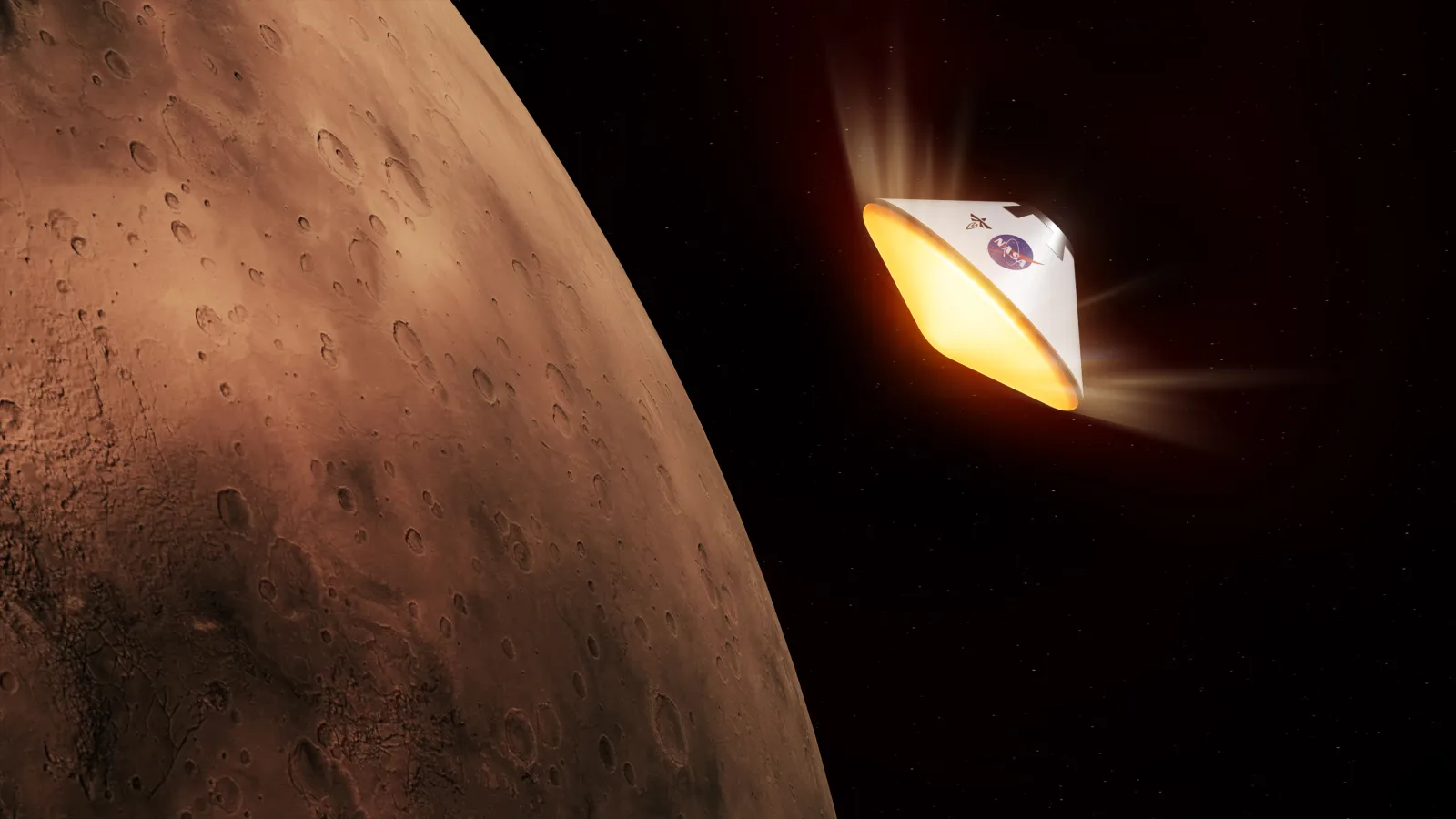
Firefly Aerospace, the Nasdaq-listed space and defence company headquartered in Cedar Park, Texas, has secured a $13 million subcontract from NASA's Jet Propulsion Laboratory to manufacture, test, and deliver the aeroshell for the SkyFall Mars mission, currently targeted for launch in late 2028. The award is the first to emerge from Firefly's newly established Gloworks innovation lab, and it signals a meaningful expansion of the commercial space supply chain into deep-space planetary infrastructure.
The SkyFall aeroshell, consisting of a backshell and a heatshield, must withstand the extreme thermal and structural loads of Mars entry, descent, and landing. Firefly says it will draw on carbon composite manufacturing techniques developed across its Blue Ghost lunar landers, Elytra orbital vehicles, and Alpha and Eclipse launch vehicles. The resulting structure needs to survive not only launch from Earth but also the so-called "SkyFall Maneuver", an untethered mid-air release of three Mars helicopters during atmospheric descent that eliminates the need for a conventional landing platform.
From the Moon to Mars, at commercial speed
The strategic logic here goes beyond a single contract. Firefly's VP of Spacecraft, Ray Allensworth, was direct about the company's intent: "Everything we're doing on the Moon yields transferrable technologies and experience that we can apply to Mars." That framing matters for investors and mission planners alike. NASA's Commercial Lunar Payload Services (CLPS) programme has functioned, in part, as a subsidised proving ground for the commercial space supply chain. Firefly, which successfully landed its Blue Ghost spacecraft on the Moon earlier this year, is now explicitly converting that track record into deeper planetary contracts.
The SkyFall helicopters themselves build on Ingenuity, the rotorcraft NASA operated on Mars as part of the Perseverance rover mission. Where Ingenuity was a technology demonstration, SkyFall's three aircraft are designed to perform genuine scientific work: capturing high-resolution surface imagery and subsurface radar data to locate water ice and assess terrain ahead of eventual crewed missions. That shift from demonstration to operational science marks a maturation of the Mars aerial survey capability, and it raises the engineering stakes for the aeroshell that must deliver those aircraft intact.
Convergence angle: commercial deep-space and the planetary supply chain
The broader significance of this award sits at the intersection of commercial aerospace, defence-adjacent dual-use technology, and the emerging planetary exploration economy. Firefly's composite structures originate in launch-vehicle manufacturing, a discipline closely linked to defence missile technology, and are now being repurposed for deep-space entry systems. That technology migration across application domains is precisely the kind of convergence Disrupts tracks: a capability built for one sector quietly enabling another.
For capital allocators, the SkyFall contract also illustrates the expanding commercial addressable market inside NASA's deep-space budget. JPL has historically relied on large prime contractors for planetary hardware. Firefly's subcontract position, coming alongside a parallel JPL award for four drones above the lunar south pole via its Elytra spacecraft, suggests the laboratory is diversifying its supplier base toward leaner, faster-cycle companies. That trend, if it continues, has downstream implications for incumbents in the planetary mission supply chain, and for mid-cap space investors weighing exposure to the next phase of US planetary exploration beyond the Moon. The 2028 launch window gives capital markets roughly two years to assess whether Firefly's production ramp at its recently expanded Texas facilities can absorb simultaneous lunar and Martian mission commitments without slipping timelines.