
Uber and Baidu launch driverless Apollo Go robotaxis in Dubai
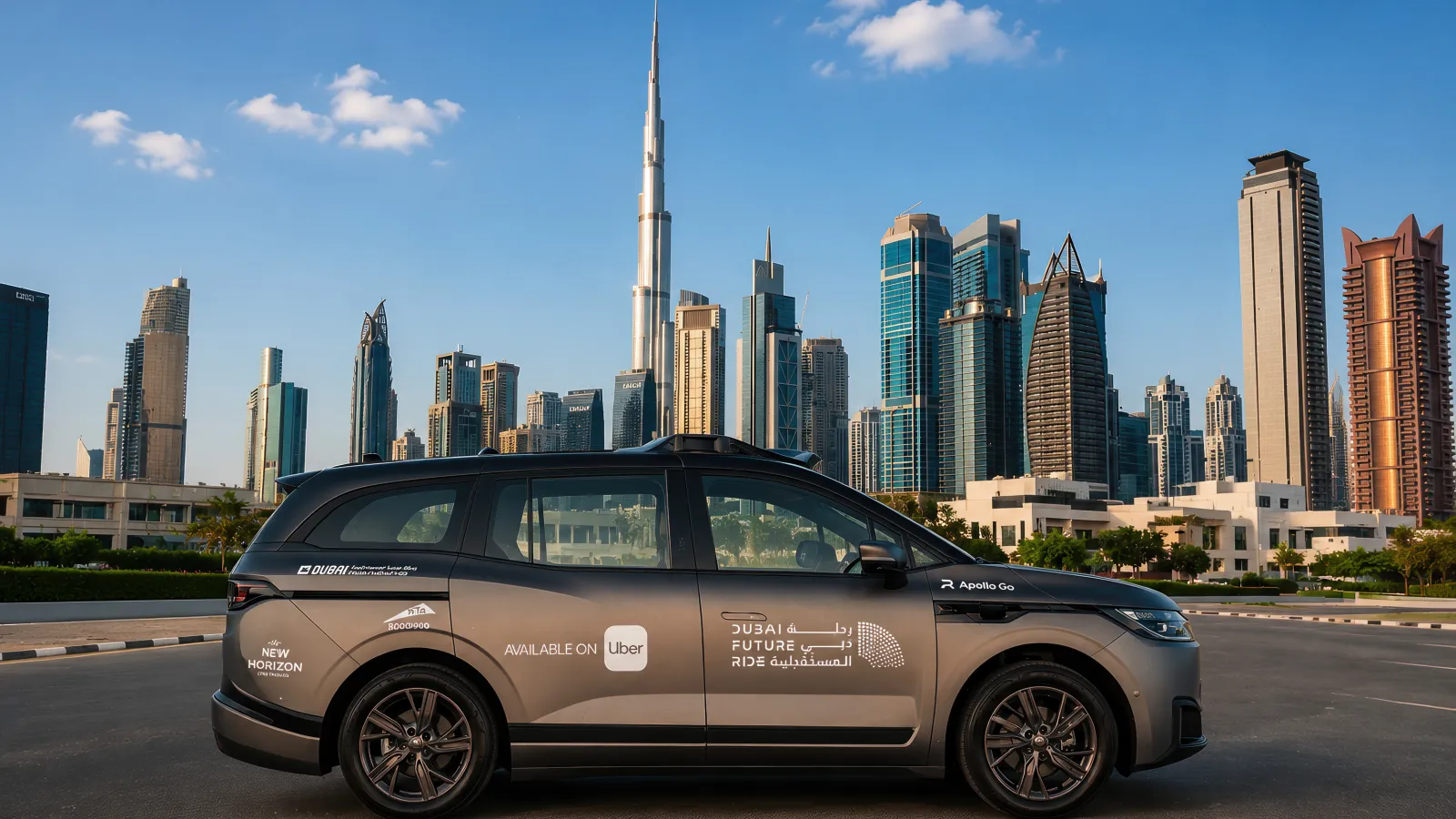
Uber and Baidu have activated a fully driverless robotaxi service on Dubai's public roads, marking the first time Uber's multi-partner autonomous vehicle strategy has translated from ambition into live commercial operation. Baidu's Apollo Go RT6 vehicles are now bookable through the Uber app under UberX and Uber Comfort, or via a dedicated "Autonomous" toggle, with fleet operations handled by New Horizon Luxury Transport. The launch covers select zones in Umm Suqeim and Jumeirah, with expansion planned across both territory and time.
The partnership is framed as the opening move in a multi-year agreement, with Dubai serving as the proving ground before Apollo Go scales to thousands of vehicles across Uber's broader global network. That framing matters: Uber is not positioning this as a bilateral experiment but as the first instance of a repeatable, platform-agnostic playbook for deploying third-party autonomous fleets at scale.
From bilateral deal to network architecture
The structural novelty here is less about the robotaxi itself and more about what Uber calls a "hybrid network," in which autonomous vehicles and human drivers occupy the same dispatch layer. With more than 30 AV partners declared and millions of autonomous trips completed annually, Uber is assembling an aggregation model for autonomy rather than betting on a single technology stack. Apollo Go's RT6 is purpose-built for fully driverless operation, carrying up to three passengers and running on more than 30 sensors with onboard real-time processing. Baidu says the Apollo Go fleet has accumulated over 350 million autonomous kilometres globally across 28 cities, of which more than 240 million were fully driverless, a deployment record that few Western robotaxi programmes can match.
"Launching in Dubai marks the first time our multi-partner vision comes to life on public roads, demonstrating how combining advanced autonomous technology with our global marketplace can accelerate an electric, shared, and autonomous future," said Sarfraz Maredia, Global Head of Autonomous at Uber.
For Baidu, the Dubai launch introduces a dual-model architecture internationally: self-operated Apollo Go services running alongside partner-operated Uber-integrated ones in the same city. That separation matters for unit economics, since the partner model offloads fleet capital expenditure while preserving brand and technology presence.
Gulf geography as convergence catalyst
Dubai's role as the launch city is not incidental. The emirate has been systematically positioning itself as a live testbed for autonomous mobility regulation, with the Roads and Transport Authority setting out licensing frameworks for driverless vehicles ahead of most Western jurisdictions. For Uber, that regulatory readiness lowers the deployment friction that has stalled or slowed robotaxi rollouts in San Francisco, London, and Tokyo. For Baidu, it offers an international showcase at a moment when Apollo Go's domestic China operations face intensifying competition from Pony.ai and WeRide, both of which have been expanding their own Gulf and South-east Asian footprints.
The cross-sector read-across extends into capital allocation. Gulf sovereign wealth funds, led by Mubadala and the Abu Dhabi Investment Authority, have been diversifying aggressively into mobility and AI infrastructure. A commercially operational, multi-partner AV network in Dubai creates a visible asset class for that capital to follow, particularly as Western autonomous vehicle programmes remain loss-making at scale. Waymo, the most advanced US robotaxi operator, is still confined to a handful of US cities and has not disclosed a path to international deployment. The Uber-Baidu model, precisely because it decouples the technology stack from the fleet operator and the marketplace platform, is structurally easier to export.
The broader implication for cross-sector investors is that autonomous mobility is beginning to bifurcate: vertically integrated players building proprietary hardware, software, and fleets on one side, and platform aggregators licensing third-party autonomy on the other. Uber is explicitly choosing the latter. If the Dubai network scales as intended, the next question is which cities follow and whether Gulf-based fleet operators begin to attract institutional capital as a distinct infrastructure sub-asset class in their own right.