
LiveU and Airwise unite drone video and airspace tools for public safety
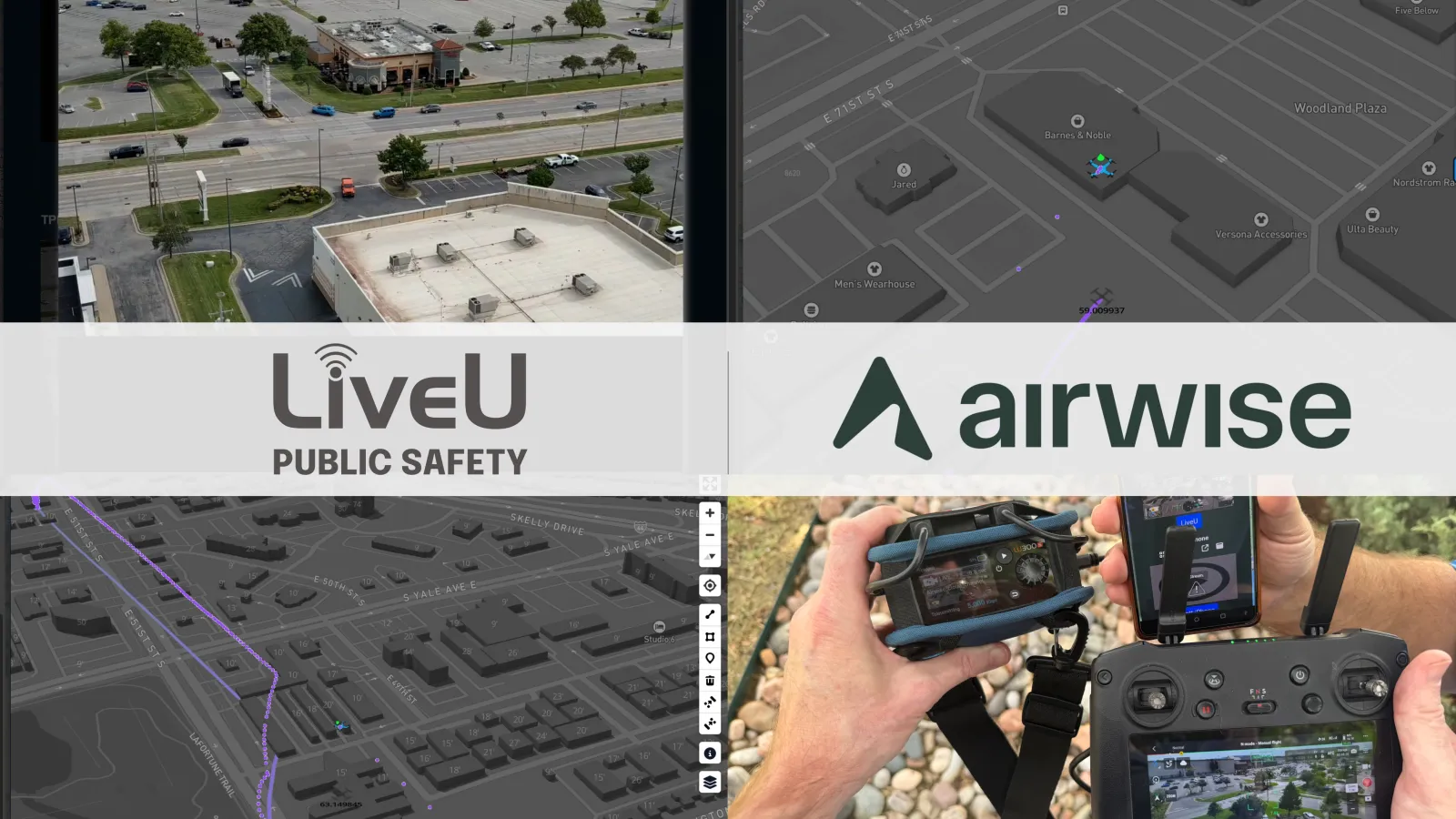
LiveU, a bonded-connectivity and live-video transmission specialist, and Airwise Solutions, an operational intelligence platform for enterprise drone fleets, have announced a strategic partnership that fuses two previously distinct layers of the public safety drone stack into a single validated architecture. The deal targets a persistent frustration for emergency agencies: the need to stitch together video streaming, wireless connectivity, fleet management, and airspace compliance from vendors whose systems were never designed to interoperate.
The joint offering connects LiveU's IP-bonded transmission protocol, which aggregates multiple cellular and other network links to sustain low-latency video from the field, with Airwise's airwiseOS platform, which handles airspace authorisations, pilot and fleet management, mission planning, and a common operating picture called Nexus. The result, the companies say, is a drone-to-command stack in which an agency can launch a mission, maintain regulatory compliance, and deliver live footage to incident commanders and mobile devices without switching between separate consoles.
Fragmented workflows and the cost of vendor sprawl
The problem the partnership addresses is structural rather than marginal. Public safety agencies operating uncrewed aerial systems (UAS) in the United States must satisfy Federal Aviation Administration airspace requirements in real time, manage assets across multiple operators, and simultaneously push high-resolution video to command posts that may be miles from the incident. Each of those functions has historically required a separate vendor relationship, a separate interface, and a separate point of failure. Gabe Graveline, EMS Officer and Robotics Coordinator at Tulsa Fire Department, an early user of the integrated stack, said the unified system "allows our operators to focus on the mission and airspace compliance, knowing that crystal-clear video is reaching incident command without delay."
The two companies will stage a live demonstration at DRONE RESPONDERS TEXCON 2026, running 19-22 October at Globe Life Field in Arlington, Texas, walking attendees through a complete end-to-end scenario from flight management through video delivery to command displays.
Convergence read-across: defence, robotics and the data pipeline
The LiveU-Airwise deal sits within a broader structural shift that extends well beyond public safety procurement. Defence and homeland security programmes on both sides of the Atlantic are under sustained pressure to field interoperable UAS command architectures that can be validated quickly and scaled without bespoke integration work. The US Department of Defence's Blue UAS framework and equivalent NATO standardisation efforts have accelerated demand for pre-integrated drone stacks, because the cost and delay of custom integration at the mission edge is increasingly untenable.
For the robotics and defence-tech investor community, the partnership illustrates a consolidation dynamic taking hold across the drone-software layer: point solutions for airspace, fleet management, and video streaming are converging into platforms. That mirrors the trajectory of the broader robotics software market, where fragmented middleware is giving way to integrated operational systems. Capital has tracked this pattern, with enterprise drone software companies attracting meaningful venture and corporate-venture interest in 2025 and into 2026, particularly where regulatory compliance (airspace authorisation, UTM operational intent) is bundled into the platform rather than left to the operator.
The second-order implication is about data. A unified drone-to-command stack does not just deliver video; it generates a structured operational record of every flight, every airspace interaction, and every stakeholder notification. That dataset becomes strategically significant as agencies and their technology suppliers move toward AI-assisted situational awareness, where historical mission data trains models for autonomous or semi-autonomous incident response. Neither LiveU nor Airwise has publicly outlined an AI roadmap, but the architecture they are building is precisely the kind of instrumented, networked foundation that makes such capabilities possible.
For cross-sector investors watching the convergence of robotics, connectivity infrastructure, and public-sector AI procurement, the LiveU-Airwise model is a template worth tracking: two mid-market specialists combining to present a fuller platform sale to a customer base that is consolidating its vendor relationships under budget pressure and operational urgency.