
Discovery 2Scale brings AI robotics to advanced materials in New Mexico
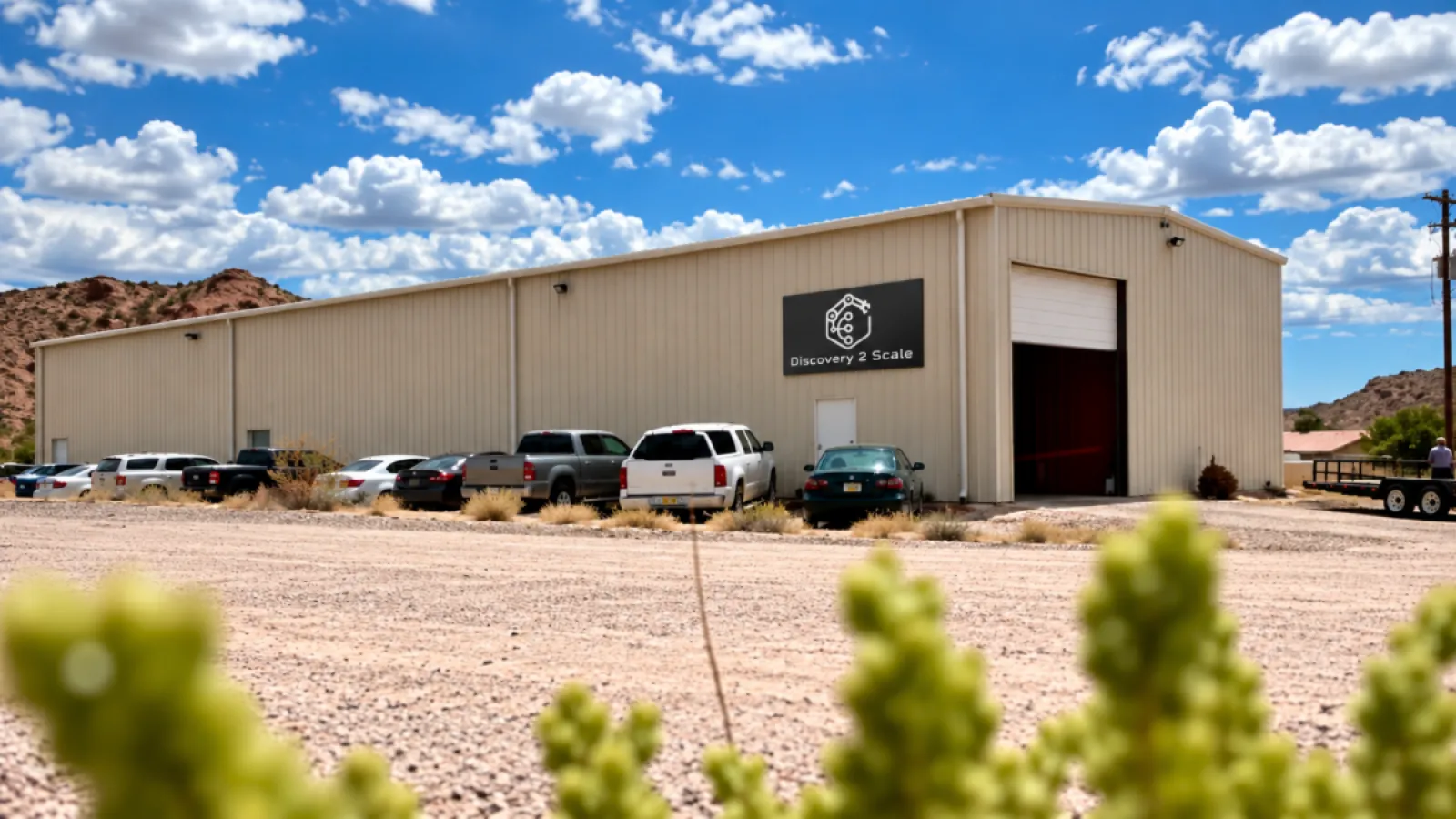
Discovery 2 Scale (D2S), a New Mexico advanced-materials company founded by former Los Alamos National Laboratory scientist Dr Saryu Fensin, is establishing its headquarters at Nambé Pueblo in Northern New Mexico, backed by $500,000 in state economic-development funding. The company's platform combines artificial intelligence, robotics and in-house testing to compress the journey from laboratory discovery to commercial-scale production, a bottleneck that has historically throttled the commercialisation of frontier materials.
The move is significant not because of the job count alone, but because it represents a structural attempt to close a gap that has long frustrated defence procurement and advanced-energy programmes alike. New materials, lighter armour composites, radiation-resistant compounds for fusion reactors, are frequently proven at bench scale inside national laboratories, then lost to the "valley of death" between proof-of-concept and manufacturable product. D2S is positioning itself explicitly as the bridge.
From lab to line: the commercialisation gap
"Discovering a new material is not the hard part anymore, the hard part is proving it works and figuring out how to make it at scale," said Dr Fensin. "We are putting AI, robotics, manufacturing and testing together under one roof because discovery alone doesn't put a material on an aircraft, in a ship or into a manufacturing line."
The 6,500-square-foot facility at Nambé Pueblo will house laboratory and office space leased and improved with Local Economic Development Act (LEDA) support from Economic Development New Mexico. The company says it expects to create more than 80 high-paying roles for scientists, technicians and skilled workers. Senator Martin Heinrich framed the investment squarely within national-security priorities, noting New Mexico's national laboratories as critical to both defence and advanced manufacturing. The location matters: Nambé Pueblo's development corporation has explicitly described the project as a vehicle for drawing tribal communities into New Mexico's innovation economy, creating what its president Randy Vigil called "pathways for collaboration, investment and technical workforce development."
Cross-sector read: defence, fusion and the materials bottleneck
The convergence angle here spans at least three sectors. In defence, lighter armour translates directly to platform weight budgets for aircraft and naval vessels, a persistent constraint as the Pentagon seeks to field faster, more agile systems. In energy, radiation-resistant materials are a non-negotiable prerequisite for commercial fusion, and the fusion industry's timeline is increasingly tied not to plasma physics but to materials engineering and manufacturing readiness. In both cases, the limiting factor is the same: the inability to produce validated materials at industrial volumes quickly enough to meet procurement or deployment schedules.
AI-assisted materials discovery is not new, groups including Google DeepMind and various national-lab consortia have used machine-learning models to predict material properties in silico. What D2S is attempting is the harder downstream step: automating the physical validation and scaling process using robotics, so that the number of human-hours required to move from a promising simulation to a tested, manufactured batch shrinks materially. If the approach proves out, it could reduce the time-to-qualification cycle that currently stretches to years for defence-certified materials.
From a capital-allocation perspective, the story also illustrates a broader pattern: US state governments and federal labs are increasingly acting as de facto early-stage investors in dual-use deep-tech, filling a gap that pure venture capital has historically avoided because materials-science companies carry long development timelines and heavy capex. New Mexico's LEDA mechanism is a relatively modest instrument, but it signals the state's intent to retain intellectual property developed at Los Alamos and Sandia within the local private sector rather than seeing it commercialised elsewhere. For cross-sector investors tracking the fusion-materials-defence nexus, the emergence of robotics-accelerated materials platforms is a watch-list development, the category is early, but the demand signal from both defence and energy buyers is structural rather than cyclical.