
Quantinuum puts Helios quantum computer inside Oracle Cloud
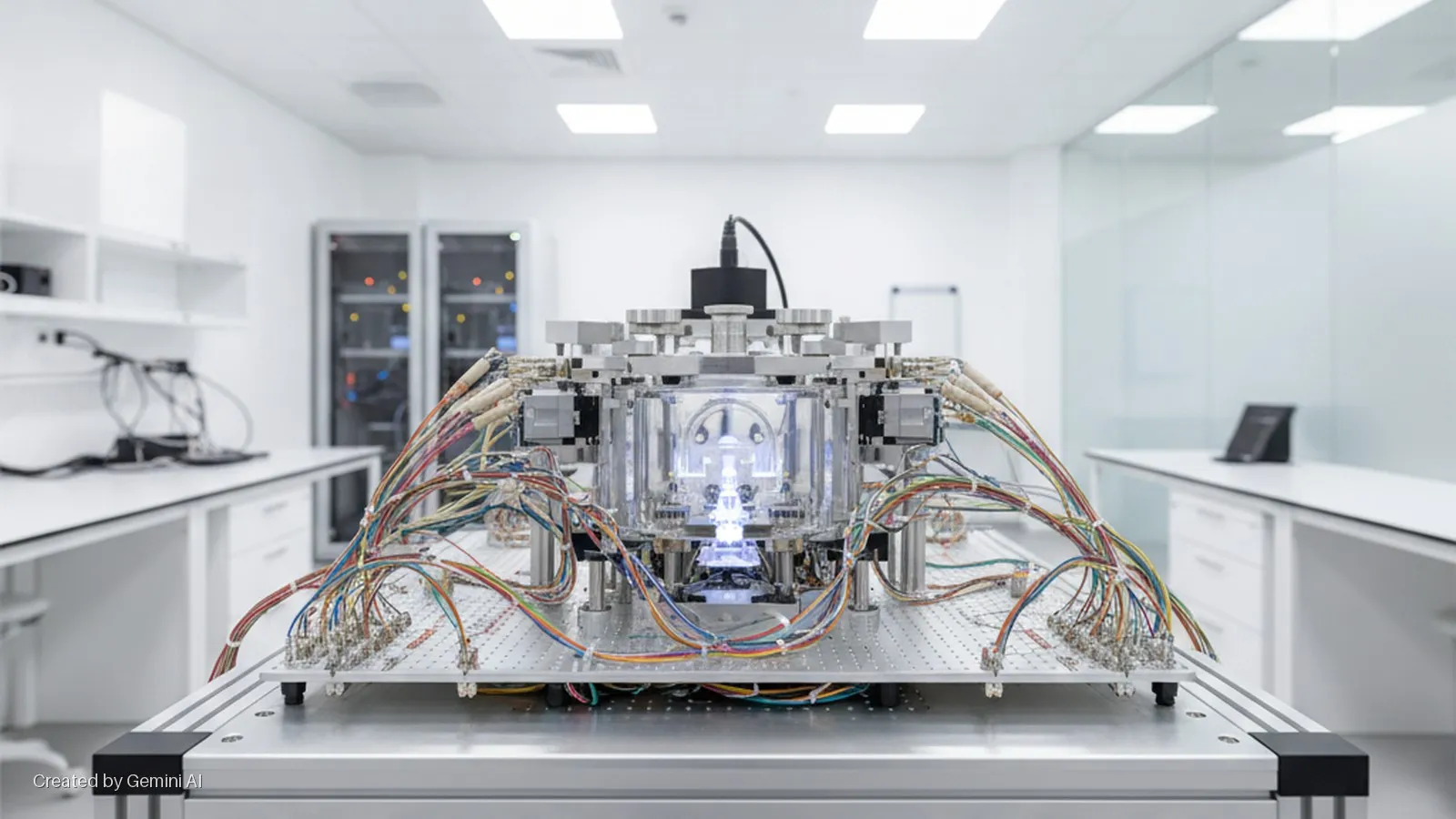
Quantinuum and Oracle have announced a multi-year strategic partnership that will see Quantinuum's third-generation Helios quantum computer deployed physically inside an Oracle Cloud Infrastructure (OCI) data centre in the United States. The arrangement makes Helios accessible to OCI customers as a managed cloud service, positioned alongside Oracle's existing high-performance computing (HPC) and GPU infrastructure. It is one of the most concrete steps any major cloud vendor has taken to embed a commercial quantum processing unit (QPU) directly into a hyperscale platform.
Helios, which Quantinuum launched commercially in November 2025, is a 98-physical-qubit trapped-ion system. The company says it has demonstrated performance at 48 logical qubits and achieves an average two-qubit gate fidelity of 99.921%, a figure it describes as exceeding the widely-cited "three 9s" threshold that the quantum industry treats as a meaningful reliability benchmark. By hosting the hardware on-premises within OCI's facilities, Quantinuum says customers will gain access under the same identity, governance and data-security controls they already use, removing the need to procure or operate specialist quantum facilities independently.
Energy economics as the hidden convergence driver
One detail in the release deserves more strategic attention than it typically receives in quantum announcements: power consumption. According to a 2026 paper cited by Quantinuum, leading supercomputers draw between 16 megawatts and 39 megawatts. A single Helios unit, the company says, runs at approximately 60 kilowatts without an HVAC system, less than one percent of a top supercomputer's draw. As hyperscalers face acute pressure over data-centre power budgets, particularly under tightening grid constraints in the US and Europe, the energy profile of quantum co-processors becomes a meaningful variable in infrastructure planning. A QPU that can shoulder specific classes of computationally intensive workload at a fraction of the wattage reframes quantum not just as a performance story but as an energy-efficiency lever for cloud operators already struggling to satisfy AI-driven power demand.
Oracle's EVP for OCI, Mahesh Thiagarajan, framed the partnership squarely around that complementarity: "By bringing Quantinuum's Helios to Oracle Cloud Infrastructure, we want to give developers a practical and secure way to explore how quantum computing could complement their existing AI and HPC workloads while improving compute efficiency and energy use."
Cross-sector applications and capital read-across
The use cases both companies cite span several industries simultaneously: drug discovery, materials science, financial modelling, logistics optimisation, and large-scale AI workloads. That breadth is deliberate. Quantinuum already holds active engagements with customers in pharmaceuticals, materials science, financial services, government and industrial markets. Embedding Helios inside OCI is partly a distribution play, expanding the addressable pool from specialist quantum teams to the broader universe of enterprise OCI users who have never operated quantum hardware.
From a capital and competitive-landscape perspective, the deal lands at a formative moment. IBM, Google, IonQ and Rigetti are each pursuing different routes to enterprise quantum adoption, with cloud integration increasingly the dominant go-to-market model. Microsoft has pursued a hybrid quantum-classical architecture through Azure Quantum, while AWS has aggregated third-party QPUs through Amazon Braket. Oracle's move to host Quantinuum's hardware on-premises rather than simply brokering API access represents a deeper integration model, one that raises questions about exclusivity, co-investment and how quickly OCI can convert its existing enterprise base into quantum workload experimenters.
Oracle says it plans to preview its OCI quantum service "in the coming months," with support for open-source hybrid-programming frameworks to let developers build and test quantum-classical applications using familiar tooling. The Ellison Institute of Technology has already indicated it plans to explore the platform for scientific computing, pointing to academic and research adoption as an early proving ground before broader commercial rollout. The key open question is whether enterprise adoption timelines align with Quantinuum's hardware roadmap, and whether the energy and performance case for hybrid workloads can be demonstrated convincingly enough to shift procurement conversations at scale.