
sensiBel NOVA32 targets drone detection with 32-mic edge AI array
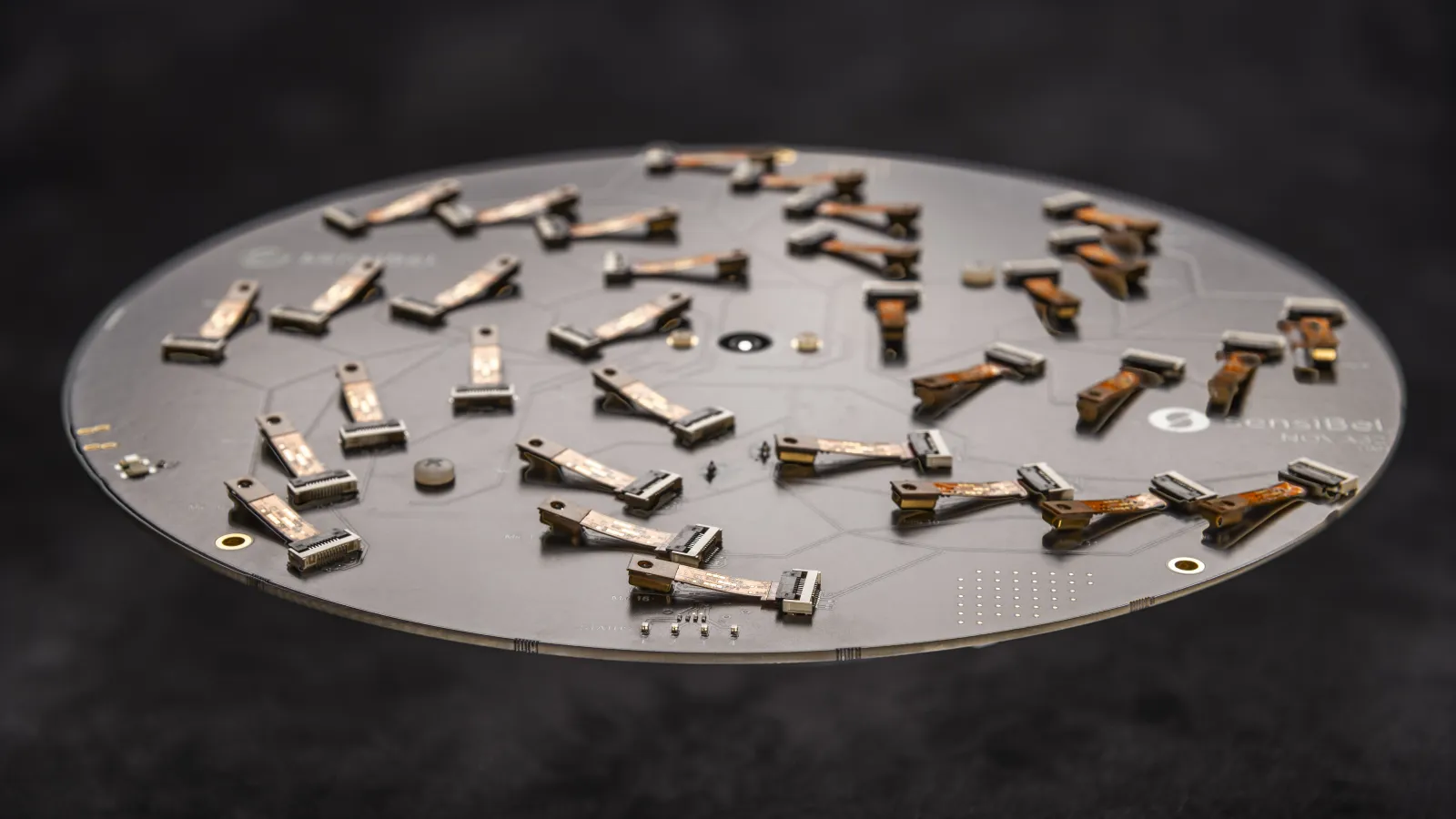
Norwegian deep-tech firm sensiBel has launched NOVA32, a 32-microphone optical MEMS array development kit designed to compress the gap between hardware prototyping and deployable edge AI applications. The kit targets three converging use cases: drone detection, industrial predictive maintenance, and environmental noise mapping. Each is a domain where acoustic precision is becoming a strategic differentiator, and where the compute is increasingly happening at the sensor rather than in the cloud.
NOVA32 aggregates 32 of sensiBel's SBM100B optical MEMS microphones into a single 32-channel, 24-bit USB audio stream, processed via an XMOS XCORE.AI chip that replaces the FPGAs and analogue-to-digital converters that would otherwise demand separate integration work. The plug-and-play USB interface is compatible with NVIDIA Jetson development platforms, as well as Windows, MacOS and Linux systems, meaning developers can attach the array to an existing edge compute node without custom firmware scaffolding.
Acoustic physics as a competitive moat
The performance specifications are the centrepiece of sensiBel's pitch to system integrators. The company says NOVA32's microphones deliver 14dBA equivalent input noise, 132dB dynamic range, and an 80dBA signal-to-noise ratio. These figures matter in real-world deployment: a drone-detection system that struggles to distinguish rotorcraft signatures from ambient urban noise is operationally useless, whereas one with high dynamic range can maintain detection confidence across quiet rural and loud city environments alike.
Tom Hazlett, sensiBel's vice president of sales and marketing, claims the optical MEMS architecture delivers "two-and-a-half times the microphone-array performance over even the best capacitive MEMS microphones." That claim carries promotional weight and cannot be independently verified from the release, but it speaks to a structural distinction: optical MEMS microphones measure acoustic pressure via light interference rather than capacitive displacement, which the company says removes a key source of self-noise inherent to conventional MEMS designs. The kit also supports TDM (time-division multiplexing) architectures, giving integrators a path to phase-aligned, scalable beamforming without multiplying signal lines.
Where this sits in the edge AI and defence-tech landscape
The strategic context for NOVA32 extends well beyond a hardware product launch. Drone detection has moved from a niche security concern to a mainstream infrastructure priority: the proliferation of commercial UAS platforms has forced airports, critical-infrastructure operators, and urban planners to deploy multi-modal detection networks combining radar, RF sensing, optical, and acoustic modalities. Acoustic arrays are valued for their ability to classify threats passively, without emitting detectable signals, making them an attractive complement to active radar in both civil and military environments.
This positions sensiBel at the intersection of the defence-tech and industrial IoT markets, both of which are attracting sustained capital inflows. European sovereign and institutional investors have been explicitly expanding their exposure to dual-use deep-tech since 2022, with Scandinavian deep-tech firms benefiting from proximity to NATO procurement pipelines and a domestic policy environment supportive of dual-use commercialisation. A Norwegian sensor company building acoustic edge AI hardware for drone detection is, structurally, a credible candidate for defence procurement frameworks as well as commercial industrial contracts.
The broader edge AI sensor market is also being reshaped by the economics of inference. As enterprise and government buyers seek to reduce latency and cloud-compute costs, processing acoustic classification at the sensor node rather than routing raw audio to a central server becomes both a performance and a cost argument. sensiBel's integration of the XMOS AI processor directly into the NOVA32 kit signals an intent to own that full stack, from microphone physics through to the inference-ready data stream.
For capital allocators tracking deep-tech in Northern Europe, NOVA32 is a concrete signal that the company has moved from component supplier to platform vendor. The next question is whether sensiBel can attract the system integrator partnerships, particularly in defence and critical infrastructure, that would convert hardware kit sales into recurring software and services revenue.