
Fasset reaches $1B valuation with $68M SBI-led Series C
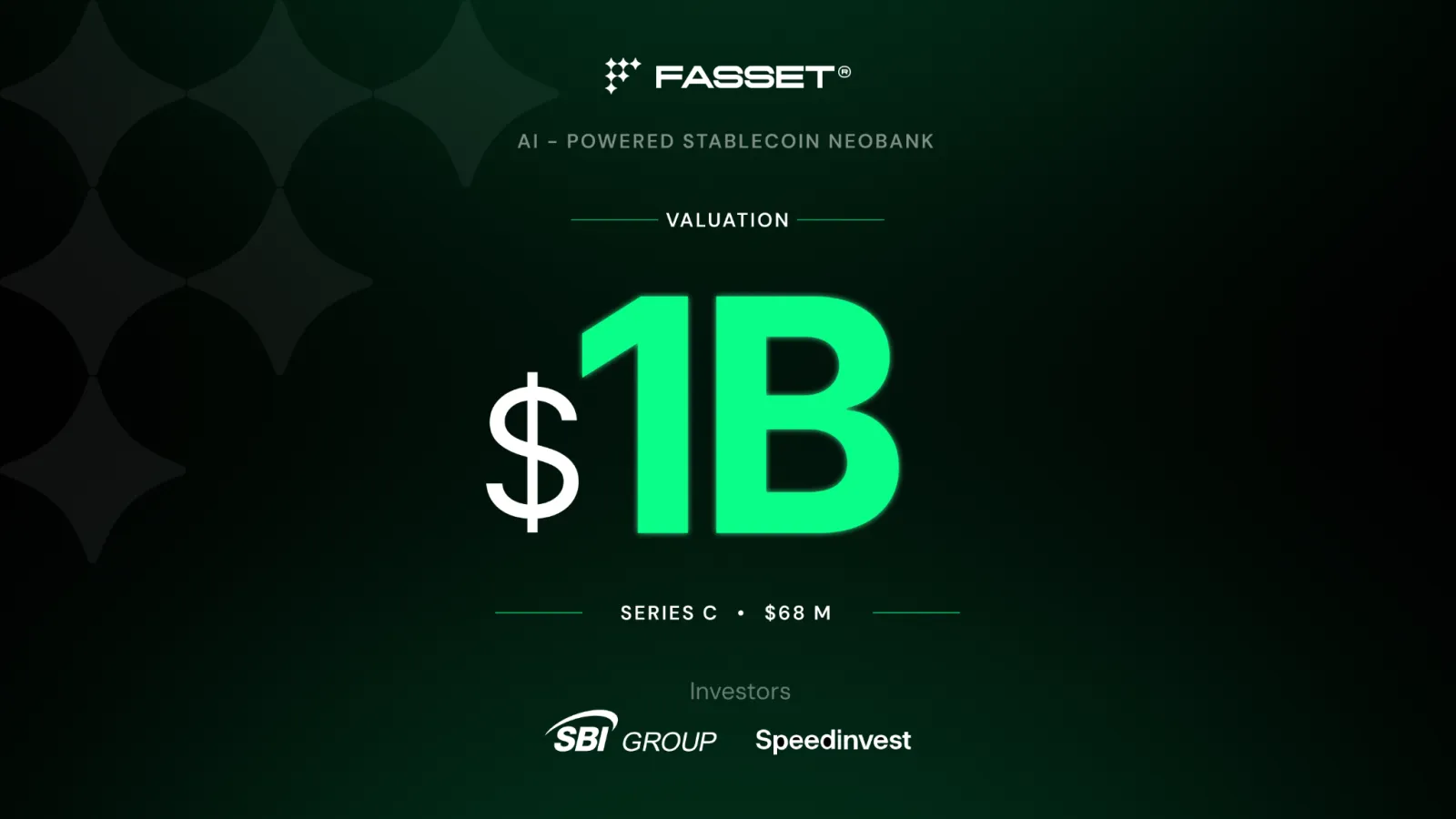
Fasset, the stablecoin neobanking platform founded in Los Angeles in 2019, has closed a $68 million Series C at a $1 billion valuation, crossing the unicorn threshold and bringing its total 2026 fundraising to $119 million. SBI Group, the Tokyo-listed financial conglomerate, led the round, with Speedinvest continuing its backing from the $51 million Series B closed in May. The raise is more than a headline number: it marks one of Japan's most prominent institutional investors making an explicit bet that the next layer of global banking infrastructure will be built on stablecoins and agentic AI, not legacy correspondent networks.
Fasset says it now processes more than $40 billion in annualised transaction volume across 3 million wallets and over 1,000 enterprise clients in 125 countries. Its Own Network connects local banking systems, payment providers, telcos, liquidity pools, and custody partners across more than 100 banking corridors, using stablecoins as settlement rails where they offer advantages in cost or speed.
SBI's strategic calculus: an on-chain economic zone
SBI's motivation is strategic in ways that go beyond a standard fintech equity stake. Yoshitaka Kitao, chairman and CEO of SBI Holdings, framed the investment as a component of SBI's "APAC Digital Economic Zone" thesis: "An international remittance and settlement infrastructure built on stablecoins is a core component. Together with Fasset, we will advance the development of the next generation of on-chain financial systems, extending from the Asia-Pacific region to the Middle East and Africa."
SBI already holds positions in Ripple, Circle, and Morpho, as well as a stake in B2C2, the institutional crypto liquidity firm. The Fasset investment adds a regulated, multi-corridor neobanking platform to that portfolio, giving SBI a distribution mechanism into GCC, South and South-East Asian markets where conventional correspondent banking is slow and expensive. Access to SBI Remit's network, which supports bank-account remittances to roughly 200 countries, extends Fasset's reach further than its own licences alone could achieve.
The convergence angle: where fintech, AI and geopolitics intersect
The capital deployment plan points to where the real convergence story lies. Fasset intends to deepen agentic AI systems for transaction routing, stablecoin settlement, and tokenised asset infrastructure. Agentic AI in payments means autonomous systems making real-time routing decisions across currencies, rails, and liquidity providers, optimising for cost, speed, and regulatory compliance without human intervention at each step. That is a meaningful technical shift from the rule-based payment engines that underpin most neobanks today.
The geopolitical dimension is also hard to ignore. GCC regulators have spent the past three years building frameworks for digital assets and stablecoin issuance, partly to attract exactly this kind of cross-border infrastructure investment. Fasset's regulatory footprint in the Gulf, combined with SBI's Asia-Pacific network and Speedinvest's European presence, gives the platform a multi-jurisdictional architecture that is difficult to replicate quickly. For sovereign wealth allocators and cross-sector investors watching the battle over global payment rails, the question is whether stablecoin-native infrastructure of this scale can credibly challenge SWIFT-adjacent correspondent banking before the next round of central-bank digital currency frameworks locks in a different settlement standard.
Mohammad Raafi Hossain, Fasset's co-founder and CEO, described the ambition bluntly: "The banking system is broken. It's not enough to build another financial front on current rails. We are investing deeper into the stack, from licences in emerging markets to enabling agentic payments, to rebuild the way we do banking from the ground up."
For macro investors, the Series C signals that institutional capital is increasingly willing to fund the replacement of banking plumbing, not merely another consumer-facing layer on top of it. The next test will be whether Fasset's corridor economics hold at scale as central banks in its core markets advance their own digital currency ambitions.