
Kratos posts 30% revenue surge on hypersonic and drone demand
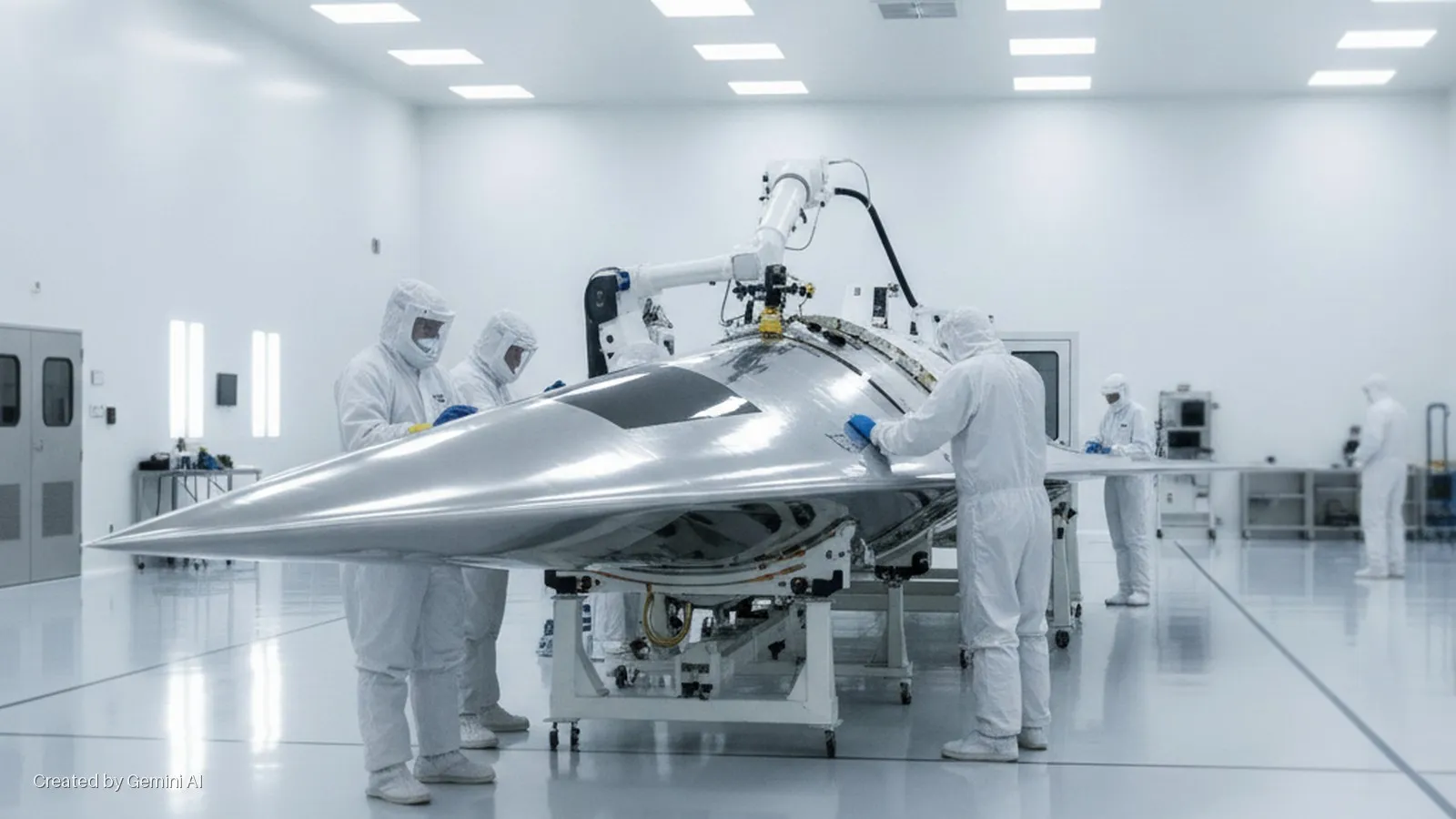
Kratos Defense & Security Solutions posted second-quarter 2026 revenues of $458.8 million, a 30.5 percent year-on-year increase and 19.1 percent organic growth, as surging Pentagon demand for hypersonic systems, jet-powered drones, and missile propulsion drove the San Diego-based contractor to raise its full-year revenue guidance to between $1.75 billion and $1.81 billion.
The results signal something broader than a single company's earnings beat. Kratos is one of the clearest publicly listed proxies for the US Department of Defence's shift toward affordable, mass-producible advanced weapons, the "Department of War" framing that CEO Eric DeMarco used throughout his commentary, reflecting the Pentagon's recent rebranding. That framing matters: it points to a procurement doctrine that prioritises scalable unit economics over bespoke capability, a posture that is reshaping which industrial-base players attract capital.
The numbers behind the growth
Within Kratos' Government Solutions segment, which generated $379.7 million of the quarter's total, the standout growth came from Defence Rocket Systems (up 50.2 percent organically), Turbine Technologies (up 43.3 percent), and Microwave Products (up 29.5 percent). The Unmanned Systems segment, home to the Valkyrie jet-powered drone, added 8.1 percent organic growth to reach $79.1 million, with management forecasting approximately 10 percent organic growth for the full year as recent contract awards come through. The company's consolidated book-to-bill ratio of 1.3 to 1.0 over the last twelve months, on bookings of $1.99 billion, points to a pipeline that is still expanding: Kratos' bid and proposal pipeline stood at $15 billion at quarter-end, up from $14.3 billion at the close of Q1.
Adjusted EBITDA of $38.2 million (8.3 percent of revenue) remains relatively thin for a defence hardware business, but Kratos is deliberately front-loading capital. The company is targeting 3,000 small jet engines annually by 2027 to meet cruise-missile demand, and plans to begin producing approximately 40 Valkyrie aircraft per year by the start of 2028. Capital expenditure guidance of $125 million to $135 million for 2026, alongside a projected free cash outflow of $85 million to $105 million, reflects a company in aggressive industrial build-out mode rather than harvest mode.
Convergence read-across: where defence spend meets adjacent sectors
The strategic read-across for cross-sector investors extends well beyond traditional defence equities. Kratos' ramp in hypersonic integration, engine manufacturing, and space and satellite secure facilities represents a form of dual-use industrial infrastructure whose inputs cut across energy (propulsion test cells draw significant grid power), advanced materials, and precision manufacturing, the same supply chain that serves commercial space and next-generation aerospace primes.
The microwave electronics and C5ISR (command, control, communications, computing, combat, intelligence, surveillance and reconnaissance) businesses also sit at the intersection of defence and the broader satellite-communications market, where commercial operators and sovereign customers are increasingly buying from the same component suppliers. Kratos' space and satellite facility expansion, with $7 million to $8 million of dedicated capital spend in 2026, feeds confidential government programmes but uses the same engineering talent pool that underpins commercial low-Earth-orbit infrastructure.
For macro investors, the picture is one of a structural US defence-industrial recapitalisation that is only beginning to show up in contractor revenue lines. The late-2025 and early-2026 continuing resolution constrained contract awards; as that backlog releases through the second half of 2026, Kratos and peers are likely to see an additional tailwind. DeMarco noted that EBITDA margins are forecast to expand sequentially through H2 2026 and into 2027 as fixed-cost leverage kicks in, a pattern that defence-specialist investors will recognise from earlier up-cycles, but which this time is accompanied by a more explicit government mandate to rebuild industrial capacity at scale.
The Israel exposure, over 700 personnel in microwave electronics, facing currency headwinds from shekel strength, represents a geopolitical risk that bears watching, particularly given ongoing regional volatility. It is a reminder that even the most domestically oriented US defence ramp carries international supply-chain dependencies that can compress margins in ways that procurement growth alone cannot fully offset.