
HII advances AUKUS supply chain with Australian minister's SC tour
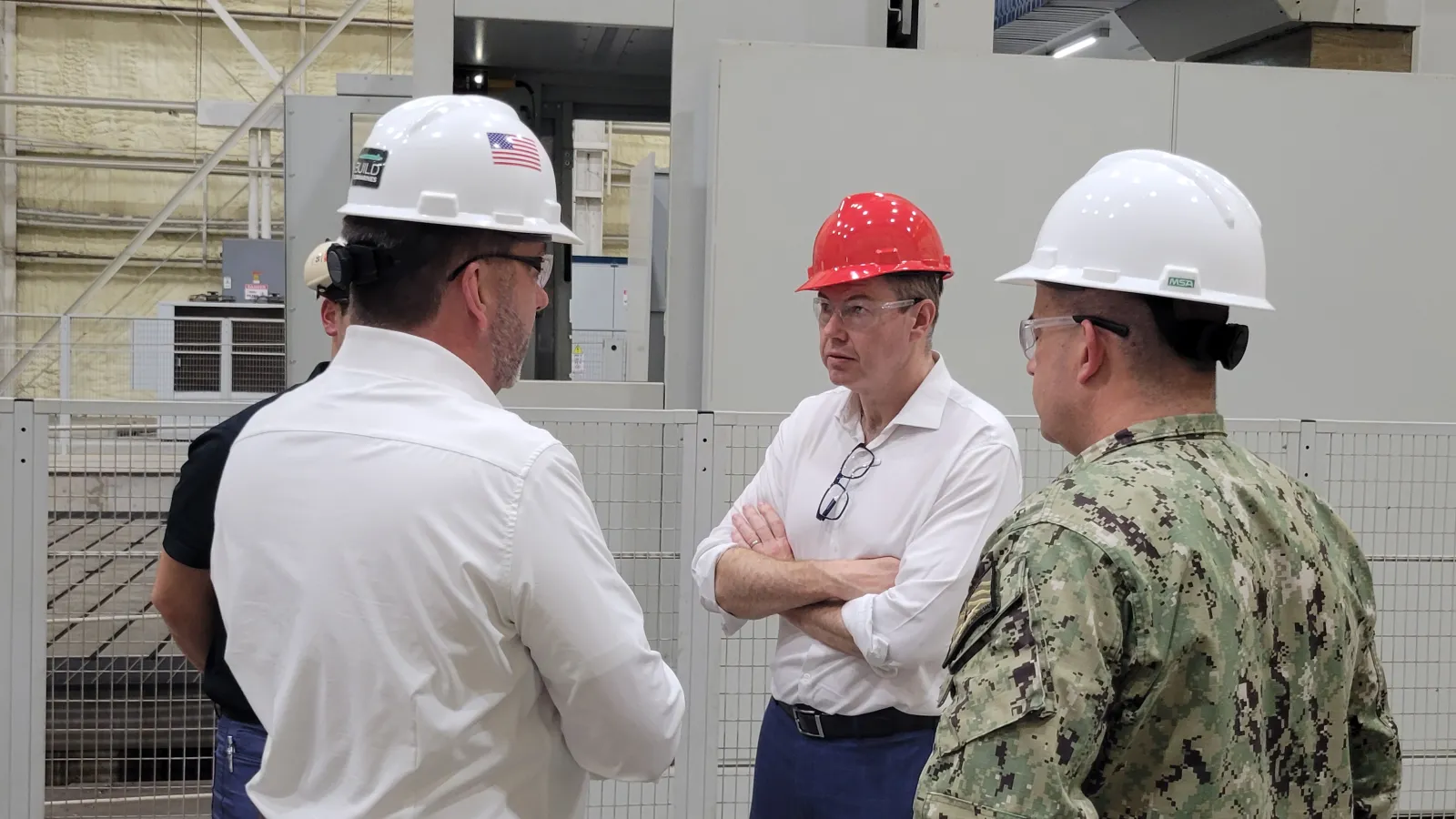
HII, America's largest shipbuilder, hosted Australian Minister for Defence Industry Pat Conroy at its Newport News Shipbuilding Charleston Operations facility in South Carolina last week, deepening the operational substance of the AUKUS trilateral security partnership beyond diplomatic declarations and into factory-floor integration.
The visit centred on HII's distributed shipbuilding initiative, an approach designed to spread production capacity across multiple sites to lift throughput and address growing demand from the US Navy. HII says the Charleston site, covering 45 acres and more than 480,000 square feet of covered manufacturing space along the Cooper River, has increased production by more than 50% under its ownership. The facility has barge and rail access and sits within what HII describes as South Carolina's rapidly growing maritime trades ecosystem.
Qualifying Australian industry for the nuclear supply chain
The centrepiece of the strategic relationship is the Australian Submarine Supplier Qualification (AUSSQ) Programme, a contract HII has been awarded to identify, develop and certify Australian suppliers for integration into the US and UK nuclear submarine industrial base. To date, 13 Australian small and medium-sized enterprises have been qualified, each gaining a pathway into programmes supporting Virginia-class submarine construction and the future SSN-AUKUS platform. The programme spans seven critical work packages covering both construction and long-term sustainment.
Minister Conroy, who toured the production facility and met company leadership, pointed directly to the industrial ambition underpinning the partnership. "I look forward to seeing Australian-made parts coming through this, and other US facilities, demonstrating the strength of the AUKUS partnership and our shared commitment to industrial uplift," he said.
HII is also working with Australian universities and industry bodies to build the skilled workforce required to sustain a sovereign nuclear-powered submarine capability across its full lifecycle, covering engineers, nuclear tradespeople and maritime specialists. The scale of that workforce development task is substantial: the company says it is educating and training thousands of professionals across these disciplines.
The convergence angle: industrial sovereignty as strategic infrastructure
For cross-sector strategists, the AUSSQ story is less about a shipbuilder winning a contract and more about how trilateral security architecture is being used to deliberately construct industrial sovereignty. Qualifying Australian SMEs into the US and UK nuclear submarine supply chains is a form of capability transfer that has parallels with semiconductor friend-shoring and pharmaceutical supply-chain diversification post-COVID. In each case, a geopolitical framework (AUKUS, the CHIPS Act, pandemic-era reshoring incentives) is being used to justify the economic cost of building redundant but strategically aligned production capacity in allied nations.
For capital allocators watching the defence-industrial complex, the AUKUS programme represents a multi-decade demand signal. Virginia-class submarines carry a unit cost north of three billion dollars, and the SSN-AUKUS platform is expected to be even more expensive. The supply chains feeding those programmes will absorb investment across precision manufacturing, materials science, nuclear engineering services and advanced sensors, sectors that increasingly overlap with civilian deep-tech verticals. Australian defence primes, tier-two manufacturers and the sovereign wealth vehicles backing them face a structurally long runway of AUKUS-linked procurement if the programme holds its political momentum in Canberra, London and Washington.
The broader read-across touches transportation and logistics infrastructure as well. Embedding Australian-made components into US and UK production lines requires new freight, certification and logistics corridors between three jurisdictions operating under different regulatory regimes. That complexity is itself an opportunity for the logistics and supply-chain technology sector, particularly as digital thread and track-and-trace capabilities become a compliance requirement for nuclear-grade components.
HII's Charleston expansion, and the ministerial attention it is attracting, signals that the physical infrastructure of AUKUS is moving from planning documents into poured concrete and qualified suppliers, a transition that narrows the gap between geopolitical ambition and deliverable capability.