
Aduro Clean Technologies scales plastic-waste chemistry to FOAK plant
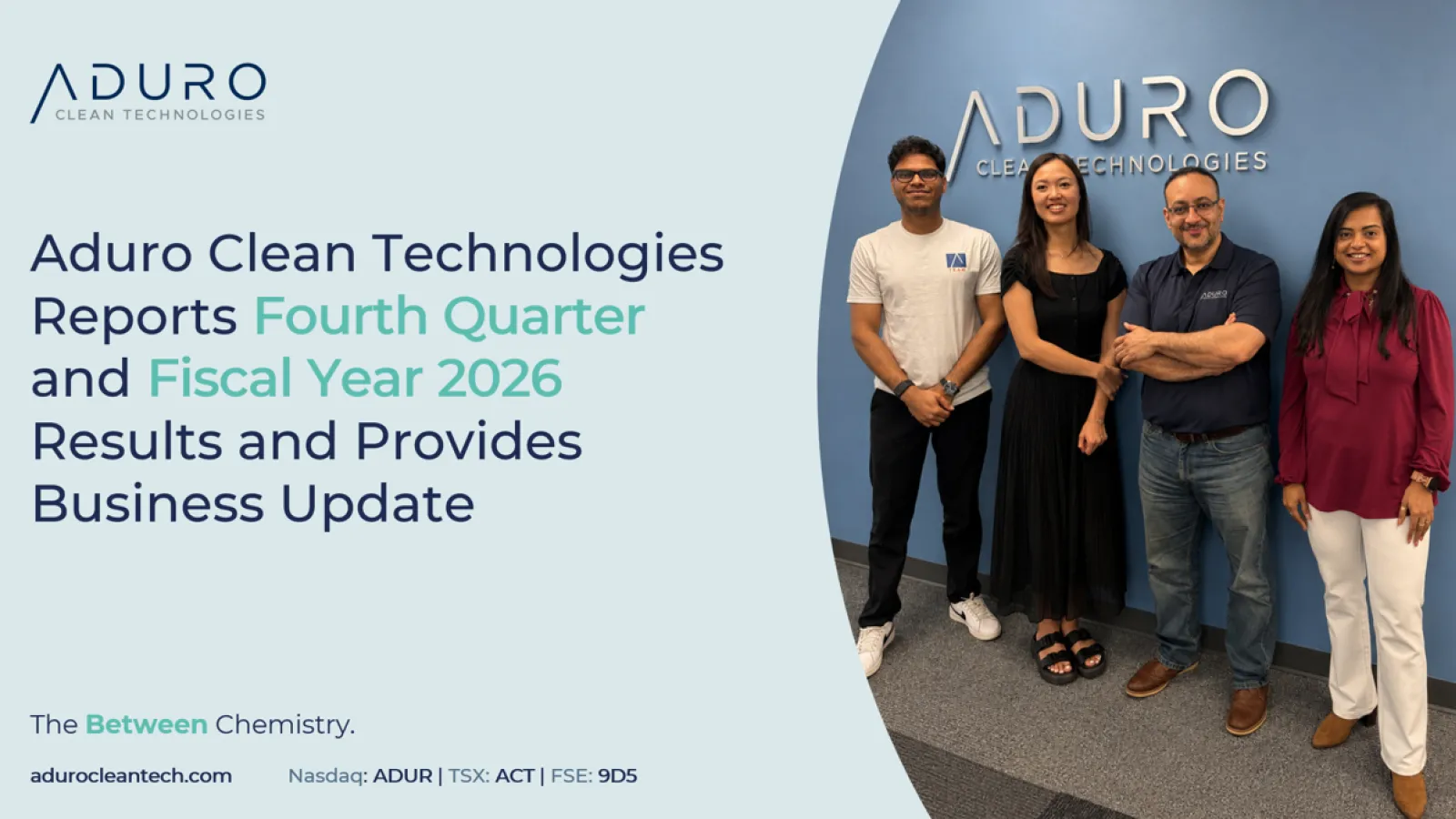
Aduro Clean Technologies, a Canadian clean-tech developer listed on Nasdaq, the TSX and Frankfurt, has closed its fiscal year 2026 with a strengthened balance sheet and a pipeline of commercial partnerships that move its water-based Hydrochemolytic Technology (HCT) closer to industrial deployment. The company is advancing a First-of-a-Kind (FOAK) plant at Chemelot Industrial Park in the Netherlands, targeting waste plastics, heavy bitumen, and paraffinic crude as feedstocks for conversion into liquid hydrocarbons.
The results underscore a company firmly in the capital-deployment phase rather than revenue generation. Full-year revenue was C$167,206, down 28% year on year, reflecting the discretionary, project-timed nature of its Customer Engagement Programmes. Adjusted EBITDA for fiscal 2026 was negative C$10.7m. Yet cash on hand reached C$38.3m at May 31, 2026, up from C$6.96m a year earlier, driven by two US public offerings that generated net proceeds of approximately C$40m. A subsequent US public offering and private placement raised a further US$15.64m and C$9.16m respectively.
Pilot data, partnerships, and a path to Chemelot
The technical centrepiece of the year was Aduro's Next Generation Process (NGP) Pilot Plant, which moved from commissioning into structured operating campaigns. A June 2026 campaign running on polypropylene from waste plastics achieved steady-state operation for 35 continuous hours, with liquid hydrocarbon recovery representing approximately 86% of feedstock mass. The company says around 85% of that recovered liquid consisted of hydrocarbons with carbon numbers of C20 and below, a specification relevant to downstream petrochemical blending.
Commercially, Aduro signed a non-binding letter of intent with an unnamed international commodities trading firm to validate pilot output ahead of an initial offtake commitment from the FOAK plant. It also signed a memorandum of understanding with a major global engineering, procurement and construction organisation to co-develop a commercial licence package, and selected Saipem to lead early-works engineering and procurement at Chemelot. Separately, MOUs with AstroTurf and Dutch waste-management group Ortessa Groep add synthetic-turf recycling and feedstock logistics to the programme scope. Mexico-based ECOCE has advanced to HCT test campaigns on flexible and multilayer packaging streams.
Convergence read-across: circular materials meet energy and capital markets
Aduro's story is not solely a recycling narrative. The expansion of HCT into paraffinic crude upgrading, where bench-scale tests on Uinta Basin yellow-wax and black-wax feedstocks demonstrated reduced wax content and a lighter, ambient-stable crude, positions the technology at the intersection of circular materials and conventional petroleum infrastructure. A dedicated continuous-flow unit is now operational for this programme, and a new patent application has been filed. The appointment of Scott Smith as Programme Director for Petroleum Technology Solutions formalises what was previously exploratory work.
For cross-sector strategists, the capital structure is telling. Aduro has attracted funding through US public equity markets and a Canadian listed-issuer private placement, while seeking regulatory engagement via Chemical Recycling Europe membership and permitting contracts at Chemelot. The FOAK programme sits inside a broader European circular-plastics regulatory push, including the EU Packaging and Packaging Waste Regulation, which is beginning to create structural demand for non-mechanical chemical recycling routes. This regulatory tailwind is attracting engineering majors such as Saipem and global commodity traders who need certified circular feedstock to satisfy downstream customers and brand-owner commitments.
The second-order question for investors is capital intensity at scale. The NGP Pilot Plant asset base reached C$10m at year-end, roughly double the prior year. FOAK engineering, permitting, and construction costs remain undefined in the public record, but Saipem's early-works scope, which covers capital cost estimate refinement, will begin to establish that figure. As the industry moves from pilot to industrial scale, the companies that have secured offtake commitments and engineering partners early, as Aduro appears to be doing, are better positioned to access project-finance structures rather than repeated equity dilution. The parallel question is whether the petroleum-upgrading angle broadens Aduro's addressable market enough to attract energy-sector capital alongside the recycling-focused investors currently supporting the stock.
"Fiscal 2026 was a year of deliberate investment in pilot plant operations, engineering, technical personnel and project development," said Mena Beshay, Chief Financial Officer. "We maintained financial discipline throughout the year, closing fiscal 2026 with a cash position of $38.3 million."