
Canto adds agentic AI to its DAM, targeting content ops at scale
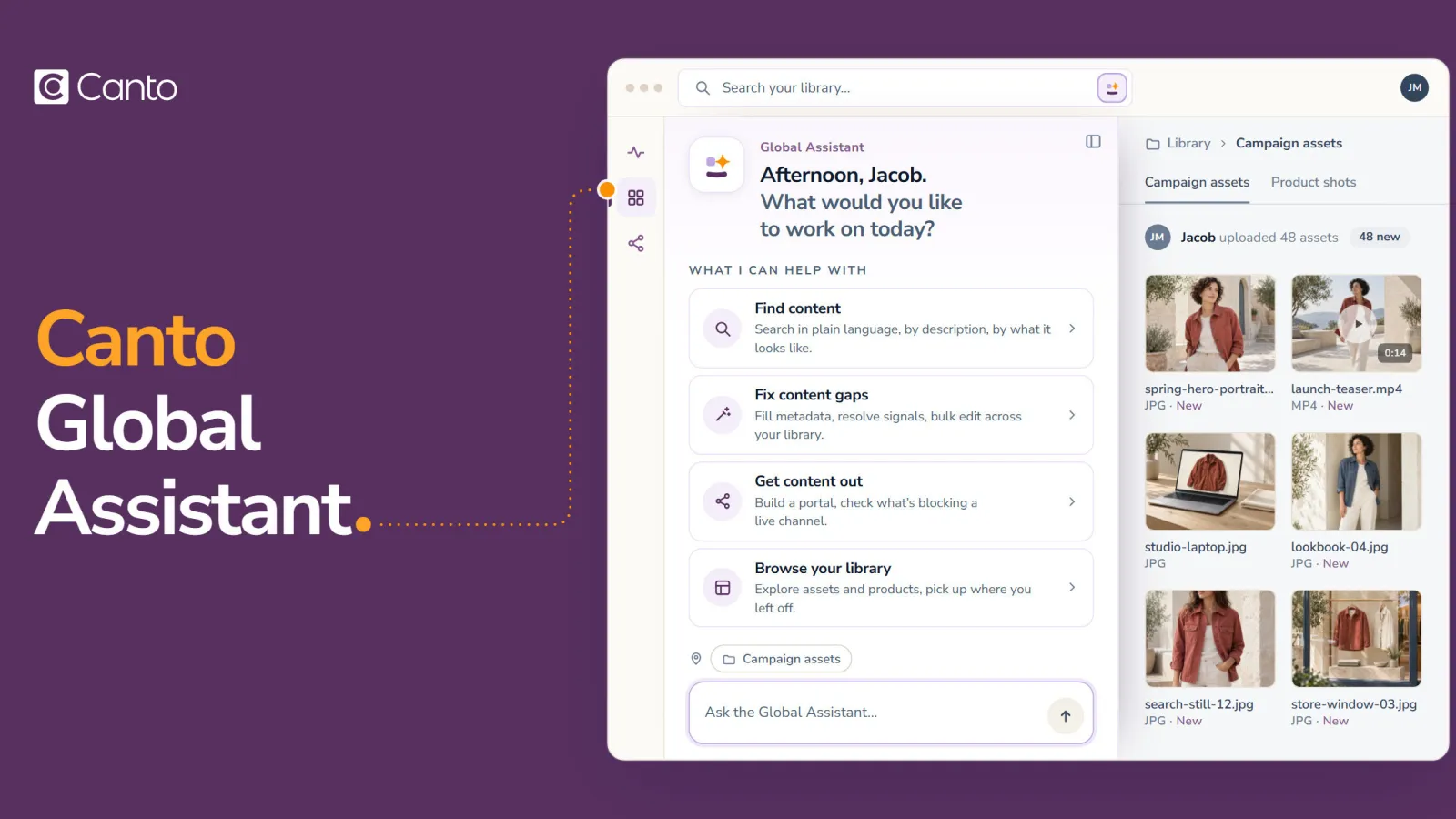
Canto, the Atlanta-headquartered digital asset management (DAM) platform, has launched Global Assistant, an agentic AI layer built directly into its core product. The release positions the company against a growing set of martech and content-operations players betting that the next wave of enterprise software value lies not in storing assets but in acting on them autonomously.
The launch arrives as brands managing content across dozens of retail, e-commerce and social channels face a compounding volume problem. More channels mean more assets, more metadata requirements, more rights expiry dates, and more risk of an unapproved or incomplete image reaching a live storefront. Canto says Global Assistant addresses that operational drag by replacing manual triage with a set of specialised agents the platform deploys automatically depending on the task at hand.
From passive library to active content operator
The product launches with two defined workflow categories: content readiness and AI asset distribution. On the readiness side, Global Assistant maintains a live Library Health dashboard that surfaces assets missing alt text, rights information, or linked product imagery, and can enrich new uploads at what Canto describes as roughly 20 times the speed of manual tagging. On the distribution side, users can describe a target audience and the assistant builds a branded portal ready to publish in minutes, automatically applying the same permissions and rights rules that govern the DAM itself.
CEO Wain Kellum framed the capability in terms of scale rather than novelty: "Global Assistant brings agentic AI into the DAM itself. It finds what's incomplete across assets and products and fixes it at scale, and has the power to automatically build distribution portals to deliver the finished content to the right people and places at the right time."
Chief Product and Technology Officer Alan Beiagi added that the architecture is deliberately governed. Customer content is not passed to third-party systems, every change is logged, and the platform's existing SOC 2 and ISO 27001 certifications cover Global Assistant's operations. That governance posture is increasingly a competitive differentiator as enterprise procurement teams scrutinise AI vendors more carefully following several high-profile data-handling incidents across the SaaS sector.
The broader martech convergence play
The more significant story for cross-sector strategists is what Canto's move signals about the direction of enterprise software more broadly. Agentic AI, in which software takes multi-step actions on behalf of users rather than simply surfacing information, is now migrating from specialist AI-native tools into incumbent SaaS platforms. Salesforce, Adobe and Sitecore have each announced or shipped comparable agentic capabilities for content and customer-data workflows over the past 18 months. Canto's play is to embed that capability where the assets already live rather than requiring integration with an external AI layer.
For retail and e-commerce businesses in particular, the product-readiness angle carries direct revenue implications. A product listing missing imagery or channel-specific attributes may be suppressed algorithmically by marketplace platforms before a human reviewer notices. Automating that compliance check at the point of upload, rather than after go-to-market, compresses a feedback loop that has historically cost brands measurable sales during new-product launches.
Capital in the broader martech and content-infrastructure space has been consolidating rather than expanding. Larger platform vendors are absorbing point-solution capabilities, and pure-play DAM vendors face the strategic choice of either deepening integration with adjacent platforms or building enough autonomous capability to justify a standalone footprint. Global Assistant represents Canto's answer to that question: embed the intelligence, own the workflow, and reduce the argument for replacing the DAM with a broader suite.
Whether the agentic layer proves sticky enough to defend that position against Adobe Experience Manager or Salesforce's content cloud will depend on enterprise adoption rates that are not yet visible. For now, the launch confirms that the DAM category, long treated as infrastructure rather than intelligence, is being reclassified.