
Visa and Lianlian complete Asia Pacific's first live agentic B2B deal
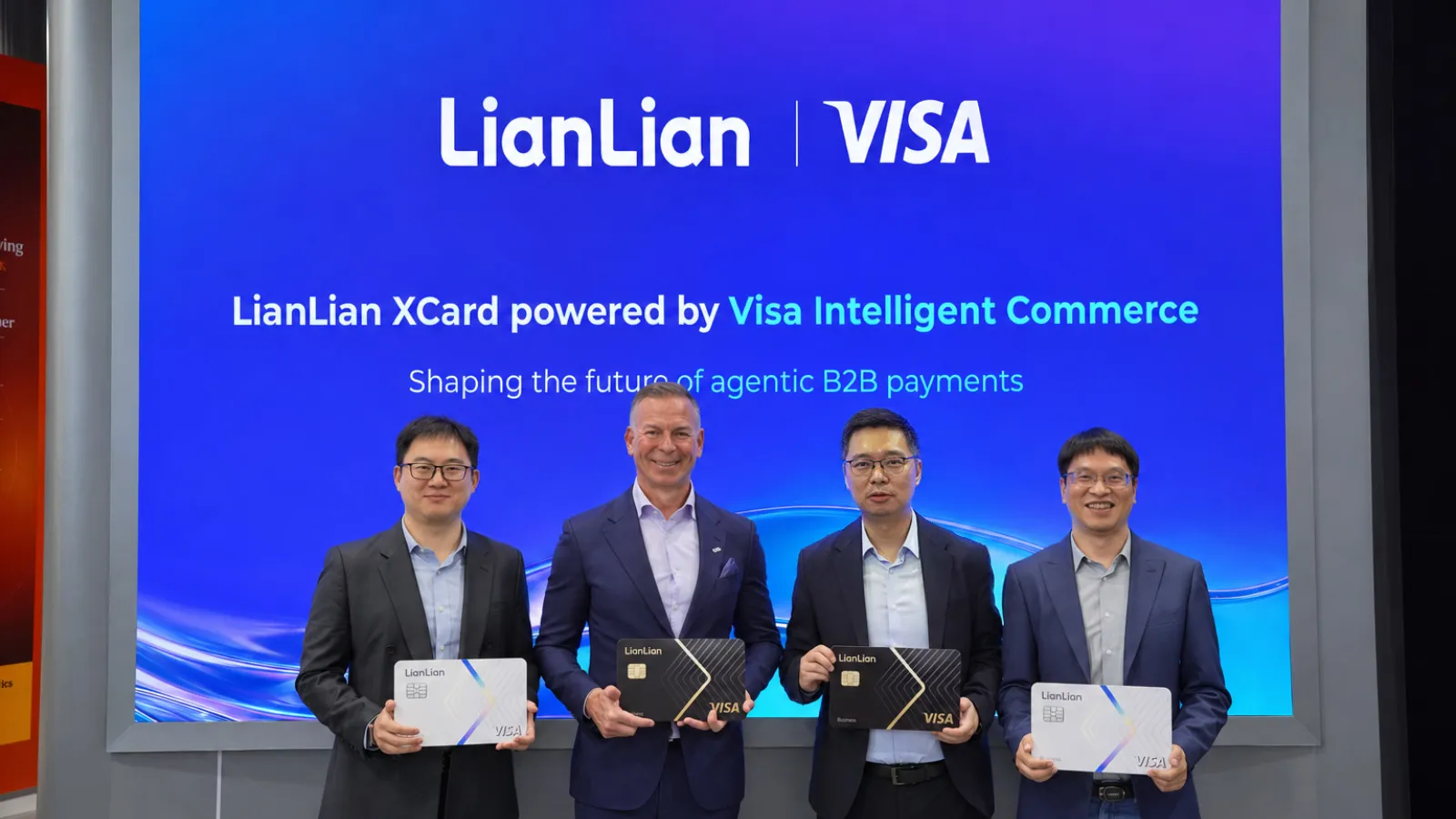
Visa and Lianlian DigiTech have completed Asia Pacific's first live business-to-business transaction executed entirely by an authorised AI agent, marking a concrete step in the shift from agentic commerce as a concept to an operational reality. The milestone, unveiled at the Singapore Fintech Festival on 18 November 2026, also saw Lianlian launch LianLian XCard, a business spending and expense management product powered by Visa Intelligent Commerce.
The transaction was carried out by LianLian XWorker, an AI agent registered in Visa's Agentic Directory, a verified registry of AI agents and merchants sanctioned to participate in agentic commerce. XWorker obtained an agent-specific tokenised payment credential via Visa Intelligent Commerce Connect, then autonomously completed a live office supply purchase within predefined spending parameters. It follows an earlier proof-of-concept in which Lianlian's LoopX Pay agent identified a purchasing requirement, evaluated suppliers, placed an order and settled payment, all without human intervention at the transaction level.
From proof-of-concept to commercial product
The launch of LianLian XCard moves the partnership from demonstration to revenue-generating product. Available from 18 November to eligible clients applying through the LianLian XWorker agent, the card offers configurable limits and transaction thresholds across teams and projects. Customers can also link their LianLian XPay wallet, enabling authorised agents to make payments within business-defined guardrails. Selected AI-related benefits are planned for qualifying customers, though the companies have not yet specified what those entail.
"As AI agents take on a greater role in commerce, trust will be essential to helping businesses adopt these new capabilities with confidence," said Stephen Karpin, President, Asia Pacific at Visa. The remark underscores the core commercial challenge: agentic payment rails are only viable if the identity and authorisation layer can be trusted by both buyer and seller at machine speed.
The two companies say they will continue exploring applications across procurement, supplier payments and other B2B workflows, with small and medium-sized enterprises in Asia Pacific the stated primary audience.
Why the convergence angle matters beyond fintech
The significance of this announcement extends well beyond payment processing. Agentic commerce, where AI systems initiate and settle transactions autonomously, represents the first major test of whether the financial infrastructure built for human-initiated payments can be repurposed for machine-to-machine economic activity. The credential and identity architecture Visa is deploying here, combining tokenisation, agent verification and transaction controls, is effectively a new settlement layer for the emerging agentic economy.
For cross-sector strategists, the implications reach into procurement, supply-chain automation and enterprise software. As agentic AI is increasingly embedded into ERP and procurement platforms, the ability to attach a verified, controlled payment credential to an agent's workflow collapses the boundary between operational decision-making and financial execution. That is a structural shift in how business spending is authorised and recorded, with downstream consequences for audit, compliance and treasury functions.
From a capital-allocation perspective, the race to own the identity and credentialing layer for agentic commerce is becoming its own investment thesis. Visa's move to establish a proprietary Agentic Directory suggests incumbents are positioning to control the trust infrastructure before open-standards bodies or challenger networks can establish alternatives. For investors tracking the agentic-AI stack, the payment rail and the identity layer may ultimately carry more long-term value than the agents themselves.