
STMicro LiDAR module targets edge AI across robotics and health
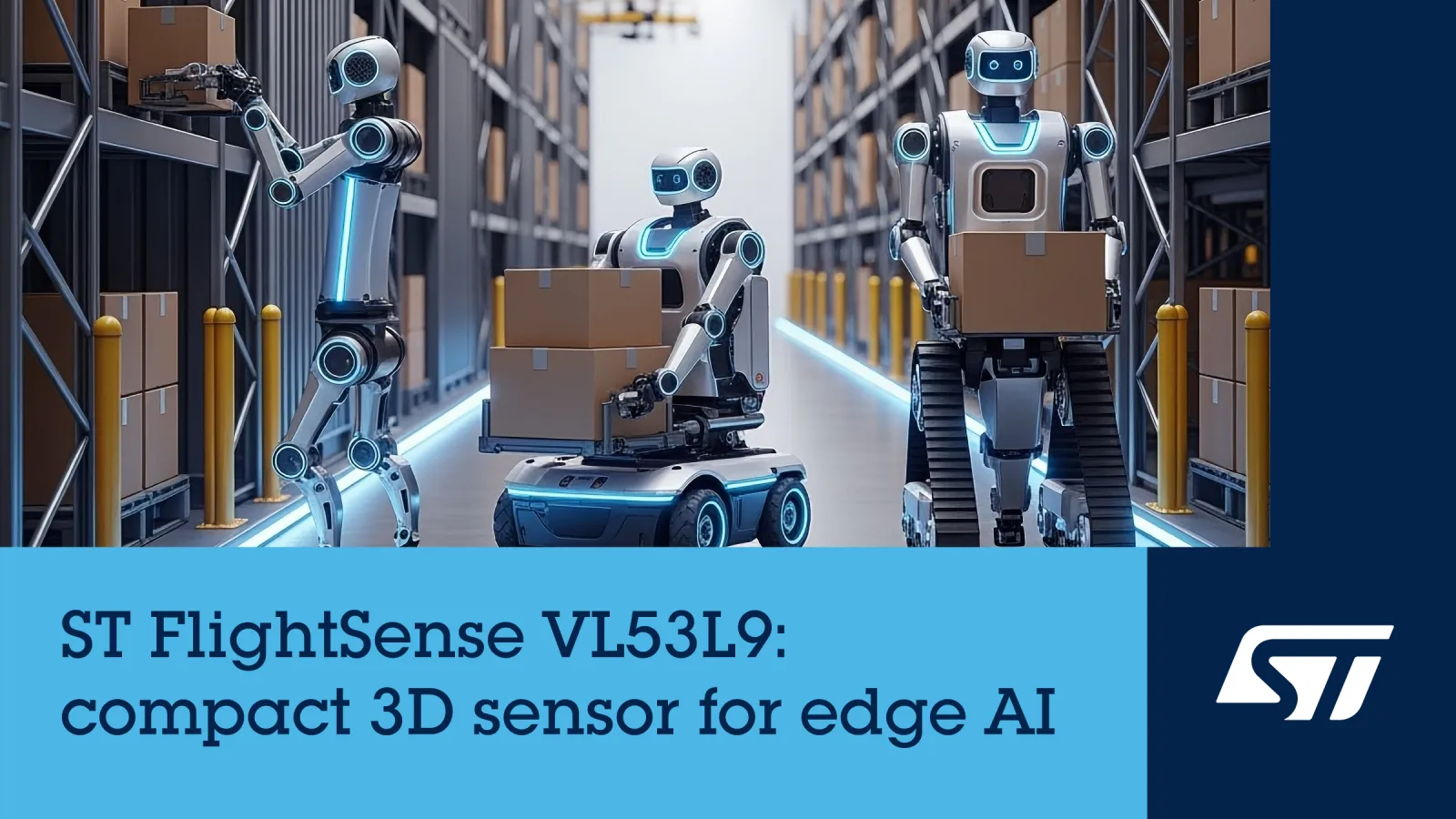
STMicroelectronics has launched the VL53L9, a compact direct Time-of-Flight (dToF) 3D LiDAR module designed to deliver high-resolution spatial awareness to edge AI systems running on small microcontrollers. The chip giant says the module is its first all-in-one dToF LiDAR product, and positions it as a single-component solution for developers building across robotics, industrial automation, smart buildings, augmented and virtual reality, and healthcare monitoring.
The launch matters beyond the product itself. It signals a structural shift in how edge AI perceives the physical world: not through cloud-tethered compute, but through increasingly capable, deeply integrated sensing hardware that can run inference locally on constrained silicon.
A sensor built for the convergence era
The VL53L9 resolves 2,268 zones across a 54-by-42 degree field of view, captures depth from under five centimetres to nine metres, and outputs data at up to 100 frames per second. ST says the module uses proprietary stacked BSI SPAD sensor technology alongside metasurface optical elements to achieve up to 1% ranging accuracy. On-chip dToF processing and a calibration-free design are intended to reduce the system integration burden for customers, lowering the compute overhead required to run edge AI workloads.
Alexandre Balmefrezol, Executive Vice President and General Manager of ST's Imaging Sub-Group, said: "By simplifying integration and reducing system complexity, we enable customers to accelerate the development of applications such as robotics, smart infrastructure, and healthcare monitoring."
The module measures 12.8 mm by 6.1 mm by 4.6 mm, supports MIPI and I3C data interfaces, and is rated Class 1 laser-safe. Volume shipments are expected from early July 2026.
Cross-sector read-across: from chips to autonomous systems
The strategic weight of this announcement sits in the convergence of semiconductor miniaturisation, edge AI deployment, and the expanding universe of autonomous physical systems. Analysts at Yole Group, cited in ST's release, note that Time-of-Flight technology is migrating beyond smartphones into navigation, people monitoring, gesture recognition, and safety applications, with the 2025-to-2030 window characterised by rising demand for compact, affordable, multizone depth sensors.
For Disrupts readers allocating capital or setting product strategy across sectors, the implications run in several directions at once. In robotics and industrial automation, affordable high-resolution LiDAR accelerates the economics of deploying autonomous systems in warehouses, factories, and logistics environments where sub-ten-metre spatial awareness is the operative constraint. In smart buildings, privacy-preserving presence detection without camera imagery is increasingly attractive to operators navigating GDPR and equivalent regimes. In healthcare, fall detection at the edge, without connectivity to a central server, addresses both latency and data-sovereignty concerns in eldercare settings.
The deeper macro signal is about where intelligence is being driven. The prevailing narrative of the past two years has placed generative AI's centre of gravity in hyperscale data centres, with enormous GPU clusters processing requests from thin clients. The VL53L9 represents the counter-current: sensing and inference pushed as far toward the physical edge as silicon allows. ST's explicit framing of the product as targeting "small MCUs with low compute requirements" is a deliberate positioning against the compute-hungry architectures that dominate the current AI investment conversation.
For investors tracking the semiconductor landscape, this raises a pointed question about where margin and volume growth accumulate as autonomous systems proliferate. Integrated sensing modules that bundle optics, processing, and power management into a single reflowable component compress the bill of materials for device makers, but they also concentrate value with the module vendor rather than the system integrator. ST's move deepens its presence in the sensing layer of the edge AI stack, at a moment when that layer is becoming the primary differentiator in robotics and spatial-computing hardware development.